

The cost of local SEO software is not the monthly subscription fee. The real cost is the lost revenue from every customer who can’t find your business online. A cheap tool that requires hours of manual work isn’t a bargain; it’s a liability. An effective platform is an investment in operational efficiency and customer acquisition. It should deliver a clear, measurable return by automating tasks, improving your visibility, and driving qualified leads directly to your phone and inbox. This guide breaks down what separates an adequate tool from the best local seo software, helping you make a strategic investment that accelerates growth rather than just adding another line item to your expenses.
Key Takeaways
- Unify Your Local SEO Toolkit: Managing separate tools for listings, reviews, and rank tracking is inefficient and produces fragmented results. A single, integrated platform provides the command center necessary to manage your entire local presence with authority and precision.
- Demand Non-Negotiable Features: Your software must provide core functions like automated listings management, centralized review monitoring, and accurate map rank tracking. Settling for a tool without these capabilities is a strategic error that compromises your local visibility.
- Connect SEO Directly to Operations: The most powerful local SEO software integrates with your core business systems. Select a platform that links lead capture and reputation management directly to your CRM and appointment scheduling to create a seamless, growth-focused workflow.
Why Your Small Business Needs Local SEO Software
Your customers are searching for you right now. When a pipe bursts or a car breaks down, they pull out their phones and search for “plumber near me” or “auto repair in [City].” If your business doesn’t appear at the top of those results, you are invisible. Local SEO software is the system that ensures you are seen by the customers in your immediate service area, turning their urgent needs into your next job. It’s not an optional marketing expense; it’s a fundamental tool for acquiring local customers and dominating your geographic market.
Effective local SEO for small businesses requires absolute consistency. Search engines like Google need to see the exact same business name, address, and phone number across every directory, from Yelp to the Yellow Pages. Even a small discrepancy, like “St.” versus “Street,” can erode trust and damage your rankings. Manually managing this information is inefficient and prone to error. Software automates this process, using powerful listings management solutions to enforce consistency and build the authority needed to rank.
Beyond just your business information, your reputation is a primary ranking factor. Customer reviews directly influence how high you appear in local searches. A steady stream of positive reviews signals to search engines that you are a trustworthy and high-quality provider. Local SEO software provides a centralized dashboard to monitor, request, and respond to reviews. This control allows you to build a powerful online reputation that not only attracts customers but also fuels your search visibility, creating a cycle of growth. Without it, you are leaving your most valuable marketing asset to chance.
Demand These Features in Your Local SEO Software
Effective local SEO software is not a luxury; it is a core component of your operational toolkit. Settling for a tool that only offers partial solutions creates more work and delivers inferior results. Your business requires a platform that centralizes command over every factor influencing your local search visibility. Anything less is a liability. Fragmented tools that only handle one piece of the puzzle, like rank tracking or review monitoring, force you to juggle multiple subscriptions and dashboards. This approach is inefficient and leads to missed opportunities.
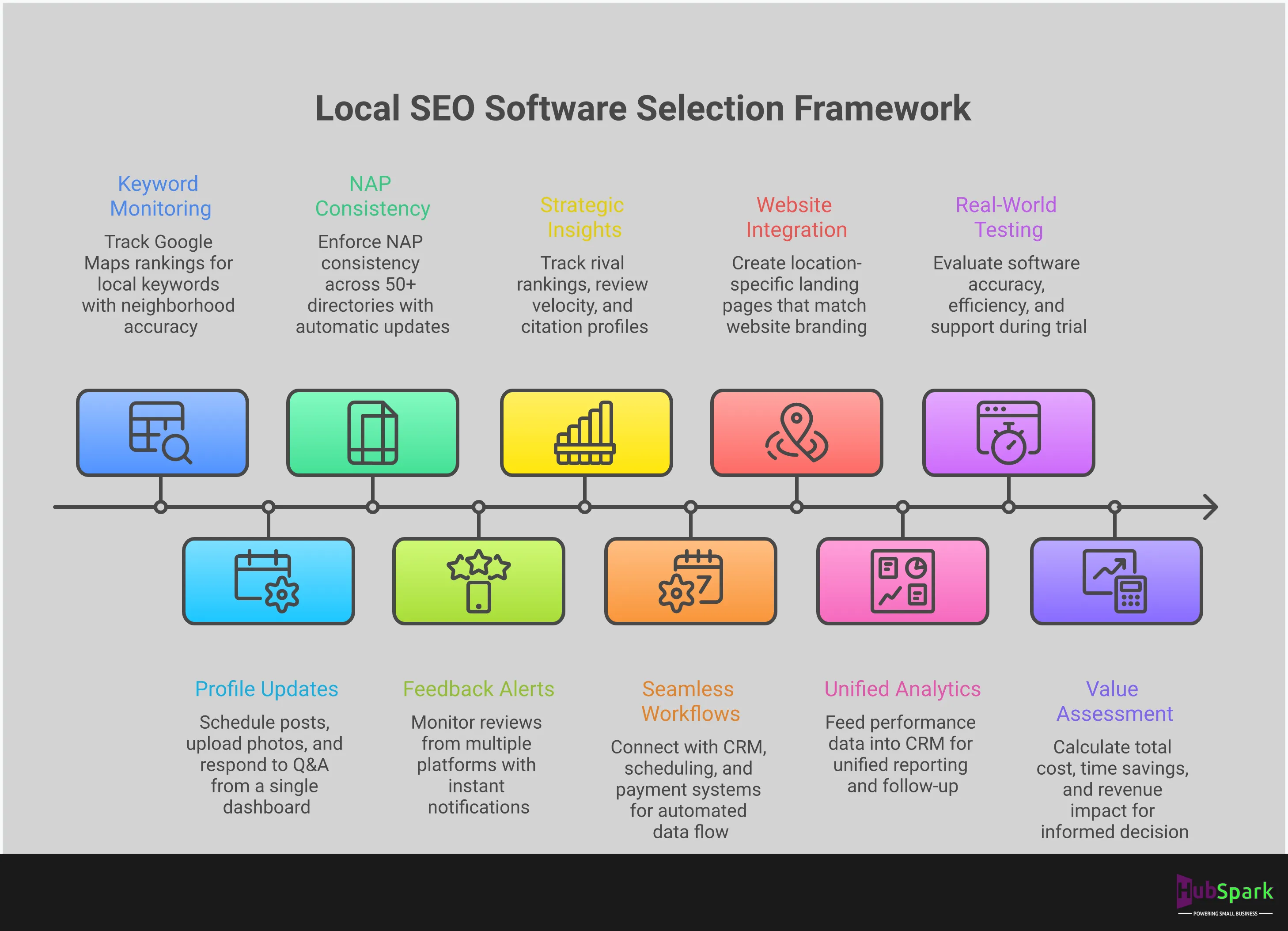
When evaluating software, treat the following features as non-negotiable requirements. This is not a wish list. It is a checklist of essential capabilities that separate professional-grade platforms from inadequate alternatives. A proper tool will not just provide data; it will equip you with the mechanisms to act on that data decisively. From tracking your map rankings to managing customer reviews, each feature should integrate seamlessly to give you complete control over how local customers find and choose your business. Your software should function as a command center, not just another reporting tool.
Track Your Local Map Rankings
Your position on Google Maps and in the local search pack is your digital storefront. If you don’t know where you stand, you cannot improve. Your software must provide accurate, real-time tracking of your rankings for the keywords that matter most to your business, like “emergency plumber in Dallas” or “auto repair near me.” This isn’t about vanity; it’s about measuring performance. Effective local SEO software shows you precisely where you appear when a potential customer needs your services, giving you the data required to dominate the map in your service area. Vague estimates are useless; demand precision.
Optimize Your Google Business Profile
Your Google Business Profile (GBP) is the foundation of your local search presence. It is often the first interaction a customer has with your brand. The right software does more than just display your GBP information; it provides tools to actively optimize and manage it. This includes updating business hours, uploading new photos, publishing posts, and responding to customer questions directly from the dashboard. A powerful platform centralizes these tasks, eliminating the need to log into Google separately. It transforms your GBP from a static listing into a dynamic tool for customer acquisition.
Manage Citations and Directory Listings
Inconsistent business information scattered across the web confuses customers and erodes trust with search engines. A citation is any online mention of your business’s name, address, and phone number (NAP). Your software must automate the management of these citations across dozens of relevant directories. Manually correcting every listing is an impossible task. Demand a tool that scans for inconsistencies and distributes the correct information automatically. This ensures your listings management is accurate everywhere, building the authority needed to secure top local rankings.
Control Your Online Reputation and Reviews
Your online reviews are a primary driver of both customer trust and search engine rankings. An effective local SEO tool must include robust reputation management features. This means aggregating reviews from Google, Yelp, Facebook, and other industry-specific sites into a single, unified inbox. This centralization allows you to respond to feedback immediately, demonstrating excellent customer service and mitigating the impact of negative comments. The ability to monitor and react to reviews from one dashboard is essential for maintaining a stellar online reputation that attracts new business.
Analyze Your Local Competitors
To outperform your competition, you must first understand their strategy. Your software should provide clear insights into the local SEO performance of your direct competitors. This includes tracking their map rankings for critical keywords, analyzing their review volume and velocity, and examining their citation profile. This data is not for passive observation; it is for identifying strategic opportunities. By seeing where your competitors are weak, you can focus your efforts to capture their market share. A top-tier platform delivers actionable competitive intelligence, not just a list of names.
Get Automated Performance Reports
As a business owner, your time is your most valuable asset. You cannot afford to spend hours manually compiling data to gauge the effectiveness of your SEO efforts. Your software must deliver automated, easy-to-understand performance reports. These reports should clearly illustrate progress on key metrics, including ranking improvements, review growth, and listing accuracy. They provide the accountability needed to confirm your investment is generating a positive return.
HubSpark: The All-in-One Local SEO Command Center
Managing local SEO should not require juggling a dozen different apps. Effective strategy demands integration. Instead of patching together separate tools for reviews, listings, and analytics, you need a single platform where every action supports your local visibility. HubSpark centralizes your entire local marketing operation, connecting your SEO efforts directly to your customer management, scheduling, and payment systems. This unified approach eliminates operational drag and gives you a clear, accurate view of what drives local growth, all from one dashboard.
Integrate Local SEO with Your Core Operations
Your local SEO doesn’t exist in a vacuum; it’s directly tied to how you run your business. HubSpark integrates powerful local SEO tools for small businesses directly into your daily operations. When a customer books an appointment, pays an invoice, or leaves a review, that data informs your marketing strategy without any manual input. This seamless connection means you can stop wasting time exporting data between platforms and start focusing on your core services. By embedding SEO into your operational workflow, you create a system that consistently attracts and retains local customers.
Use Listings Management That Actually Works
Inaccurate business listings across the web damage your search rankings and confuse potential customers. HubSpark’s Listings Management Solutions give you direct control over your online presence. From a single dashboard, you can update your name, address, phone number, and hours across dozens of critical directories. This ensures consistency, a key factor for local search algorithms. The system also monitors for unauthorized changes, protecting your brand’s integrity. Stop wasting hours chasing down individual listings and start managing your business information with complete authority.
Build Location Pages That Drive Local Traffic
If you serve specific neighborhoods or cities, generic web pages won’t cut it. You need to show customers exactly where you operate. With HubSpark, you can build optimized Location Pages that target the precise service areas you cover. These geo-targeted pages are designed to rank in local search results, attracting qualified customers who are actively looking for your services in their area. This strategy improves your visibility where it matters most, turning local searches into tangible leads and appointments for your business. Stop hoping local customers find you; make it inevitable.
Manage Your Reputation from a Single Dashboard
Your online reputation is one of your most valuable assets. Responding to reviews quickly and professionally is critical, but it’s impossible when you have to log into multiple sites. HubSpark provides a centralized platform for reviews and reputation management. You receive instant notifications for new reviews, allowing you to address feedback immediately. From one screen, you can monitor customer sentiment, showcase positive testimonials, and manage negative comments before they escalate. This gives you complete command over your online image, building trust with both new and existing customers.
Evaluating the Local SEO Tool Landscape
The market for local SEO software is crowded and fragmented. Different tools solve different pieces of the puzzle, forcing many business owners to patch together a collection of subscriptions that create more work, not less. This fragmented approach drains your time and budget, with data scattered across multiple platforms. Understanding the primary categories of these tools is the first step to cutting through the noise and selecting a solution that centralizes your efforts. Your goal is not to become an expert in five different software dashboards; it is to find a single command center for your local marketing.
Most tools fall into one of several categories: comprehensive suites that try to do everything, specialized tools that excel at one specific task like citation building or rank tracking, and website plugins that only handle on-site optimization. Each has its place, but for a service business focused on growth, the limitations of a fragmented approach quickly become a bottleneck. Evaluating the landscape means identifying not just what a tool does, but how it fits into your daily operations. A standalone map tracker is useless if you don’t have time to log in and check it. A citation builder that doesn’t integrate with your review management is creating an extra step in your workflow. The right software doesn’t just provide data; it integrates with your core operations to drive action.
All-in-One Suites
All-in-one suites aim to provide a complete toolkit for local SEO. Platforms like BrightLocal and SEMrush offer a wide array of features, including business listing management, review monitoring, and local rank tracking. They are designed to be a comprehensive solution for agencies or businesses with dedicated marketing staff. These platforms consolidate multiple data points into a single environment, which is a significant step up from using several disconnected tools. However, they often come with a steep learning curve and a price tag to match, and they still operate separately from your core business functions like appointment scheduling and payment processing. This separation creates an operational silo, preventing a truly unified workflow.
Specialized Citation Builders
Citations are online mentions of your business’s name, address, and phone number (NAP). Consistency in this data across directories like Yelp, Yellow Pages, and industry-specific sites is a critical local ranking factor. Specialized tools like Whitespark focus almost exclusively on this task. They help you find new citation opportunities, identify inconsistencies in your existing listings, and automate the process of cleaning them up. While essential for building a strong foundation, these tools only address one component of local SEO. Effective listings management must be part of a broader strategy that also includes reputation management and on-page optimization.
Dedicated Map Rank Trackers
Knowing where you rank on Google Maps is crucial for attracting local customers. Dedicated map rank trackers like Local Falcon provide granular, grid-based reports that show your search visibility on a block-by-block basis. This allows you to see exactly how a customer searching a few streets over sees your business versus one searching from across town. This level of detail is powerful for diagnosing visibility issues and tracking competitor movements. However, these tools are highly specialized. They offer deep insights into one specific metric but do not help you manage the factors that actually influence those rankings, such as reviews, listings, or your website.
WordPress SEO Plugins
If your business website runs on WordPress, SEO plugins like Rank Math can handle the on-site elements of your local strategy. These tools make it simple to add structured data (or schema markup) to your site, which helps Google understand key information like your business hours, address, and service area. They can also help you optimize your location pages and track keyword rankings. While incredibly useful for website-specific tasks, their scope is limited to your own domain. They do not manage your presence on external sites like Google Business Profile or other directories, which are equally important for local SEO success.
Using Google Business Profile as Your Foundation
Before you invest in any paid software, your Google Business Profile (GBP) must be claimed and fully optimized. This free listing is your most important asset in local search. It is where you manage your appearance on Google Search and Maps, respond to reviews, upload photos, and answer customer questions. No software can replace the need for a complete and active GBP. However, managing it effectively, especially across multiple locations or alongside dozens of other daily tasks, is a challenge. Think of GBP as the engine; local SEO software is the dashboard and control system that allows you to operate it efficiently and strategically.
Breaking Down Local SEO Software Costs
Understanding the cost of local SEO software requires looking beyond the monthly subscription price. The true investment is measured in both dollars and the time you spend managing your tools. A cheap tool that requires hours of manual work each week is not a bargain. Your goal is to find a solution that delivers a clear return by centralizing tasks and driving measurable growth, not one that simply adds another line item to your expenses. A fragmented approach creates operational drag, while a unified platform accelerates your ability to attract and serve local customers.
Free Tools vs. Paid Solutions: What You Actually Get
Free tools are the logical starting point for any business. Claiming your Google Business Profile is non-negotiable; it’s the foundation of your local presence and costs nothing. However, relying solely on free options creates inefficiency. You will spend significant time switching between different platforms to track rankings, update listings, and respond to reviews. Paid solutions are designed to eliminate this friction. A comprehensive platform centralizes your local SEO efforts, integrating them with core business functions like appointment booking and customer messaging. This consolidation saves time and provides a unified view of your performance, something a collection of free tools can never offer.
What to Expect from Budget-Friendly Tools
Low-cost SEO tools can be effective for executing specific, isolated tasks. For example, Google Search Console is an excellent free resource for checking your website’s ranking accuracy. The trade-off is a lack of integration and automation. These tools tell you what is happening but rarely help you act on the information efficiently. A dedicated platform, by contrast, connects insights to action. For instance, it doesn’t just show you a new review; it allows you to respond instantly from the same dashboard you use to manage your customer relationships. This direct link between data and execution is what separates a simple tool from a true business operating system.
Pricing for Multi-Location Businesses
For businesses managing more than one location, pricing models become far more complex. Most software providers charge on a per-location basis, which means your costs can multiply quickly as you expand. While specialized tools exist for multi-location management, they often focus exclusively on one function, like citation building. This forces you to purchase other tools to cover the rest of your needs. The correct approach is to find a platform built to scale. A system with integrated location pages and centralized listings management allows you to maintain brand consistency and operational control across all sites without paying for redundant, disconnected software at each address.
Watch Out for Hidden Costs and Setup Fees
The advertised monthly price for local SEO software is often just the beginning. Be vigilant for hidden costs, including mandatory onboarding fees, long-term contracts with steep cancellation penalties, and premium charges for essential features. Some platforms lock core functions like review management or reporting behind higher-priced tiers. Before committing, demand a clear breakdown of all potential charges. An effective partner provides transparent, predictable pricing. Your software should be a straightforward investment, not a source of financial surprises. A unified system like HubSpark consolidates these functions under one predictable cost, eliminating the need to audit multiple bills for unexpected fees.
Weighing the Pros and Cons of Different Tool Types
Choosing your local SEO software requires a strategic decision between two fundamentally different approaches: patching together multiple specialized tools or implementing a single, unified platform. The right choice directly impacts your operational efficiency and your ability to scale. While niche tools can excel at a single task, they often create data silos and workflow bottlenecks. An all-in-one system is designed to eliminate these inefficiencies by integrating your
All-in-One Platforms vs. Specialized Tools
The debate between integrated platforms and specialized tools is a critical one. It’s true that some niche tools perform a single function, like map tracking, exceptionally well. However, managing a collection of disconnected software creates unnecessary complexity. You are forced to juggle multiple logins, dashboards, and subscription fees, which fragments your data and wastes valuable time. An all-in-one platform centralizes your entire strategy. This approach ensures your local SEO efforts are directly connected to your customer database and reputation management, providing a complete and accurate view of your business performance from a single command center.
Consider Performance Speed and Data Accuracy
Your local SEO software is useless if it is slow or provides inaccurate information. A tool that lags or takes minutes to load reports is an operational drag that costs you money. Performance issues are a clear sign of inefficient software. Furthermore, you must demand data accuracy. Rank tracking can be inconsistent because results vary based on search location and history, so your tool must provide reliable, localized data. Inaccurate reporting leads to flawed strategies and missed opportunities. Prioritize a platform built for speed and precision to ensure you are making decisions based on reality, not guesswork.
Assess Integration Capabilities and Technical Limits
A tool’s value is measured by its ability to integrate with your existing operations. Modern platforms use automation to streamline repetitive tasks, but their true power lies in connectivity. For example, effective listings management ensures your business information is correct everywhere online. When this function is integrated with your CRM, any update you make is instantly consistent across all platforms and your customer records. This level of integration eliminates manual data entry and prevents errors. Evaluate software based on how deeply it connects with your core business systems, turning isolated tasks into a seamless, automated workflow.
Find the Right Local SEO Software for Your Industry
The local SEO software that works for a multi-location franchise is not the right tool for a solo plumber. Different business models have distinct operational needs, and your software must be selected to meet those specific demands. Choosing the wrong tool creates inefficiencies and wastes resources. The goal is to find a platform that aligns with your industry’s customer acquisition model and provides the precise features required to dominate your local market. Don’t settle for a generic solution; identify the software built to solve your specific challenges.
For Service-Based Businesses (HVAC, Plumbing, etc.)
When a customer’s air conditioner fails in the middle of summer, they search for “AC repair near me.” Your business must appear at the top of that search, period. For service-based businesses, local SEO is not a marketing strategy; it is a direct line to revenue. Your software must be optimized for immediate-need searches. This requires more than just a listing; it demands tools that aggressively track map rankings, generate a constant stream of positive reviews to build trust, and attract customers in your direct service area. The right platform helps you stay competitive and win the jobs that matter.
For Professional Services (Law Firms, Agencies)
Professionals sell trust and expertise. Your online presence is your digital handshake, and it must be firm. For law firms, consultants, and agencies, reputation is paramount. Your local SEO software must therefore prioritize citation accuracy and reputation management. A single incorrect phone number on a directory or a series of unanswered negative reviews can erode credibility and deter potential clients. You need a system that meticulously manages your online information and provides a command center to monitor customer feedback. This ensures your digital footprint accurately reflects your professional authority and helps you manage your online reputation effectively.
For Multi-Location Businesses and Franchises
Managing the digital identity of ten, fifty, or a hundred locations with disconnected tools is an operational failure. Inconsistencies in addresses, hours, and promotions across different branches confuse customers and dilute your brand. A multi-location business requires a centralized platform designed for scale. Your software must provide a single dashboard to manage all your business listings, monitor reviews for each location, and deploy updates universally. Look for a system that uses automation to ensure every one of your Location Pages is accurate and optimized, transforming a complex management task into a streamlined, efficient process.
Common Local SEO Software Challenges (And How to Solve Them)
Executing a local SEO strategy introduces operational hurdles that can stall growth. Many business owners find themselves wrestling with fragmented tools, a lack of time, and the constant pressure of algorithm updates. These are not just minor inconveniences; they are significant drains on your resources that prevent you from focusing on core business activities. The key is not to work harder with inefficient tools, but to adopt a system that eliminates these challenges entirely.
An effective local SEO software should not add to your workload. It must function as a streamlined extension of your business, automating complex tasks and delivering clear, actionable insights. Instead of patching together multiple subscriptions or spending hours trying to interpret complex data, you need a single platform that centralizes control. The right system solves the common points of failure before they can impact your bottom line, turning potential challenges into competitive advantages. Let’s break down the most frequent problems and their definitive solutions.
The Problem with Juggling Multiple Tools
Many businesses fall into the trap of using separate tools for each part of their local SEO. You might have one subscription for map rank tracking, another for citation building, and a third for managing online reviews. While some tools excel at specific tasks, this fragmented approach creates operational chaos. You waste valuable time logging into different dashboards, trying to reconcile conflicting data, and paying multiple invoices. This inefficiency is a direct cost to your business.
The solution is to stop managing software and start managing your strategy from a single command center. An integrated platform like HubSpark centralizes every critical function, from listings management to reputation control. Instead of piecing together reports from different sources, you get a unified view of your performance. This eliminates data silos and gives you the clarity needed to make decisive, growth-oriented decisions without the friction of multiple logins.
Overcoming Limited Time and Technical Skill
As a business owner, your primary role is to run your company, not to become a full-time SEO analyst. The learning curve for many specialized SEO tools is steep, demanding a significant investment of time you simply don’t have. The alternative, hiring an agency, can be prohibitively expensive. This leaves many owners either neglecting their local SEO or making uninformed decisions that fail to produce results. Your time is your most valuable asset; it should be spent serving customers, not deciphering technical jargon.
A powerful platform should be intuitive enough for an owner to use effectively without extensive training. HubSpark is engineered to solve this exact problem. We automate the most time-consuming aspects of local SEO for small businesses, translating complex analytics into straightforward actions. You don’t need to be an expert to understand your performance or identify opportunities. The system provides the power of an agency-level toolset within a simple, efficient dashboard, allowing you to execute a professional strategy in a fraction of the time.
Staying Ahead of SEO Algorithm Changes
Google’s search algorithms are constantly changing, and strategies that worked last year may be obsolete today. Keeping up with these updates is a formidable task. Business owners who rely on outdated tools or static strategies risk becoming invisible to local customers. Furthermore, new technologies are reshaping how local search works, and failing to adapt means ceding ground to your competitors who do. You cannot afford to let your strategy become stagnant.
The most effective way to future-proof your local SEO is to partner with a platform committed to innovation. HubSpark handles the complexity of algorithm changes for you. Our system is continuously updated to align with Google’s best practices, so your strategy remains effective. We integrate cutting-edge features, such as AI-powered assistance for responding to customer feedback, directly into our reviews and reputation management solutions. This ensures you are always using the most current and powerful tools without having to research every algorithm shift yourself.
How to Evaluate Local SEO Software Before You Buy
Selecting the right local SEO software is a strategic decision that directly impacts your operational efficiency and growth. Before you invest, you must conduct a thorough evaluation to ensure the tool aligns with your business objectives. A fragmented approach, using multiple disconnected applications, creates bottlenecks and wastes valuable time. The goal is to find a single, powerful system that not only meets your current needs but also supports your future expansion. A proper assessment moves beyond marketing claims and focuses on core functionality, scalability, and proven performance.
Ask These Questions Before Choosing a Tool
Before you review any software, define your minimum requirements. What are the non-negotiable features your business needs to dominate the local market? A comprehensive platform must provide essential tools like local map rank tracking, Google Business Profile optimization, and automated citation management. Furthermore, it should integrate reviews and reputation management to build customer trust. Don’t settle for a tool that only handles one piece of the puzzle. Your objective is to find a central command center that consolidates these functions, eliminating the chaos of switching between different dashboards and logins. A unified system is the only way to manage your local presence efficiently.
Choose a Tool That Scales with Your Business
The software that works for you today must also work for you tomorrow. As your business grows, your operational needs will become more complex. Whether you plan to add new service areas or open additional locations, your software must be able to scale with you. A platform designed for growth will offer features like multi-location dashboards and centralized management for all your business listings. Choosing a scalable solution from the start prevents the costly and disruptive process of migrating to a new system down the road. Ensure your chosen tool can support your long-term vision, including features like dedicated location pages that drive targeted local traffic.
Related Articles
- How HubSpark Helps with Local SEO for Small Businesses – HubSpark
- 12 Best SEO Tools for Small Businesses (Free & Paid)
Frequently Asked Questions
I already manage my Google Business Profile. Why do I need paid software? Your Google Business Profile is the foundation, but it is not a complete system. Managing it in isolation is inefficient. Professional software acts as a command center, integrating your GBP with every other part of your online presence, including directory listings and customer reviews. It automates consistency across all platforms and connects your local search performance directly to your core operations, like scheduling and payments, saving you time and eliminating errors.
If I can only focus on one thing, what’s the most critical local SEO feature? While all features work together, reputation and review management is the most critical driver of growth. A steady stream of positive reviews directly impacts your search rankings and is often the deciding factor for a potential customer choosing you over a competitor. A platform that centralizes review monitoring and makes it easy to request new reviews provides the highest return, as it builds the trust needed to convert searchers into clients.
How does local SEO software translate into actual customers and revenue? Local SEO software ensures your business is highly visible when potential customers in your service area search for what you offer. By optimizing your listings, managing your reputation, and tracking your map rankings, the software places you directly in the path of motivated buyers. This increased visibility leads to more website traffic, more phone calls, and more appointments booked, which directly translates to increased revenue.
Are all-in-one platforms like HubSpark really better than specialized tools for things like rank tracking? Yes, because specialized tools create operational drag. Juggling multiple logins for rank tracking, citation building, and review monitoring wastes time and scatters your data. An integrated platform centralizes these functions and, more importantly, connects them to your customer management and scheduling systems. This creates a seamless workflow where your marketing efforts and your daily operations support each other, providing a complete and accurate picture of your business from a single dashboard.
How do I determine if local SEO software is a worthwhile investment for my business? Evaluate the investment based on two factors: time saved and new business generated. Calculate the hours you currently spend manually updating listings, responding to reviews on different sites, and trying to track your performance. A unified platform automates these tasks, returning that time to you. Then, consider that appearing on the first page of local search results can generate a significant increase in qualified leads. The right software pays for itself through operational efficiency and customer acquisition.

I am a serial entrepreneur with a 20+ year background in marketing & advertising, with a specific focus on SEO/online/digital marketing. I have a passion for helping owners of small & medium sized businesses grow rapidly through organic search engine optimization & digital marketing. I am blessed to lead a team of some of the most hard working, brilliant, and passionate team to help all of our clients reach their revenue goals!
 App Today!