

Your time is best spent running your business, not managing a dozen disconnected software tools. If your process for handling new inquiries involves copying and pasting information between a form builder, an email inbox, and a separate CRM, you have an operational bottleneck that is costing you money. This fragmentation slows you down and creates opportunities for error. The foundation of a scalable business is automation and centralization. Effective lead capture systems are designed to eliminate this manual work entirely, funneling every prospect into a single, unified dashboard. This guide explains the non-negotiable components of a system that streamlines your workflow and gives you back the time needed to focus on growth.
Key Takeaways
- Automate your lead process for immediate engagement: Your system must instantly capture lead data, route it to your CRM, and trigger an automated follow-up. This operational speed eliminates manual errors and ensures you connect with prospects before your competition does.
- Choose an integrated platform over standalone tools: Juggling multiple applications creates data silos and operational drag that directly cost you revenue. A unified system like HubSpark consolidates lead capture, CRM, and communications, providing a single command center for efficient growth.
- Optimize every touchpoint for conversion: A successful lead capture strategy requires a frictionless customer experience. Implement simple forms, adopt a mobile-first design, and establish a clear follow-up process to remove barriers and maximize the number of leads you convert into customers.
What is a Lead Capture System?
Every visitor to your website is a potential customer, but without a system to identify them, they remain anonymous. A lead capture system is the operational process your business uses to collect and organize contact information from these prospects. It acts as the bridge between a potential customer’s initial interest and your first direct conversation, systematically converting anonymous traffic into actionable sales opportunities. This is the foundational step in building a predictable revenue pipeline.
This system works by using digital touchpoints to prompt visitors to share their details. Common tools include web forms (“Request a Quote”), dedicated landing pages for special offers, and even SMS opt-ins. In exchange for valuable information like a free estimate, a downloadable guide, or an appointment booking, a visitor provides their name, email, and phone number. That information is then automatically collected and organized within your customer relationship management (CRM) software.
Instead of manually tracking inquiries from emails or phone calls, a lead capture system automates the entire process. It ensures no opportunity is missed and provides your team with a centralized list of qualified contacts ready for follow-up. The primary goal is to optimize website lead management by creating a reliable, repeatable method for identifying and engaging potential clients the moment they show interest in your services.
Key Features Your Lead Capture System Must Have
An effective lead capture system is not a luxury; it is a fundamental component of a high-growth business. The right system operates as a seamless extension of your sales process, converting passive website traffic into actionable opportunities. Evaluating a platform requires looking beyond flashy features to the core functionalities that drive results. Your system must be intuitive, powerful, and fully integrated into your daily operations. Anything less is a bottleneck that costs you time and potential revenue. These are the five non-negotiable features your lead capture system must have to compete effectively.
An Intuitive, User-Friendly Interface
You don’t have time to become a software developer. Your lead capture system must be immediately operational with a minimal learning curve. Look for a platform with a clean, user-friendly interface and tools like a drag-and-drop editor for building forms and landing pages. The ability to create professional, high-converting assets without technical expertise is critical. If you can’t set up and manage your lead capture forms in minutes, the system is too complicated. Your focus should be on strategy and growth, not on fighting with clunky software. An intuitive design ensures you can adapt quickly and keep your lead generation efforts running smoothly.
Powerful Lead Generation Tools
Your system’s primary function is to convert visitors into leads. This requires a robust suite of tools designed for this exact purpose. Effective lead capture relies on more than a simple “contact us” form. Your platform must provide customizable web forms, dedicated landing pages, and even interactive tools like web chat to engage visitors in real time. These tools work together to optimize website lead management by giving potential customers multiple, convenient ways to provide their contact information. A system without these foundational tools is incomplete and will fail to capture the full spectrum of potential leads visiting your site.
Centralized Data Management
Capturing a lead is only the first step. Where that data goes is what determines its value. A critical feature of any lead capture system is its ability to automatically centralize all lead information into a single database, your Customer Relationship Management (CRM) software. This eliminates the need to manually transfer data from spreadsheets or different apps, a process that is both inefficient and prone to error. Having all contact information, interaction history, and lead sources in one dashboard provides a complete view of your customer pipeline. This organization is essential for effective follow-up and building strong customer relationships, highlighting the benefits of a CRM that is integrated from the start.
Automated Follow-Up Sequences
Speed is everything when it comes to lead conversion. The moment a potential customer submits their information, the clock starts ticking. Your lead capture system must include automated follow-up capabilities to engage leads immediately. This could be a welcome email, an introductory text message, or a notification to your sales team. These automated sequences ensure that every new lead receives a prompt, professional response, keeping them engaged while their interest is at its peak. Manually following up with every lead is not scalable. Automation guarantees consistency and efficiency, allowing you to nurture leads without constant manual effort and turning initial interest into booked appointments.
Seamless Integration Capabilities
A lead capture tool that doesn’t connect with your other business systems creates more problems than it solves. Your platform must integrate seamlessly with the tools you already use for marketing, sales, and operations. However, the ultimate solution is a system where these functions are already unified. An all-in-one platform like HubSpark eliminates the need for complex, often fragile, third-party integrations. When your text marketing, payment processing, and appointment scheduling are all part of the same system as your lead capture, you create a truly streamlined workflow. This eliminates data silos and ensures every part of your business operates from a single source of truth.
Evaluating Lead Capture Tools: Standalone vs. All-in-One
When selecting a lead capture system, your choice comes down to two distinct paths: assembling a collection of specialized, standalone tools or implementing a single, all-in-one platform. The first approach involves patching together separate applications for web forms, email marketing, scheduling, and customer management. While each tool might perform its specific function well, this fragmented setup creates operational drag. Data gets trapped in silos, forcing you to manually transfer information, which leads to delays, errors, and missed opportunities.
The alternative is an integrated system that consolidates these functions into one command center. An all-in-one platform ensures that when a lead is captured, it flows seamlessly through every stage of your sales process without friction. This isn’t just a matter of convenience; it’s a strategic decision. The right system eliminates bottlenecks and provides a unified view of your customer, directly impacting your team’s efficiency and your business’s capacity for growth. Your choice will determine whether you spend your time managing software or managing your business.
The Limits of Standalone Form Builders
Most businesses start with a standalone form builder on their website. It seems like a simple solution, but it’s a critical point of failure. The problem isn’t just the form itself; it’s what happens after a potential customer hits “submit.” Standalone tools often create inefficient follow-up systems where lead data is dumped into a spreadsheet or a basic inbox. This information is completely disconnected from your sales and marketing operations. Your team is left to manually copy-paste contact details, which slows response times and introduces human error. A lead that waits is a lead you will lose. This approach fails to optimize website lead management and leaves revenue on the table.
Why Email Platforms Are Only a Partial Solution
Many email marketing platforms have expanded to include basic lead capture forms, but they are not a complete answer. These tools are built around email communication, not comprehensive customer relationship management. Relying on them alone creates a disjointed experience for both your team and your potential clients. Failing to personalize the lead capture and follow-up process is a significant missed opportunity that leads to disengagement. The lead data captured is confined to the email platform, offering a flat, one-dimensional view of the customer. Your sales team lacks the full context needed for effective outreach, and the customer receives generic communication that fails to convert. A true CRM for business growth requires more depth.
Analyzing Price vs. Features in Lead Capture Tools
Choosing a lead capture tool is not about finding the cheapest option; it is about investing in the most efficient system for growth. A low price tag often conceals hidden costs, including wasted time managing disconnected apps, lost leads due to slow follow-up, and fragmented customer data that offers zero strategic value. The right system pays for itself by converting more leads into paying customers and eliminating operational bottlenecks.
To make a sound investment, you must move beyond surface-level pricing. A proper analysis requires evaluating the limitations of free systems against the capabilities of paid platforms. It also means deconstructing complex pricing tiers to identify true value and conducting a rigorous feature-by-feature comparison. This process ensures you select a tool that not only meets your current needs but also scales with your business, providing a clear return on investment instead of becoming another sunk cost.
Evaluating Free vs. Paid Systems
Free lead capture tools are tempting, but they are a short-term fix, not a long-term strategy. These systems typically offer only the most basic features, lack critical integration capabilities, and often place their own branding on your forms, which undermines your professionalism. While they can serve as a temporary entry point, your business will quickly hit a ceiling. To effectively scale operations, you need a professional-grade paid system. A dedicated platform provides the advanced features, automation, and analytics required to optimize website lead management and drive sustainable growth. Don’t let a free tool become a bottleneck that costs you valuable leads.
Deconstructing Pricing Tiers for Maximum Value
When evaluating paid systems, look past the monthly fee and scrutinize the value delivered in each pricing tier. Many providers create complex tiers that gate essential features, forcing you to upgrade sooner than expected. Analyze the cost structure, whether it is per user, per contact, or feature-based, and calculate the total cost as your business grows. The most valuable systems are not always the ones with the lowest entry price. An integrated system that combines lead capture with CRM, marketing automation, and payment processing eliminates the need for multiple subscriptions, delivering superior value and a streamlined workflow.
A Feature-by-Feature Breakdown
A robust lead capture system is more than just a form builder. It is a command center for your customer acquisition strategy. Your evaluation must confirm the presence of non-negotiable features. Demand powerful lead generation tools, including customizable pop-up forms, dedicated landing pages, and integrated email marketing capabilities. The system must also provide built-in analytics to track performance. Without clear reports on form conversions, lead sources, and website traffic, you are operating blind. A complete toolset gives you the mechanisms to capture leads and the data to continuously refine your approach for maximum impact.
The Core Benefits of an Effective Lead Capture System
A disorganized lead capture process is a direct threat to your revenue. When potential customers are forced to navigate clunky forms or wait for a response, they move on to your competition. An effective lead capture system eliminates these friction points, converting interest into action. It’s not just about collecting names and numbers; it’s about creating a direct, efficient pipeline from initial contact to a closed deal. Implementing the right system provides clear, measurable advantages that impact every part of your business, from sales efficiency to marketing intelligence.
Accelerate Conversion Rates
Every lead represents a potential sale, and speed is your greatest asset. A streamlined lead capture system ensures you engage with prospects the moment they show interest. By automating the initial contact and instantly routing information to the right person, you eliminate delays that kill deals. This immediate response capability demonstrates professionalism and positions your business as the most attentive option. An integrated platform allows you to optimize website lead management by centralizing every inquiry, guaranteeing no opportunity is lost due to slow follow-up or manual error. This operational discipline directly translates to higher conversion rates and a stronger bottom line.
Streamline Your Lead Management Process
Manual data entry is inefficient and prone to error. A superior lead capture system automates the entire process, funneling contact information, service inquiries, and communication history directly into a centralized database. This eliminates the need to copy and paste information between spreadsheets, email inboxes, and calendars. All lead data is captured and organized within your Customer Relationship Management (CRM) software, creating a single source of truth for every customer interaction. This consolidation saves administrative time and equips your team with the complete context needed to manage relationships effectively from the first touchpoint.
Gain Deeper Customer Insights
Effective marketing requires data, not guesswork. A unified lead capture system provides clean, consistent data that reveals exactly how customers find your business and what they need. By tracking lead sources and analyzing conversion patterns, you can identify your most profitable marketing channels and customer segments. This clarity allows you to stop wasting money on campaigns that don’t perform and double down on what works. High-quality data ensures you understand your operational performance and the true return on investment for your marketing spend, empowering you to make strategic decisions that drive sustainable growth.
Maximize Your Marketing ROI
Your marketing budget should generate revenue, not just activity. An integrated lead capture system is the critical link between your marketing efforts and your sales results. By managing all leads in one place, you ensure every dollar spent on advertising, SEO, or content has a clear path to conversion. The ability to quickly respond and nurture leads from a single dashboard is essential for success. This efficiency transforms your marketing from a cost center into a predictable revenue engine. With a system like HubSpark, you can manage everything from text marketing campaigns to online reviews, ensuring a cohesive strategy that maximizes your return.
How to Choose the Right Lead Capture System
Selecting a lead capture system is a foundational business decision that directly impacts your revenue and operational efficiency. The right system doesn’t just collect contact information; it acts as the entry point to your entire sales pipeline. A haphazard choice leads to lost leads, fragmented data, and wasted marketing spend. This framework will guide you through a strategic evaluation to ensure you select a system that accelerates growth, not one that creates new problems.
Assess Your Business and Industry Needs
Your industry dictates your lead capture requirements. For service-based businesses, speed is non-negotiable. When a homeowner has a leaking pipe or a broken air conditioner, they contact the first company that responds. Your system must enable immediate engagement. The ability to quickly respond to leads and manage them in one place is critical for success. Evaluate potential systems based on their capacity to centralize inquiries from your website, phone calls, and social media into a single, manageable inbox. This eliminates the chaos of checking multiple platforms and ensures no lead falls through the cracks.
Define Your Integration Requirements
A lead capture tool operating in isolation is a liability. To be effective, it must integrate seamlessly with your core business software, especially your Customer Relationship Management (CRM) system. An interconnected data system is essential for speed and accurate reporting. Without it, you are forced to manually transfer data, which introduces errors and delays your response time. Your lead capture system should automatically feed new contacts into your CRM for business growth, trigger follow-up sequences, and provide a complete view of the customer journey. This level of integration transforms a simple contact form into a powerful, automated sales machine.
Align Your Budget with Your Growth Strategy
Evaluate pricing based on value and total cost of ownership, not just the monthly fee. Free tools may seem appealing, but their limitations often create expensive bottlenecks as you grow. Paid tiers can also be deceptive, with essential features locked behind enterprise-level plans. Instead of focusing on the initial price, calculate the return on investment. A system that consolidates your website lead management, CRM, and communications into one platform eliminates the need for multiple subscriptions. Choose a system that scales with your business and provides the features you need to dominate your market, not just the ones you can afford today.
Prioritize Mobile Optimization
Your customers are searching for your services on their phones. If your lead capture forms are difficult to use on a mobile device, you are losing business. It is that simple. Your system must be built with a mobile-first approach. This means more than just a responsive design; it requires clear, concise forms and compelling call-to-action buttons that are easy to tap. Test every form and landing page on a mobile device before it goes live. The system you choose should make this effortless, automatically optimizing every customer-facing element for the mobile experience to ensure you capture every possible lead, regardless of the device they use.
Common Lead Capture Mistakes to Avoid
Generating leads is only half the battle. Capturing them effectively requires a system that eliminates friction and builds immediate trust. Many businesses leak potential revenue through simple, avoidable errors in their lead capture process. These are not minor missteps; they are significant operational bottlenecks that directly impact your bottom line. A disorganized approach creates a poor customer experience and allows high-intent prospects to fall through the cracks.
To accelerate growth, you must identify and correct these common failures. From poorly designed forms to non-existent follow-up, each mistake represents a lost opportunity. By addressing these issues, you can create a seamless path from prospect to paying customer, ensuring no lead is left behind. The following points detail the most critical errors small businesses make and provide the framework to correct them permanently.
Ineffective Form Design and Placement
Your lead capture form is the gateway for new customers, yet it is often the weakest link in the process. A poorly designed or hidden form is a direct barrier to conversion. If a potential client has to search your website to figure out how to contact you, you have already lost their confidence. Ineffective form design leads to user frustration and causes high-value leads to abandon the process before they even begin.
Your forms must be prominent, simple, and intuitive. Place them above the fold on key service pages and your homepage. Use a clear, compelling call-to-action that tells the user exactly what to do next. To truly optimize website lead management, ensure every form is mobile-responsive, loading quickly and correctly on any device. This is not just a suggestion; it is a requirement for capturing leads in today’s market.
Asking for Too Much Information
One of the fastest ways to kill a conversion is by asking for too much information upfront. A long, complicated form feels intrusive and demanding. Potential customers are busy and protective of their personal data. When faced with a dozen fields to fill out just to ask a question or get a quote, most will simply leave and find a competitor with an easier process. Every additional field you require is another reason for a lead to drop off.
Limit your initial request to the absolute essentials: a name, an email address, and a phone number. This minimal approach respects the user’s time and privacy, making them far more likely to complete the form. You can gather additional details later in the sales process. A strong customer relationship management system allows you to build out customer profiles over time, without creating unnecessary friction at the first point of contact.
Failing to Implement a Follow-Up Strategy
Capturing a lead is useless if you fail to act on it. The moment a potential customer submits their information, the clock starts ticking. Without a swift and effective follow-up, that lead’s interest will fade. Neglecting to implement an immediate follow-up strategy is a critical error that guarantees lost opportunities. In a competitive market, the business that responds first is often the one that wins the job.
Your system must trigger an immediate response. Automated confirmations via email or SMS assure the lead that their inquiry was received and is being handled. Better yet, use automated text marketing to start a conversation instantly. A simple message like, “Hi [Name], we received your request and will call you within 15 minutes,” can dramatically increase your connection rate. A manual, inconsistent follow-up process is not a strategy; it is a liability.
Overlooking Data Privacy and Compliance
Customers are more cautious than ever about their personal information. Overlooking data privacy and compliance is not just poor form; it can have severe legal and financial repercussions. Many small businesses mistakenly believe these regulations do not apply to them, but this assumption can lead to hefty fines and, more importantly, a complete loss of customer trust. A single compliance issue can permanently damage your reputation.
You must be transparent about how you collect, use, and protect customer data. Your website needs a clear and accessible privacy policy. Ensure your lead capture forms include consent checkboxes for marketing communications. Using a professional, integrated platform like HubSpark helps centralize your data securely, ensuring you meet compliance standards without having to become a legal expert. Prioritizing data privacy demonstrates professionalism and builds the trust necessary for a lasting customer relationship.
Strategies to Maximize Lead Capture
A powerful lead capture system is only effective when paired with a deliberate strategy. To turn website traffic and audience engagement into tangible business opportunities, you must actively guide potential customers into your sales funnel. Implementing the right tactics will ensure your system operates at peak efficiency, consistently generating high-quality leads. These strategies are not suggestions; they are essential actions for accelerating growth and dominating your local market.
Use Targeted Social Media Advertising
Stop broadcasting your message to everyone and start targeting the right people. Social media platforms provide powerful tools to place your ads directly in front of your ideal customer based on demographics, interests, and online behavior. To make this process seamless, use lead generation forms directly within your ads. These forms often pre-fill with a user’s profile information, drastically reducing friction and making it effortless for a prospect to submit their details. Every lead captured from these campaigns must be funneled directly into your central system, allowing for immediate follow-up. This is a critical step to optimize website lead management and convert interest into appointments before your competition does.
Develop High-Value Content and Lead Magnets
Your expertise is a valuable asset, so use it to attract clients. A lead magnet is a high-value resource you offer for free in exchange for a prospect’s contact information. This isn’t just any content; it must solve a specific problem for your target audience. For an HVAC company, this could be a “Winter Maintenance Checklist.” For a law firm, it might be a guide on “5 Things to Know Before Filing a Small Claim.” By providing immediate value, you establish authority and build trust from the very first interaction. The contact information you collect is gold, feeding directly into your database and forming the foundation of your customer relationship management efforts.
Optimize Email Campaigns for Lead Generation
Every email you send must have a clear purpose and a single, compelling call-to-action (CTA). Whether you are nurturing new leads or re-engaging past clients, your message should guide them toward the next step. Use persuasive, action-oriented language in your CTA buttons, such as “Book Your Free Consultation” or “Get My Quote Now.” Vague requests get ignored. Personalized content, segmented by customer history or interest, will always outperform generic blasts. Ensure your CTAs link directly to a simple, mobile-friendly form or scheduling page. The goal is to eliminate unnecessary steps and make it as easy as possible for a lead to book a service using your appointment management solutions.
Implement A/B Testing and Track Performance
Do not guess what works; use data to prove it. A/B testing is the process of comparing two versions of a webpage, form, or ad to determine which one performs better. You can test headlines, button colors, form length, or images to identify the combination that generates the most conversions. This is not a one-time fix but a continuous cycle of improvement. Track your performance metrics relentlessly. Know your conversion rates, your cost per lead, and which channels deliver the best results. An integrated system is essential for this, as it allows you to monitor every touchpoint and make data-driven decisions to optimize your lead management process and maximize your return on investment.
A Framework for Successful Implementation
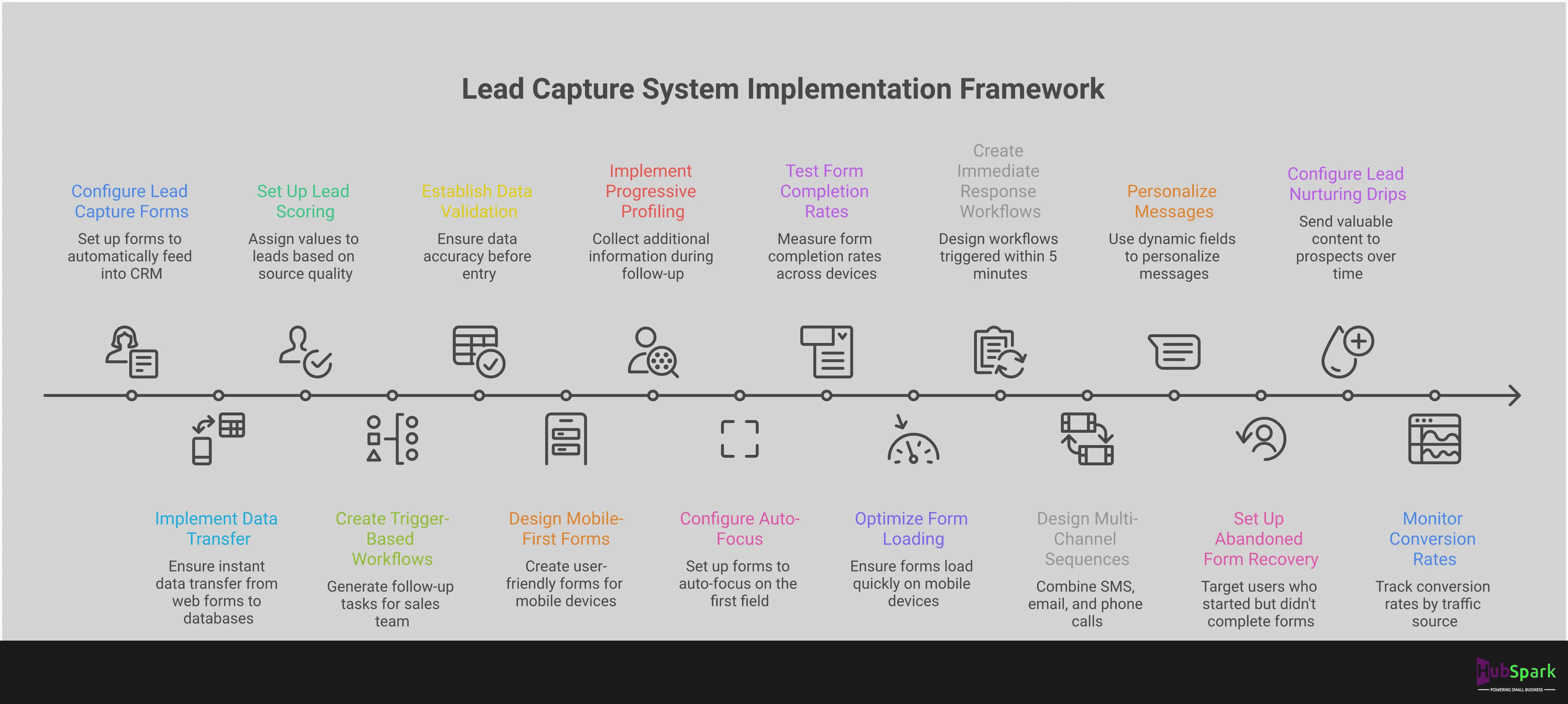
Executing a lead capture strategy requires more than just choosing a tool; it demands a structured approach. A successful framework ensures your system is efficient, compliant, and optimized for growth. Without this structure, even the most advanced software will fail to deliver results. The following steps are not suggestions, they are operational requirements for turning website visitors into paying clients. This framework moves your business from passively collecting contacts to actively managing a pipeline of qualified leads.
Integrate with Your CRM
Your lead capture system must feed directly into your Customer Relationship Management (CRM) software. A delay or manual transfer between capturing a lead and adding it to your sales pipeline is a critical failure point where potential clients are lost. A good CRM helps you get leads, sort them, and assign them to the right team member instantly. This integration eliminates manual data entry, reduces response times, and ensures every lead is tracked from initial contact to final sale. An all-in-one platform with built-in CRM benefits makes this process automatic, creating a seamless flow of information that accelerates your entire sales cycle.
Adopt a Mobile-First Design
The majority of your potential clients will interact with your website and lead capture forms on a mobile device. A system that is not optimized for mobile is obsolete. Your landing pages and forms must be designed with clear, concise copy and compelling visuals that load quickly on a smartphone. Use persuasive call-to-action buttons that are easy to tap and encourage visitors to provide their information. A mobile-first approach is a non-negotiable standard for modern lead capture. It ensures your system is accessible and effective for users on any device, maximizing your opportunity to convert traffic from sources like local search and social media.
Ensure Data Privacy Compliance
Protecting customer data is a fundamental responsibility. Your lead capture process must be transparent and compliant with privacy regulations. Always include a clear and accessible privacy policy wherever you collect personal information like names, phone numbers, or email addresses. This is not just a legal requirement; it is essential for building trust with your audience. Customers are more likely to share their information with a business that respects their privacy. An integrated system like HubSpark helps manage this by centralizing customer data securely, making it easier to maintain compliance and demonstrate your commitment to protecting client information.
Monitor and Optimize Performance Continuously
Implementing a lead capture system is not a one-time task. It requires continuous monitoring and optimization to achieve peak performance. You must track key metrics like form submission rates, conversion rates, and cost per lead to understand what is working and what is not. Use A/B testing, which involves creating two slightly different versions of a page or form, to see which one is better at capturing leads. This data-driven approach allows you to make informed adjustments to your forms, calls-to-action, and overall strategy. An effective system provides the analytics you need to optimize website lead management and consistently improve your results over time.
The HubSpark Advantage: An All-in-One Solution
Fragmented systems are operational bottlenecks. Juggling standalone form builders, separate email platforms, and a disconnected CRM creates inefficiencies that cost you leads and revenue. The solution is not to find better individual tools; it is to eliminate the need for them entirely. HubSpark centralizes your entire lead capture and management process into a single, powerful operating system designed for the specific demands of a small business.
Our platform is built on the principle that lead capture should not be an isolated activity. It must be fully integrated with your customer relationship management. When a potential client submits their information through your website, HubSpark instantly automates the data entry and enrichment process. This action triggers intelligent follow-up sequences through our unified messaging solutions, ensuring no lead goes cold. You gain immediate control without the manual work.
Furthermore, HubSpark connects lead generation directly to your business’s credibility. The system facilitates automated review requests, turning satisfied customers into powerful social proof that attracts new prospects. This creates a self-sustaining growth cycle where excellent service, captured through our reputation management solutions, directly fuels your lead pipeline. By consolidating lead capture, CRM, messaging, and reputation management, HubSpark provides a complete, streamlined framework to accelerate business growth.
Related Articles
- How Does HubSpark Help Business Owners with Lead Generation?
- Optimize Website Lead Management – HubSpark
- Marketing Automation for Lead Follow-Up & Nurturing | HubSpark
Frequently Asked Questions
Why can’t I just use a standard “contact us” form on my website? A standard contact form is a passive tool that drops an email into a crowded inbox. A true lead capture system is an active, automated process. It instantly funnels a prospect’s information into your CRM, triggers an immediate follow-up sequence, and tracks the lead’s entire journey. It is the difference between having a digital mailbox and operating an automated sales pipeline.
What’s the most critical mistake businesses make with lead capture? The most damaging error is failing to implement an immediate follow-up strategy. Capturing a lead is useless if you let it go cold. In competitive service industries, the first business to respond is almost always the one that wins the job. Your system must automate the initial contact to guarantee you engage every single lead the moment their interest is at its peak.
Is an all-in-one platform really necessary for a small business? It is not about necessity; it is about operational efficiency and your capacity for growth. Juggling separate tools for forms, emails, and customer management creates data silos and forces you to perform manual work that costs time and invites errors. An all-in-one platform eliminates that chaos, streamlining your entire workflow from first contact to final payment from a single dashboard.
How does a lead capture system provide value beyond just getting new customers? A proper system delivers critical business intelligence. By tracking where your most qualified leads originate, you can make smarter, more profitable marketing investments instead of relying on guesswork. Centralizing all customer data also helps you understand client needs on a deeper level, which improves your service quality and builds the foundation for long-term relationships and repeat business.
How much information should I ask for on my lead capture forms? Request the absolute minimum required to start a conversation. For most businesses, this means a name, an email address, and a phone number. Every additional field you require increases the likelihood that a potential customer will abandon the form. The goal of the initial capture is to open the door; you can gather more specific details during your follow-up call or appointment.

I am a serial entrepreneur with a 20+ year background in marketing & advertising, with a specific focus on SEO/online/digital marketing. I have a passion for helping owners of small & medium sized businesses grow rapidly through organic search engine optimization & digital marketing. I am blessed to lead a team of some of the most hard working, brilliant, and passionate team to help all of our clients reach their revenue goals!
 App Today!