
Your customers are not all in one place, so your business cannot be either. While many searches start on Google, a homeowner looking for a contractor might go directly to Angi, while someone seeking a lawyer may use Avvo. Being absent from these platforms means you are invisible to a segment of your most qualified customers. A comprehensive visibility strategy requires you to be present wherever your clients are searching. This multi-platform approach builds credibility and creates numerous pathways for leads to find you. This guide provides the essential list of business listing sites, from foundational directories to industry-specific powerhouses, required to capture leads from every corner of your market.
Key Takeaways
- Prioritize Foundational Accuracy: Before anything else, claim and optimize your profiles on core platforms like Google, Yelp, and Apple Maps. Your Name, Address, and Phone number (NAP) must be identical everywhere—this is the non-negotiable foundation for local search dominance.
- Optimize for Customer Acquisition: An unoptimized listing is a wasted asset. Convert profiles into lead-generation tools by writing compelling, keyword-rich descriptions, adding high-quality photos, and implementing a system to consistently generate positive customer reviews.
- Expand Strategically to Dominate Your Niche: Once your foundation is solid, target industry-specific directories where high-intent customers are actively searching. A widespread, yet targeted, presence across multiple platforms builds authority and creates multiple pathways for new business.
What Are Business Listings and Why Are They Critical?
Business listings are digital profiles of your company’s essential information published on online directories. Think of platforms like Google, Yelp, and Facebook—these are modern-day directories where customers actively search for local services. A listing contains your business Name, Address, and Phone number (NAP), along with other vital details like hours of operation, services offered, and customer reviews. They are not passive records; they are active tools for customer acquisition. When a potential customer searches for “plumber near me,” these directories are what the search engine uses to provide relevant, local results.
The criticality of these listings extends directly to your bottom line for two primary reasons. First, they are foundational to your local SEO performance. When search engines like Google find consistent and accurate information about your business across dozens of reputable sites, it validates your legitimacy. This digital trust is a primary factor that determines how high you rank in local search results. More listings with consistent data signal to Google that you are an established, trustworthy business, placing you above competitors with a weaker digital footprint.
Second, accurate listings eliminate friction for potential buyers. An incorrect phone number, a wrong address, or outdated business hours on a major directory is a closed door to a sale. A frustrated prospect who can’t find or contact you will immediately move on to your competitor. Managing these listings across every relevant platform is a non-negotiable operational task. Inaccuracy isn’t an option, and consistency is the key to dominating your local market and ensuring every potential customer can find and hire you.
The Essential Business Listing Sites for Local Dominance
Not all business directories are created equal. While hundreds of sites exist, a select few carry the authority to significantly impact your local search visibility and customer acquisition. Focusing your efforts on these essential platforms is the most efficient path to dominating your local market. These are the foundational pillars of your online presence; getting them right is not a suggestion, but a requirement for growth. Each listing acts as a verified citation of your business’s name, address, and phone number (NAP), sending powerful trust signals to search engines like Google.
Inconsistent or missing information on these core sites creates customer confusion and damages your search rankings. The goal is to build a consistent, professional, and compelling presence across the board. This is the first step in a robust local SEO strategy that attracts high-intent customers directly to your door. Centralizing control over these listings is critical. Using a single dashboard to manage updates ensures accuracy and saves you from the operational bottleneck of logging into multiple platforms. Before you expand to niche or industry-specific directories, you must establish a rock-solid foundation on these essential sites.
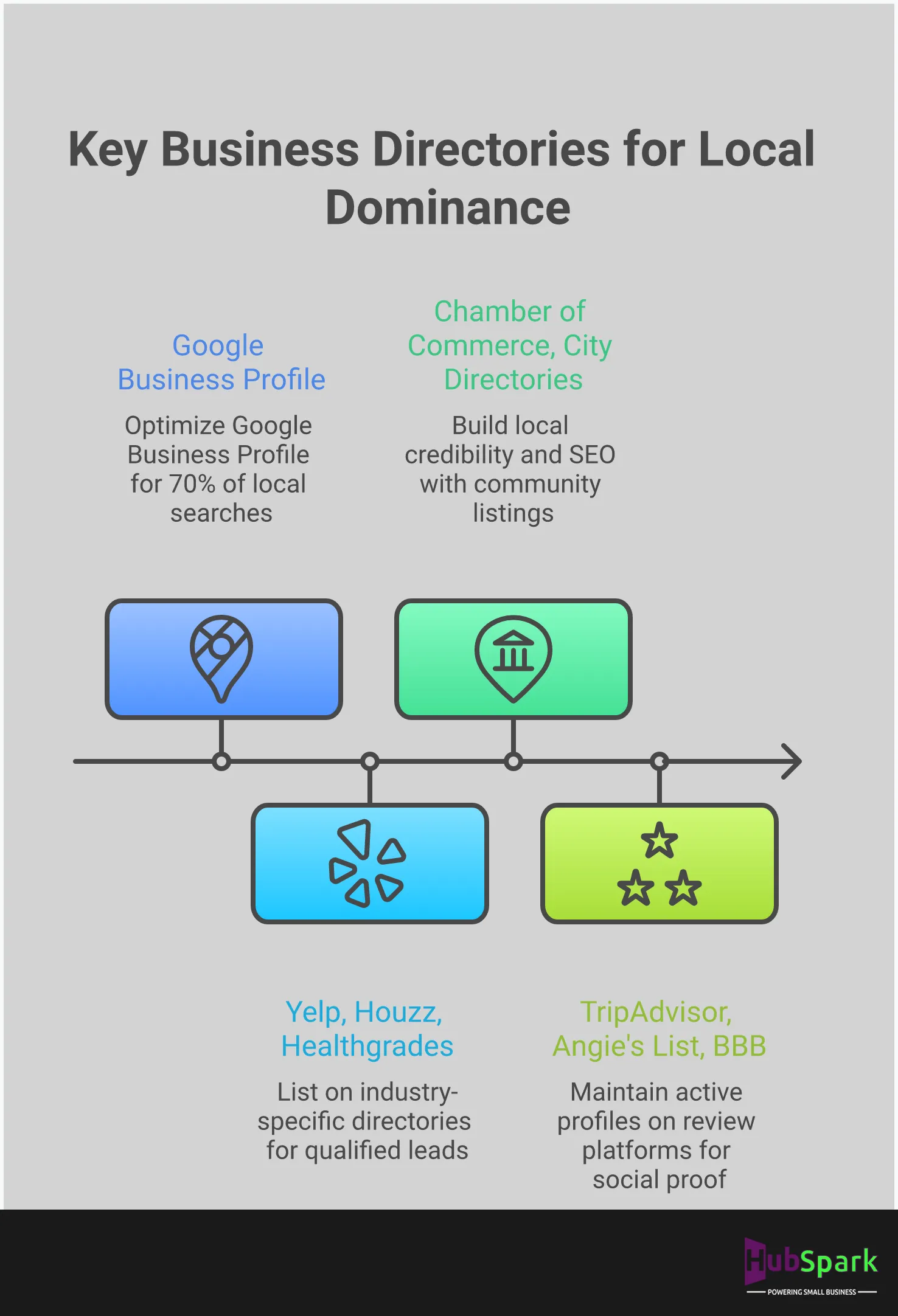
Google Business Profile
This is the most critical business listing for any local operation. A complete and optimized Google Business Profile (GBP) is non-negotiable because it directly feeds Google Search and Google Maps. When a potential customer searches for “plumbers near me,” the information in your GBP—including your hours, phone number, and reviews—determines if you appear in the valuable Local Pack results. As one expert puts it, “You need to claim and set up your Google My Business page because Google uses it for local search results.” This listing is your digital storefront on the world’s largest search engine; treat it as your top priority.
Yelp
Yelp is a dominant force in the world of customer reviews. For service-based businesses like contractors, auto shops, and law firms, a strong Yelp presence is essential for building credibility. Potential customers turn to Yelp specifically to evaluate the quality of local services based on the experiences of others. A high rating and positive, detailed reviews can be the deciding factor that converts a prospect into a paying customer. Many customers use top review sites, and search engines recognize their authority, which can influence your overall search visibility. Proactive reputation management on this platform is crucial.
Facebook Business
With billions of users, Facebook is more than a social network; it’s a powerful discovery engine for local businesses. Your Facebook Business Page acts as a dynamic listing where you can share updates, post photos, and engage directly with your community. It’s also a major source of reviews and recommendations that potential customers trust. With an estimated “40 million small businesses using its platform,” being absent from Facebook means missing out on a massive audience. An active and professional page signals that your business is open, engaged, and ready to connect with new clients.
Bing Places for Business
While Google holds the largest market share, ignoring other search engines is a strategic error. Bing Places for Business is Microsoft’s equivalent of Google Business Profile and powers local search results on Bing and through voice assistants like Alexa. Setting up your profile is a straightforward process and ensures you capture customers who use Microsoft’s ecosystem. To achieve comprehensive visibility, you must list your business on well-known sites, and that includes Bing. Centralized listings management solutions make it simple to maintain consistency across both Google and Bing without duplicating your efforts.
Apple Maps
Every iPhone user has Apple Maps installed by default, making it a critical directory for capturing mobile customers. When a user asks Siri for directions or searches for a local service, the results are pulled from Apple Maps. If your business isn’t listed or the information is incorrect, you are invisible to a significant and often affluent segment of the market. Being listed on major platforms like Apple Maps is a foundational step for any local business. Ensuring your information is accurate here is essential for driving foot traffic and phone calls directly from Apple devices.
Better Business Bureau
For over a century, the Better Business Bureau (BBB) has been a trusted source for consumers seeking reputable businesses. An accredited listing on the BBB website serves as a powerful signal of trust and legitimacy. Customers often check the BBB to verify a company’s credibility and review its complaint history before making a significant purchase, especially for home services or professional contractors. The BBB is one of the directories where every small and local business should be listed to build confidence with potential clients and demonstrate a commitment to ethical business practices.
Yellow Pages
The Yellow Pages has successfully transitioned from a massive print book to a powerful online directory, YP.com. It remains a household name that many consumers still turn to when searching for local services. The platform’s authority and brand recognition give it significant weight with search engines, making a listing valuable for your SEO efforts. According to industry data, “YP.com (Yellow Pages) reaches 70 million consumers each month,” proving it is still a major player in local search. Claiming and optimizing your free listing on YP.com is an efficient way to expand your digital footprint.
Foursquare
Foursquare is a location-based social platform that helps users discover new places. Its data is also used to power location features in other major apps, including Snapchat and Uber. When users “check in” to your business on Foursquare, it creates social proof and increases your visibility within the app’s community. As a “location-based social networking site that can help businesses gain visibility,” Foursquare is particularly valuable for businesses with a physical storefront, like restaurants or retail shops. It provides another verified citation of your business location and helps you connect with a mobile-first audience.
Industry-Specific Listings That Drive High-Value Customers
While foundational directories like Google and Yelp are non-negotiable, dominating your local market requires a more targeted approach. Industry-specific listing sites are where high-intent customers go when they have a specific, urgent need. These platforms function as curated marketplaces, connecting qualified buyers directly with specialized service providers. Securing a presence on these niche directories is not just about visibility; it’s about strategically positioning your business in front of customers who are past the research phase and are ready to make a purchasing decision.
Failing to appear on these sites means you are invisible to a significant segment of your target market. For a contractor, not being on Angi is like a restaurant refusing to be on Yelp—it’s a fundamental operational error. These platforms build credibility and trust before a customer even visits your website. A comprehensive directory strategy includes both broad-reach platforms and these high-conversion, industry-specific sites. Centralizing control over all these listings through a single dashboard is the only efficient way to manage your brand’s digital footprint and ensure consistency. HubSpark’s Listings Management solutions are designed to execute this strategy flawlessly, eliminating the manual effort and risk of error.
Healthcare and Medical Services
In the healthcare sector, trust is the primary currency. Patients conduct extensive research before choosing a provider, and their first stop is often a specialized medical directory. Platforms like Healthgrades are critical for establishing credibility and managing your professional reputation. With over 3 million reviews of healthcare providers, it has become a vital resource for patients seeking quality medical care. An incomplete or unmanaged profile on this site is a direct signal of unprofessionalism. Your listing must be accurate, detailed, and filled with positive patient testimonials to attract new patients and build a thriving practice. This is a core component of modern reputation management.
Home Services and Contractors
For home service businesses—including plumbers, roofers, and HVAC technicians—your reputation is built on reliability and proven results. Homeowners turn to trusted platforms to find vetted professionals and avoid risk. Angi (formerly Angie’s List) is a dominant force in this space, as it is “used by over 3 million households and features 10 million business listings,” providing a trusted platform for homeowners to find reliable contractors. A strong profile on Angi, complete with high-quality photos of your work and a steady stream of positive reviews, directly translates into high-value leads. These are customers who are actively seeking your specific services and are prepared to hire a qualified professional.
Legal and Professional Services
Clients seeking legal counsel or other professional services require specialists, not generalists. They use industry-specific directories like Avvo, FindLaw, and Martindale-Hubbell to identify experts in a particular field. For a law firm, a detailed profile highlighting areas of practice, case results, and client testimonials on these platforms is essential for attracting the right type of clientele. These directories are not just listings; they are powerful lead-generation tools that connect you with clients who have specific, often urgent, legal needs. This targeted approach helps enhance your visibility among clients who are actively searching for your exact expertise, making it a critical part of your client acquisition strategy.
Restaurants and Food Services
The restaurant industry lives and dies by reviews and word-of-mouth, and today, that conversation happens online. Platforms like Yelp, TripAdvisor, and OpenTable are indispensable for attracting diners. The scale is massive; with 115 million reviews written by users, Yelp has become one of the most influential platforms for restaurants. A single negative review can deter dozens of potential customers, while a collection of positive ones can fill your tables. Actively managing your profiles, responding to feedback, and showcasing your menu with high-quality photos are fundamental tasks for any modern restaurant owner. This is where you build buzz and drive consistent foot traffic.
Retail and E-commerce
For retail businesses, visibility at the local level is key to driving both in-store traffic and online sales. Your goal is to appear wherever customers are searching for specific products. This means you must list your business on as many relevant local directories as possible to improve your online visibility, especially in niche markets where customers are actively searching. Beyond the major players, consider platforms like Nextdoor to connect with your immediate community or specialized e-commerce directories relevant to your product category. Ensuring your product information, hours, and location are accurate across all these sites is critical for converting a local search into a sale.
Create and Optimize Your Business Listings for Maximum Impact
Creating business listings is only the first step. To dominate local search and attract a steady stream of customers, you must strategically optimize every profile. An unoptimized listing is digital dead weight—it exists, but it doesn’t perform. Optimization transforms your listings from simple directory entries into powerful customer acquisition channels. It’s the critical process that ensures you are not just listed, but found by the people who need your services most. A complete and optimized profile signals to search engines like Google that your business is legitimate, active, and relevant to local search queries, directly impacting your visibility and credibility.
Effective optimization is a systematic process built on four pillars: absolute data consistency, compelling descriptions, rich media, and full utilization of platform features. Neglecting any one of these areas leaves a gap in your strategy that competitors can and will exploit. The goal is to provide a comprehensive, accurate, and engaging snapshot of your business across every platform where customers might find you. Centralizing this effort with a tool designed for listings management eliminates errors and ensures your brand is presented professionally and consistently everywhere online. This section provides the exact framework to turn your business listings into your most reliable lead-generation assets.
Establish Consistent NAP Information
The foundation of your entire local search presence is your NAP: Name, Address, and Phone number. This information must be 100% identical across every single directory, website, and social media profile. Search engines cross-reference this data to verify your business’s legitimacy and location. Even a minor inconsistency—like using “St.” on one listing and “Street” on another—creates confusion for algorithms and erodes the trust they place in your business. This dilution of trust directly harms your search rankings.
Treat your NAP as an unbreakable rule. Standardize it once and use that exact format everywhere. This consistency is one of the most powerful signals you can send to improve your local SEO. It confirms your physical location and makes it easier for search engines to recommend your business to nearby customers.
Write Compelling Business Descriptions with Strategic Keywords
Your business description is your digital elevator pitch. It must quickly communicate who you are, what you do, and why a customer should choose you. Write for your ideal customer first, using clear and persuasive language that highlights your unique value. At the same time, you must write for search engines by strategically including keywords your customers use to find services like yours. A plumber in Denver, for example, should include terms like “emergency plumbing,” “drain cleaning,” and “water heater repair in Denver.”
Avoid generic descriptions. Instead, focus on what sets you apart—whether it’s 24/7 service, specialized expertise, or a satisfaction guarantee. A well-crafted description not only attracts customers but also helps you rank for relevant search terms, turning your listing into a tool to optimize website lead management.
Add High-Quality Photos and Media
Listings with photos receive dramatically more customer engagement than those without. Photos build immediate trust and give potential customers a visual confirmation of your professionalism. Do not rely on a single, outdated image of your storefront. Instead, build a comprehensive gallery that includes high-resolution photos of your team, your vehicles, your equipment, and your work in action. For service businesses, before-and-after shots of completed projects are incredibly effective.
Video content takes this a step further, allowing you to showcase your expertise through customer testimonials or project walkthroughs. Regularly updating your media keeps your profile looking fresh and active, which both customers and search algorithms favor. Strong visuals are essential for building a positive online presence and are a key part of your reputation management strategy.
Utilize All Available Platform Features
Most business owners fill out the basic information on a listing and stop there. This is a significant mistake. Directories like Google Business Profile offer a suite of features designed to increase engagement, and using them gives you a competitive edge. Fully populate every available section, including business hours, service areas, and specific services offered. Use features like Google Posts to announce promotions or share updates, and enable the Q&A feature to address common customer questions proactively.
If a platform allows you to add a booking link, connect it directly to your scheduling system to streamline appointment management. A complete, feature-rich profile is a clear signal to the platform that you are an active and engaged business worthy of being shown to more potential customers.
Avoid These Common and Costly Listing Mistakes
Creating business listings is only the first step. Maintaining them correctly is what separates high-growth businesses from the competition. Many business owners make critical errors that damage their online visibility and turn potential customers away. These mistakes are not just minor oversights; they are significant operational failures that directly impact your revenue. By identifying and correcting these issues, you can ensure your listings function as powerful assets for customer acquisition.
The most effective way to prevent these errors is to centralize your efforts. Using a single dashboard to control your online presence eliminates inconsistencies and streamlines your workflow. HubSpark’s Listings Management solutions are designed to solve this exact problem, ensuring your business information is accurate and optimized across every critical platform. Avoid these four common mistakes to protect your brand’s reputation and accelerate growth.
Inconsistent Business Information Across Platforms
Search engines and customers demand accuracy. When your business name, address, and phone number (NAP) are different from one directory to the next, it creates confusion and erodes trust. Google’s algorithm interprets inconsistent information as a signal of unreliability, which will damage your local SEO rankings. A customer who finds the wrong phone number on Yelp or an old address on Apple Maps is a lost lead. Ensure your NAP data is identical across every single listing, down to the last detail. This includes standardizing abbreviations like “Street” vs. “St.” or “Suite” vs. “Ste.” This level of precision is non-negotiable for local search dominance.
Failing to Claim and Verify Your Listings
An unclaimed business listing is a liability. If you don’t take ownership of your profiles on platforms like Google Business Profile or Yelp, you leave the door open for incorrect information to spread. Worse, a competitor or disgruntled individual could potentially claim your listing and post damaging content. Claiming and verifying every listing is the only way to control your business narrative online. Start with the most critical platforms, especially Google, as it directly feeds information into local search results and maps. Verification proves to both the directory and potential customers that you are the legitimate owner, giving you full control over your hours, services, and customer interactions.
Focusing on a Single Directory
While having a powerful Google Business Profile is essential, stopping there is a strategic error. Your customers are not all in one place, and neither should your listings be. Different demographics prefer different platforms; a homeowner might find your contracting business on Yelp, while a different client might use the Better Business Bureau to verify your credentials. A comprehensive listing strategy requires a presence across a diverse mix of directories, including major platforms, industry-specific sites, and local databases. This broad approach maximizes your visibility, builds a stronger backlink profile for your website, and ensures you capture leads from every corner of the internet.
Ignoring Customer Reviews and Engagement
Your customer reviews are one of your most valuable marketing assets. Ignoring them—both positive and negative—sends a clear message that you do not value customer feedback. Failing to encourage and manage reviews means you are missing the single most important factor in building social proof and credibility. Actively request reviews from satisfied clients and respond professionally to all feedback. This engagement shows that you are an attentive and responsible business owner, which heavily influences purchasing decisions. A proactive strategy for reputation management is fundamental to converting searchers into loyal customers and improving your ranking on review-driven platforms.
How to Systematically Generate Positive Customer Reviews
Your business listings are active platforms for customer feedback. A steady stream of positive reviews is one of the most powerful assets for dominating local search and building trust. This is not a matter of luck; it requires a deliberate, repeatable system. By integrating review generation into your daily operations, you transform a passive hope into an active growth strategy. The goal is to make asking for and managing feedback as routine as sending an invoice.
A proactive approach ensures your online reputation accurately reflects the quality of your work. When potential customers find your business on Google or Yelp, a high rating and recent, positive feedback are often the deciding factors. HubSpark’s reputation management solutions centralize this entire process, allowing you to request, monitor, and respond to reviews from a single dashboard. This eliminates the operational drag of logging into multiple sites and puts you in complete control of your brand’s narrative. Stop waiting for reviews to happen and start making them happen.
Time Your Review Requests Strategically
The single most effective way to secure a positive review is to ask for it at the moment of peak customer satisfaction. Do not wait a week or even a few days. The ideal time is immediately after a successful service delivery—when the client’s problem is solved and their appreciation is highest. For an HVAC company, this is right after the air conditioning is back on. For a law firm, it’s after a favorable case outcome. Capitalize on this window of goodwill. Automating a review request via text or email ensures you never miss this critical opportunity. This simple adjustment in timing dramatically increases both the quantity and quality of the feedback you receive.
Simplify the Review Process with Direct Links
Your customers are busy. Asking them to find your business profile and write a review adds unnecessary friction to the process. You must make it effortless. The solution is to send a direct link that takes them straight to the review submission page on the platform of your choice, like Google or Facebook. This eliminates searching and multiple clicks, reducing the task to a single tap. You can easily send these links via text message as soon as a job is complete. By removing every possible barrier, you show respect for your customer’s time and significantly improve your conversion rate from happy customer to five-star reviewer.
Respond to All Reviews Professionally and Promptly
Engaging with customer feedback is non-negotiable. You must respond to every review, both positive and negative. Acknowledging a positive review with a personalized thank you reinforces customer loyalty and shows appreciation. More importantly, a prompt and professional response to a negative review demonstrates that you are accountable and committed to customer satisfaction. Research shows that a majority of consumers are more likely to use a business that responds to all of its online reviews. This public dialogue is a powerful tool for reputation management. It shows prospective customers that you value feedback and will stand behind your service, building a layer of trust before they ever contact you.
The Strategic Advantages of Multiple Business Directory Listings
Treating business listings as a one-and-done task is a critical error. A single Google Business Profile is the starting point, not the finish line. To dominate your local market, your business must be visible everywhere potential customers are searching. Spreading your presence across multiple, high-authority directories is not just about being found; it’s a calculated strategy to build authority, establish trust, and create multiple pathways for customers to reach you.
Each new listing acts as a digital signpost, pointing back to your business and reinforcing your legitimacy in the eyes of both search engines and consumers. When a potential customer searches for your services, you want your business to appear as the undeniable, professional choice. This level of visibility is achieved through a deliberate and widespread listings strategy. The more directories that validate your business information, the stronger your digital foundation becomes. This approach directly impacts your search engine ranking, your credibility with customers, and ultimately, your ability to generate a steady stream of high-quality leads.
Improve Local SEO Rankings and Search Visibility
Multiple business listings are a cornerstone of effective local SEO. Search engines like Google aim to provide users with the most accurate and reliable results. When they crawl the web and find your business name, address, and phone number (NAP) listed consistently across dozens of reputable directories, it sends a powerful signal of trust. This consistency proves that you are a legitimate, established local business.
As a result, search engines reward you with higher rankings in local search results, including the valuable “Map Pack.” Every accurate listing you create acts as a citation, building your online authority and making it easier for customers in your service area to find you instead of your competitors. This isn’t a shortcut; it’s a fundamental requirement for achieving top-tier search visibility.
Enhance Customer Trust and Credibility
Today’s customers perform their due diligence before making a purchase or booking a service. When they find your business listed on multiple trusted platforms—from Yelp and the Better Business Bureau to industry-specific sites—it immediately builds confidence. This widespread presence signals that you are a professional and transparent operation. Furthermore, these listings are prime real estate for customer reviews, which are essential for social proof.
Encouraging satisfied clients to leave feedback on these directories is a critical part of your growth. A strong portfolio of positive reviews across several sites solidifies your reputation and makes the decision easier for prospective customers. Effective reputation management across all your listings is non-negotiable for converting searchers into clients.
Accelerate Customer Acquisition and Lead Generation
Every business directory you are listed on is another channel for customer acquisition. With a huge percentage of consumers searching online for local businesses every week, you must be present where they are looking. A potential customer might not start their search on Google; they may use Yelp to find a plumber, Angi for a contractor, or another niche site for a specific service. Being absent from these platforms means you are forfeiting leads.
Each listing functions as a new front door to your business, driving calls, website visits, and appointment requests. By maximizing your visibility, you expand your reach and capture leads from various sources. This multi-channel approach ensures a more resilient and consistent flow of new customers, allowing you to optimize your lead management and accelerate business growth.
Manage Your Business Listings for Long-Term Growth
Creating your business listings is the first step. Managing them is the long-term strategy that separates high-growth businesses from the competition. Your listings are not static assets; they are dynamic channels for customer acquisition that require consistent oversight and optimization. Failing to manage them is equivalent to leaving your front door unlocked—it invites inaccuracies, damages your reputation, and costs you customers.
Effective management involves three core functions: maintaining data accuracy, monitoring performance, and strategically expanding your presence. This operational rhythm ensures your business remains visible, credible, and competitive in local search. Centralizing this process is the most efficient way to execute this strategy without draining your time and resources. A unified system allows you to control your online footprint from a single point of command, turning a complex task into a streamlined, repeatable process that fuels sustainable growth.
Perform Regular Updates and Information Maintenance
Inaccurate business information is a direct threat to your revenue. When a potential customer finds the wrong phone number, outdated hours, or an old address, you lose their trust and their business instantly. Your primary directive is to ensure your business details are correct across every single listing. This includes your name, address, and phone number (NAP), as well as your hours of operation, especially during holidays or special events.
Regularly audit your listings to confirm consistency. This isn’t just for customers; search engines like Google reward accuracy and consistency with higher rankings. When your information is uniform everywhere, it signals that your business is legitimate and reliable. The most efficient way to manage all your business listings is from one place, eliminating the need to log into dozens of separate accounts to make a simple update.
Monitor Performance Across All Platforms
Listing your business on multiple directories is a strategic imperative. The more places your accurate business information appears, the more credibility you build with search engines. This widespread presence is a powerful signal that improves your local SEO and makes it easier for customers to find you. However, simply being listed is not enough. You must monitor how these listings are performing.
Track key metrics like profile views, clicks to your website, and phone calls originating from each directory. This data reveals which platforms are driving the most valuable traffic and where you should focus your optimization efforts. Analyzing performance allows you to make data-driven decisions instead of guessing. A centralized dashboard that consolidates these analytics is the only way to efficiently monitor your entire online footprint and identify opportunities for growth without wasting hours compiling reports.
Expand to New, Relevant Directories
Once you have established and optimized your foundational listings, the next step is strategic expansion. Move beyond the major directories and identify niche platforms specific to your industry and location. City- and industry-specific directories are extremely valuable for local SEO because they demonstrate to Google that your business is highly relevant to a specific place and service category. For a plumber, a listing on a local home services directory is often more valuable than a generic national one.
Research and identify directories that cater directly to your target customer. These platforms attract high-intent searchers who are actively looking for the services you provide. Adding your business to these relevant directories strengthens your local authority, diversifies your sources of leads, and builds a more resilient online presence that is less dependent on a single platform. This targeted approach ensures your marketing efforts reach the customers most likely to convert.
Your Action Plan: Which Listing Sites to Prioritize
Effective online visibility isn’t about being everywhere; it’s about being everywhere that matters. Spreading your efforts too thin across irrelevant directories wastes time and dilutes your impact. A prioritized, systematic approach is required to dominate your local market. Stop guessing where to list your business and start executing a plan that delivers measurable results. Your strategy should be built in layers, starting with foundational platforms before expanding to more specialized directories. This ensures you capture the largest possible audience first, then target high-intent customers in your specific niche. This methodical process is the most efficient path to improving your local SEO for small businesses and driving qualified leads.
Start with the Core Four
Your first priority is to claim and fully optimize your profiles on the platforms that command the overwhelming majority of local search traffic. These are non-negotiable. Begin with Google Business Profile, Yelp, Apple Maps, and Bing Places for Business. These sites are often the first point of contact a potential customer has with your business. A complete and accurate profile on these platforms builds immediate trust and is a fundamental requirement for appearing in local map packs and search results. Treat these listings as your digital storefronts; they must be accurate, professional, and actively managed. Neglecting them means you are invisible to a huge segment of your potential customer base.
Expand to Industry-Specific Directories
Once your foundational listings are secure, the next step is to target the directories where your ideal customers are actively searching for your specific services. While Google is a starting point for everyone, a customer looking for a certified plumber or a reputable law firm will often turn to industry-specific sites like Angi, Houzz, Avvo, or Thumbtack. These platforms function as trusted third-party validators for your business. A strong presence here positions you as a credible expert in your field and connects you with leads who are further along in the buying process. Research the top local business directories in your industry and establish a presence there.
Diversify for Broader Visibility
Relying solely on one or two major platforms is a strategic error. A diversified listing portfolio creates a more resilient and authoritative online presence. Each new, accurate listing you create acts as a citation, signaling to search engines that your business is legitimate and established. This broad visibility protects your business from algorithm changes on any single platform and multiplies the number of pathways customers can use to find you. However, managing dozens of profiles manually is an operational bottleneck. Centralize control over all your profiles with HubSpark’s Listings Management Solutions to ensure consistency and save critical time.
Related Articles
- Local Listing Management Software & Tools for Businesses | HubSpark
- Improving Your Search Ranking with Local Listings – HubSpark
- Why Local SEO Is So Important – HubSpark
- Local Listings SEO: Boost Search Rankings & Visibility | HubSpark
Frequently Asked Questions
I’m already on Google Business Profile. Is that really not enough? Think of your Google Business Profile as the foundation of your digital presence—it’s absolutely critical, but it’s not the entire structure. Relying solely on Google means you are invisible to customers who start their search on other trusted platforms like Yelp, Apple Maps, or industry-specific sites like Angi. A comprehensive strategy requires being present on multiple directories to build credibility with search engines and capture leads from every possible channel. Each accurate listing acts as a vote of confidence for your business, strengthening your overall local SEO performance.
What’s more important: getting listed on more sites or optimizing the ones I already have? Your first priority must be to completely optimize your foundational listings on major platforms like Google, Yelp, and Bing. An incomplete or inconsistent profile is a liability. Once those core profiles are accurate and rich with media, your strategy should shift to strategic expansion. The goal is to achieve both depth in your key listings and breadth across other relevant directories. One without the other is an incomplete strategy that leaves you vulnerable to competitors.
How do I handle a negative review on one of these sites? You must respond to it, and you must do so promptly and professionally. Never ignore a negative review or become defensive. Your response should acknowledge the customer’s experience, express a commitment to resolving the issue, and provide a clear path to take the conversation offline. This public response is not just for the unhappy customer; it’s a powerful signal to all future prospects that you are an accountable and customer-focused business.
How often should I be updating my business listings? You should update your listings any time your core business information changes, such as your hours, phone number, or address. This should be done immediately. Beyond that, it’s a best practice to audit all your listings quarterly to ensure accuracy and to add fresh photos or respond to new reviews. Consistent activity signals to directory platforms that your business is active and engaged, which can positively influence your visibility.
If my business information is wrong on a site I don’t control, what can I do? This is a common and damaging problem that arises from not claiming your listings. The first step is to go through that specific directory’s verification process to claim ownership of the profile. Once you have control, you can correct the inaccurate information. This process underscores the importance of proactively claiming all your profiles to prevent incorrect data from spreading and to maintain full control over your brand’s online narrative.

I am a serial entrepreneur with a 20+ year background in marketing & advertising, with a specific focus on SEO/online/digital marketing. I have a passion for helping owners of small & medium sized businesses grow rapidly through organic search engine optimization & digital marketing. I am blessed to lead a team of some of the most hard working, brilliant, and passionate team to help all of our clients reach their revenue goals!
 App Today!