
Your online business listings are not a marketing task; they are a critical operational function. Every incorrect phone number, outdated address, or inconsistent business name is a direct liability that costs you customers and revenue. When a potential client finds bad data, they don’t call you for the right information, they call your competitor. This is the core challenge that effective local business listing management solves. It is the process of seizing control over your digital presence to ensure absolute accuracy across every platform where customers find you. This guide outlines the non-negotiable strategies required to eliminate these costly errors and transform your listings from a source of frustration into a powerful customer acquisition engine.
Key Takeaways
- Inaccurate Listings Are a Direct Liability: Every incorrect detail online is a barrier that actively sends customers to your competitors. This bad data erodes credibility, damages search rankings, and results in a direct loss of revenue.
- Manual Management Is a Failed Strategy: Attempting to update dozens of platforms individually is an inefficient operational bottleneck. This approach guarantees errors, wastes valuable resources, and is fundamentally unscalable for any business aiming for growth.
- Centralized Automation Is Non-Negotiable: The only effective solution is to use a single platform to control your business information everywhere. This strategy eliminates inconsistencies, protects your brand from unauthorized changes, and transforms your listings into a reliable customer acquisition tool.
What Is Local Listing Management?
Local listing management is the process of controlling your business information across every online directory, map, and app where customers might find you. Think of platforms like Google Maps, Yelp, Apple Maps, and industry-specific sites. It involves creating, updating, and optimizing your business name, address, phone number (NAP), hours of operation, and other critical details to ensure they are identical everywhere. This isn’t a one-time task; it’s an ongoing operational discipline required for any serious business.
Effective management ensures that when a potential customer searches for your services, they find the correct information instantly. Without it, you surrender control of your digital presence to data aggregators and automated systems that often publish outdated or incorrect details. This process is the foundation of your local marketing strategy. It dictates how easily customers can find you, trust you, and ultimately, choose to do business with you over a competitor. Centralizing this function is the only way to maintain absolute control and accuracy. When your information is consistent, search engines view your business as more credible, which directly impacts how often you appear in relevant search results. This is not just about being found; it’s about being found with the right information that leads to a transaction.
Why Accurate Listings Are Non-Negotiable
Inaccurate listings are a direct liability to your business. When a customer finds the wrong phone number, outdated hours, or an old address, you don’t just cause a minor inconvenience, you lose a sale. That customer will immediately contact a competitor with reliable information. This damage extends beyond a single lost opportunity. Search engines like Google depend on consistent data to verify that your business is legitimate and operational. Conflicting information across different platforms erodes that trust, causing your business to rank lower in local search results. Maintaining accuracy is a fundamental requirement for visibility, and HubSpark’s Listings Management Solutions are built to enforce that consistency.
How Listings Drive Customer Acquisition and Revenue
Accurate and optimized listings are a primary driver of customer acquisition. They function as digital signposts that guide ready-to-buy customers directly to your door. When a homeowner searches for “emergency HVAC repair,” the businesses with the most consistent, complete, and trusted listings appear at the top of the results. This prime visibility is critical because it puts your business in front of customers at the exact moment they need your services. This process is a core component of how HubSpark improves local SEO for small businesses. More visibility translates directly into more phone calls, more website visits, and more booked appointments, accelerating your revenue growth.
The True Cost of Inaccurate Business Listings
Inaccurate business listings are not a minor oversight; they are a direct threat to your revenue and reputation. Every incorrect phone number, outdated address, or inconsistent business name creates a barrier between you and a potential customer. This bad data actively misdirects clients, erodes trust, and makes your business invisible to local search engines. The consequences are tangible: lost foot traffic, fewer phone calls, and a damaged online presence that competitors will quickly exploit. Correcting these errors isn’t just about housekeeping. It’s a critical business function that directly impacts your bottom line and long-term growth.
Stop Losing Customers to Bad Data
Inaccurate business listings directly impact your visibility and cost you customers. When a potential client searches for your services, search engines rely on consistent data to rank the results. If your information is wrong on even one major directory, it creates confusion and pushes your business down in the search rankings. How well a business manages its online listings determines how often it appears in relevant local searches. An incorrect address sends a customer to the wrong location, while a wrong phone number leads to a dead end. In both cases, you have lost a sale and damaged your credibility, likely sending that customer straight to a competitor with accurate information.
Avoid Penalties from Search Engines
Search engines like Google demand accuracy. Their goal is to provide users with the most reliable and relevant information possible. Businesses that fail to provide consistent information, share misinformation, or have duplicate listings risk being penalized. These penalties are not theoretical; they result in a diminished online presence, making it significantly harder for customers to find you. Maintaining precise and uniform data across all platforms is fundamental to a successful local SEO strategy. Failure to do so signals to search engines that your business is not a trustworthy result, effectively removing you from the running for new customers.
Protect Your Business’s Credibility
Your business’s credibility is built on trust, and inaccurate listings destroy it. When a customer finds conflicting information about your business online, it plants a seed of doubt. This friction leads to frustration and a perception that your business is unprofessional or, even worse, no longer operational. Regular audits of your business listings are essential to maintain control over your online narrative. By ensuring customers always find the right information, you protect your brand’s integrity. This constant vigilance is a core part of effective reputation management, reinforcing that your business is reliable, professional, and ready to serve its clients.
The Core Challenges of Manual Listing Management
Attempting to manage your business listings manually is not a strategy for growth; it is an operational bottleneck. The process is fundamentally inefficient and exposes your business to significant risks, including data inaccuracies, customer confusion, and damaged search engine rankings. While it may seem manageable at first, the cracks in a manual system appear quickly, consuming valuable time and creating problems that directly impact your bottom line. Effective listings management requires a centralized, automated approach to eliminate these challenges before they cost you customers. The core issues with manual management fall into four distinct categories: time waste, data duplication, verification roadblocks, and unauthorized data changes. Each one presents a direct threat to your business’s online visibility and credibility.
Too Many Platforms, Not Enough Time
Your customers search for services on dozens of platforms, from Google and Bing to Yelp, Facebook, and industry-specific directories. Manually updating your business name, address, and phone number (NAP) across every single one is an unsustainable drain on your resources. What starts as a simple update becomes a multi-hour task of logging into countless accounts, navigating different interfaces, and re-entering the same information repeatedly. This tedious work pulls you away from revenue-generating activities like serving customers and closing leads. For any business planning to grow, manual listing management is a system guaranteed to fail. It simply does not scale with your success.
The High Risk of Duplicate Listings
Duplicate listings are one of the most common and damaging issues in local SEO. They occur when variations of your business information create multiple, competing profiles on the same platform. This often happens when you move locations, change a phone number, or when data aggregators automatically generate a new listing instead of updating your existing one. These duplicates confuse search engines, splitting your authority and weakening your ranking potential. They also confuse customers, who may see conflicting information, call the wrong number, or leave a review on an inactive profile. Eliminating duplicates is critical for consolidating your online presence and improving your local SEO.
The Hurdle of Claiming and Verifying Listings
Before you can even manage a listing, you must first prove you own the business. This claiming and verification process is a notorious hurdle for business owners. Each platform has its own unique and often cumbersome requirements, from mailing a postcard with a verification code to your physical address to phone calls or video submissions. These steps are time-consuming and can stall your entire listing optimization effort for weeks. Failing to complete verification leaves your profiles unclaimed and vulnerable, preventing you from correcting inaccuracies or responding to customer reviews. It’s a critical first step that a manual approach makes unnecessarily difficult.
Guard Against Unauthorized Listing Changes
Your business listings are not static. Many platforms, including Google, allow users and third-party data sources to suggest edits to your information. Without your knowledge, a customer could mistakenly mark your business as “permanently closed” or an automated system could overwrite your correct hours with old data. These unauthorized changes introduce critical inaccuracies that can turn customers away. Manually monitoring every listing for these random edits is nearly impossible. This vulnerability makes a proactive reputation management strategy essential. You must have a system in place to lock in correct data and alert you to any unauthorized changes before they can harm your business.
Demand These Features in a Listing Management Solution
Not all listing management platforms are built to deliver results. A passive tool that simply pushes data is insufficient. To dominate your local market, you need a solution that actively manages, protects, and optimizes your online presence. Your business requires a system with specific, non-negotiable features designed to eliminate errors, save time, and drive measurable growth. Anything less is a liability. The right platform provides a command center for your digital footprint, automates critical consistency tasks, syncs your data instantly, and delivers the analytics you need to make strategic decisions.
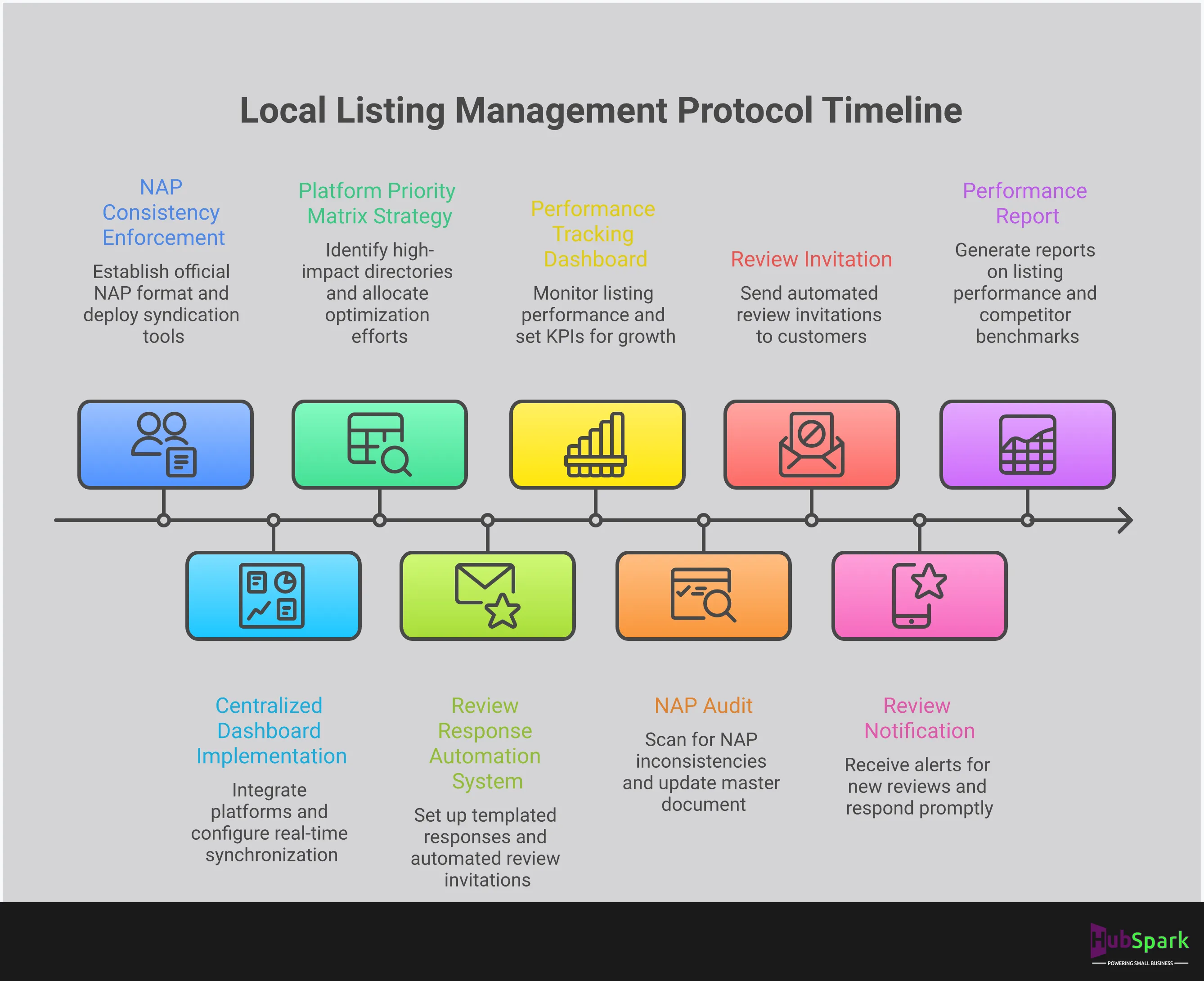
Gain Control with a Centralized Dashboard
Managing dozens of online business listings across different platforms with separate logins is an operational bottleneck. It’s inefficient and creates opportunities for costly errors. A centralized dashboard is the only way to maintain absolute control. Instead of manually updating each directory one by one, a single dashboard allows you to manage your information from one place, pushing updates to every platform simultaneously. This approach transforms a chaotic, time-consuming task into a streamlined process. HubSpark’s listings management solutions provide this unified command center, giving you the power to control your entire online presence efficiently and accurately.
Automate NAP Consistency
Your business’s Name, Address, and Phone number (NAP) must be identical everywhere online. Even minor variations, like “St.” versus “Street,” can confuse search engines and erode your local search ranking. Manually enforcing this consistency is nearly impossible. You need a platform that automates NAP consistency by finding and correcting discrepancies across the web without your direct intervention. This ensures search engines like Google see your business as a legitimate, stable entity, which is fundamental to achieving high visibility in local search results. This automation is a core component of an effective local SEO strategy.
Require Real-Time Platform Synchronization
Your business operates in real-time, and your online listings must reflect that. When you change your hours for a holiday or update a service offering, that information needs to be accurate everywhere immediately. A delay of days or even hours can lead to frustrated customers and lost sales. Demand a solution that offers real-time synchronization with its directory partners. This feature ensures that any update you make in your central dashboard is pushed live across all platforms instantly. This maintains control over your online representation and guarantees customers always find the correct information right when they need it.
Track Performance with Actionable Analytics
Effective listing management directly impacts how many local customers find and contact your business. Without performance data, you are operating blind. Your management solution must provide actionable analytics that connect your listing activity to real-world results. This includes tracking metrics like how often your business appears in search results, how many users view your profile, and what actions they take, such as clicking to call or requesting directions. These insights prove the ROI of your efforts and inform your strategy. By monitoring this data, you can also manage your online reputation, as strong reviews and reputation management are tied to listing performance.
How to Maintain Absolute Consistency Across All Platforms
Achieving consistency across online directories is not a one-time task; it is an ongoing operational discipline. Inaccurate or conflicting information erodes customer trust and damages your visibility in local search results. To dominate your local market, you must present a unified, accurate, and professional front on every platform where customers might find you. The following strategies are not suggestions, they are requirements for any serious business owner. Executing them flawlessly ensures that search engines and customers see your business as credible and reliable, directly impacting your bottom line.
Implement NAP Consistency Best Practices
Your business’s Name, Address, and Phone number (NAP) are the cornerstones of your digital identity. Every single online directory, from Google and Yelp to industry-specific sites, must display this information identically. Even minor variations, like using “St.” instead of “Street” or “(555)” instead of “555,” can create confusion for search engine algorithms. This confusion leads to lower rankings and lost visibility. The rule is simple: there should only be one authoritative listing for each of your business locations on any given directory. A consistent NAP signals to search engines that your business is legitimate and established, making them more likely to show your listing to potential customers. HubSpark’s Listings Management Solutions enforce this consistency automatically.
Establish a Regular Audit and Monitoring Process
Your business information is not static. Hours change, services evolve, and third-party sites can create duplicate or inaccurate listings without your permission. You must regain and maintain control. Implement a recurring audit process, at least quarterly, to systematically review your listings across all platforms. This process involves verifying your NAP, hours, and website, while also searching for and flagging unauthorized duplicates for removal. Regular monitoring is your defense against data decay. It ensures that customers always find the correct information when they need it most, preventing them from turning to a competitor because your listed phone number was out of date or your address was wrong.
Adopt a Centralized Management Strategy
Manually logging into dozens of different platforms to update your business information is inefficient and unsustainable. This fragmented approach guarantees errors will slip through the cracks, undermining all your consistency efforts. The only effective method is to use a centralized system. A single dashboard allows you to update your information once and syndicate it across every important directory simultaneously. This strategy eliminates the risk of manual error and saves countless hours. By centralizing control, you transform listing management from a chaotic, reactive task into a streamlined, proactive strategy. This is fundamental to improving your local SEO for small businesses and ensuring your digital presence is always accurate and professional.
Evaluating Your Listing Management Options
Choosing the right approach to manage your online listings is a critical business decision. Your options range from manual updates on individual platforms to using dedicated services or a fully integrated system. The correct path depends on your goals for efficiency, accuracy, and growth. A manual approach may seem manageable at first, but it quickly becomes a bottleneck that exposes your business to inconsistencies and lost revenue. To maintain control and ensure every customer finds the right information, you need a strategy that scales with your business, not one that holds it back.
The Integrated Solution: HubSpark
For businesses serious about growth, an integrated platform is the only sustainable solution. While manual management might work when you have one or two locations, this method breaks down as you expand. HubSpark’s Listings Management Solutions centralize control, eliminating the cracks that appear when managing dozens of profiles across multiple platforms. Instead of reacting to errors, you establish a single source of truth for your business information and push it across every relevant directory automatically. This governance-first approach maintains absolute accuracy and brand consistency everywhere, transforming listings management from a tedious chore into a powerful tool for customer acquisition.
Managing Your Foundational Profile: Google Business
Every local business must claim and optimize its Google Business Profile. This is your most important digital asset for attracting local customers. However, treating it as a standalone task is a strategic error. Business owners often face challenges with the initial verification process or have updates rejected for failing to meet Google’s strict policies. Relying solely on Google leaves your business information vulnerable on dozens of other directories where customers are also searching. While a strong Google profile is essential, it’s just one piece of a much larger local SEO puzzle. True visibility requires a consistent presence across the entire digital ecosystem.
The Limits of Standalone Listing Services
Standalone listing services appear to solve the problem of manual updates, but they often introduce a different kind of fragmentation. These tools can help push your information out, but they rarely integrate with your other core business operations, like your CRM or review management software. One of the most common problems these services fail to prevent is the creation of multiple listings for the same location, which confuses customers and harms your search rankings. Effective management is more than simple citation building; it requires a powerful, unified system to ensure your information is always accurate and optimized everywhere. Juggling a separate tool for listings only adds another platform to manage.
Your Checklist for Choosing a Listing Management Service
Selecting a listing management service is a critical decision that directly impacts your visibility and revenue. The market is crowded with options, but not all are built to deliver the control and efficiency your business requires. A subpar service creates more work, not less, by failing to correct errors or synchronize data in real time. It becomes a liability, quietly costing you customers while you focus on other tasks. Use this checklist to evaluate potential solutions and ensure you choose a partner that actively strengthens your local presence instead of just occupying a line item in your budget. Your choice should eliminate operational drag, not add to it. A powerful tool centralizes control and gives you a decisive advantage in your local market.
Ensure Comprehensive Platform Coverage and Scalability
Your business needs to be visible everywhere your customers are searching. This means your listing management service must connect with a comprehensive network of directories, from major players like Google and Yelp to industry-specific platforms. Manually managing a handful of listings is tedious; managing dozens is impossible and invites errors. As one industry report notes, manual processes begin to fail once a business reaches 100+ locations, but the principle applies even to single-location businesses aiming to dominate their local market. Your solution must provide robust listings management that scales with your ambition, whether you’re adding a new service area or opening another branch. Don’t settle for a service that only covers the basics; demand a network that gives you complete market saturation.
Verify Automation and Verification Power
The core function of any listing management service is to automate the distribution of your business information. The right tool will take your correct Name, Address, and Phone number (NAP) and syndicate it across all relevant platforms, eliminating inconsistencies that harm your local SEO. However, simply pushing data out is not enough. You need a system with verification power. This means the service must confirm that your updates have been accepted and are displayed correctly on each directory. This closed-loop process is non-negotiable. It ensures your information is always accurate and working to attract local customers, transforming your listings from a passive directory entry into an active customer acquisition tool.
Demand Seamless Integration with Your Business Tools
Your listing management service cannot operate in a silo. It must integrate directly with the other tools you use to run your business. Disconnected systems create data fragmentation and operational bottlenecks. For example, if a customer updates their contact information in your CRM, that change should be reflected in your core business data without manual entry. Furthermore, since platforms like Google allow consumer-suggested edits, your system must serve as the single source of truth, overriding unauthorized changes. A truly effective solution connects with your CRM software, appointment scheduler, and payment processor, creating a unified operational command center. This integration ensures consistency and saves you from the chaos of managing multiple, conflicting datasets.
Require Clear Reporting and Actionable Insights
Data is only valuable if it drives action. A listing management service must provide clear, concise reporting that demonstrates its impact on your business goals. Vague metrics are unacceptable. You need to see exactly how your listings perform, including search impressions, profile views, and clicks to call or get directions. Effective reporting helps you understand how customers discover your business online and which platforms deliver the most value. This information is critical for refining your marketing strategy and allocating resources effectively. Your chosen platform should also integrate analytics from your reputation management efforts, showing how reviews and ratings on your listings influence customer behavior. Demand insights, not just data.
Avoid These Common Listing Management Mistakes
Effective listing management is as much about avoiding errors as it is about proactive strategy. Many businesses undermine their own local SEO efforts with preventable mistakes that create confusion for customers and search engines alike. These common missteps are not just minor oversights; they are significant operational bottlenecks that cost you customers and revenue. Eliminating them from your process is a critical step toward dominating your local market. Here are the four most damaging mistakes to avoid.
Creating Duplicates Instead of Claiming
One of the most frequent errors is creating a duplicate listing instead of claiming and editing an existing one. When you find an incorrect listing, the impulse may be to start fresh. This is a mistake. There should only be one definitive listing for each business location in any given directory. Duplicates dilute your authority, split your customer reviews, and confuse search algorithms, which can harm your ranking. The correct action is to claim ownership of the existing profile and correct the information. A centralized listings management system automates this by finding and consolidating all mentions of your business, giving you a single point of control.
Allowing Inconsistent Business Information
Your business name, address, and phone number (NAP) must be identical everywhere online. Inconsistent information across directories is a major liability. Even small variations, like “St.” versus “Street,” can confuse customers and signal to search engines that your data is unreliable, which hurts your search ranking. This inconsistency erodes trust and sends potential customers to your competitors who provide clear, accurate information. Establishing a single source of truth for your business data and distributing it across all platforms is not optional. It is fundamental to a successful local SEO strategy and requires absolute precision.
Neglecting Updates and Maintenance
Your business listings are not static assets. Treating them as a one-time setup is a recipe for failure. Business hours change for holidays, you might add new services, or your phone number could be updated. Failing to update this information across all your listings in real-time leads to customer frustration and lost sales. You must make listing audits a regular part of your operational routine; a quarterly review is the absolute minimum. This ensures you maintain control over your online representation and that customers always find the correct information when they need it. An integrated dashboard simplifies this process from a major project into a routine task.
Ignoring Customer Reviews on Your Listings
Listings are a direct line of communication with your customers, and reviews are their primary way of speaking to you. Ignoring them is the same as ignoring a customer standing in your office. You must pay attention to what customers say in reviews and respond promptly, whether the feedback is positive or negative. Engaging with reviews directly impacts your online reputation and demonstrates to both customers and search engines that you are an active, attentive business. A systematic approach to reputation management is essential, allowing you to monitor and reply to feedback from one central location, protecting your brand and improving your local visibility.
Build Your Local Listing Management Strategy
A reactive approach to your online listings is a direct path to inconsistent data and lost revenue. To dominate your local market, you need a proactive, systematic strategy. This isn’t about occasionally checking your Google profile; it’s about establishing a repeatable process that ensures accuracy, consistency, and engagement across every platform that matters. A strong strategy is built on three core pillars: identifying your most critical platforms, committing to a strict maintenance schedule, and actively managing your customer interactions.
Executing this strategy manually is a significant operational drain. The goal is to centralize control and automate the process, freeing you to focus on running your business. An integrated platform like HubSpark transforms this strategy from a set of burdensome tasks into a streamlined, automated system. By centralizing your listings, you can enforce consistency, monitor performance, and manage your reputation from a single dashboard. This isn’t just about cleaning up your data; it’s about building a powerful customer acquisition engine that runs on accuracy and trust.
Identify Your Priority Platforms
Your time is your most valuable asset. Do not waste it by trying to manage a presence on every directory on the internet. Instead, focus your efforts on the platforms that drive real customer action. Start with the foundational players: Google Business Profile, Facebook, and Yelp. These are non-negotiable. From there, identify the industry-specific directories where your target customers are actively searching for services. For a plumber, this might be Angi; for a law firm, it could be Avvo. How well you manage your online listings on these key sites directly determines how often you appear in relevant search results. Prioritize the platforms that deliver qualified leads, and ignore the rest.
Schedule Ongoing Maintenance
Your business information is not static. Your hours change, you might add new services, or you could move to a new location. Treating your listings as a one-time setup is a critical error. You must schedule regular audits to maintain control over your online presence. At a minimum, conduct a full review of your listings every quarter. Verify your business name, address, and phone number (NAP) for absolute consistency. Update your hours for upcoming holidays and upload recent photos of your work or team. This consistent maintenance is a fundamental part of any effective local SEO strategy, signaling to search engines that your business is active, professional, and reliable.
Implement a Review Monitoring and Response System
Your business listings are not just digital billboards; they are two-way communication channels. Customers use them to leave reviews, ask questions, and engage with your brand. Ignoring these interactions is the same as letting the phone ring without answering. You need a system to monitor and respond to all customer reviews, both positive and negative, in a timely manner. A prompt response to a negative review can resolve a customer’s issue, while engaging with positive feedback builds loyalty. This active management demonstrates that you value your customers and are committed to providing excellent service, which is a cornerstone of building a strong reputation management foundation.
Related Articles
- Improving Your Search Ranking with Local Listings – HubSpark
- 8 Top Business Listing Sites USA for Local SEO
- The Ultimate List of Business Listing Sites
Frequently Asked Questions
Why does a small variation like “St.” vs. “Street” actually matter for my listings? Search engines like Google rely on absolute consistency to verify that your business information is legitimate and trustworthy. When they find even minor variations in your address or name across different directories, it creates data conflicts. This signals that your information may be unreliable, which can lower your ranking in local search results and make it harder for customers to find you. Enforcing identical information everywhere is a non-negotiable part of a serious local marketing strategy.
My Google Business Profile is accurate. Isn’t that enough? While your Google Business Profile is your most important listing, it is not the only place customers look for you. People use Yelp, Apple Maps, Facebook, and dozens of other industry-specific apps and directories to find local services. If your information is inconsistent on those other platforms, it still sends conflicting signals to search engines and can confuse potential customers, costing you leads. A strong presence requires accuracy across the entire digital ecosystem, not just on one platform.
What’s the first thing I should do if I find an incorrect listing for my business? Your first step is to claim ownership of that specific listing through the platform’s verification process. Do not create a new, correct listing, as this will result in duplicates that harm your search visibility. Once you have control of the profile, you can correct the inaccurate information. This process highlights the inefficiency of manual management; a centralized system finds and fixes these errors for you, preventing them from becoming a problem in the first place.
How does listing management connect to getting more customer reviews? Accurate and consistent listings increase your visibility, which means more customers will find and hire you. This naturally leads to a higher volume of potential reviewers. Furthermore, your listings on platforms like Google and Yelp are the primary places where customers leave feedback. By actively managing these profiles, you create a clear and accessible channel for customers to share their experiences, which is a critical component of building a strong online reputation.
I’m too busy to handle this. How much time does this actually take with the right system? Attempting to manage your listings manually is an unsustainable time drain that pulls you away from running your business. A centralized management system is designed to eliminate this burden. After the initial setup, maintaining absolute accuracy across dozens of platforms becomes a matter of minutes, not hours. You update your information in one dashboard, and the system handles the rest, transforming a chaotic, ongoing project into a simple, streamlined operation.

I am a serial entrepreneur with a 20+ year background in marketing & advertising, with a specific focus on SEO/online/digital marketing. I have a passion for helping owners of small & medium sized businesses grow rapidly through organic search engine optimization & digital marketing. I am blessed to lead a team of some of the most hard working, brilliant, and passionate team to help all of our clients reach their revenue goals!
 App Today!