
Your business information exists in dozens of places online, and you do not control most of them. An incorrect phone number on one directory or outdated hours on another creates a direct path to lost revenue and a damaged reputation. Manually correcting these errors one by one is an inefficient use of your time and an operational bottleneck that prevents growth. This is the exact problem that local listing management tools are built to solve. They centralize your business data, pushing accurate and consistent information across the web from a single dashboard. This guide cuts through the noise, reviewing the top platforms and providing a clear framework for selecting and implementing the right tool for your business.

Key Takeaways
- Enforce absolute data consistency: Your business name, address, and phone number (NAP) must be identical across every online platform. This consistency is a non-negotiable requirement for building trust with search engines and ensuring customers can find you.
- Choose an integrated system, not a point solution: A standalone listing tool only solves part of the problem. Select a platform that combines listings with reputation management and CRM to centralize control and convert local search visibility into actual revenue.
- Treat management as an ongoing discipline: Your online listings are not a “set-it-and-forget-it” task. Establish a recurring schedule to audit for inaccuracies and monitor for unauthorized changes to protect your brand’s credibility and prevent lost sales.
What is a Local Listing Management Tool?
A local listing management tool is the command center for your business’s digital footprint. Consider every online platform where a customer might find you: Google Maps, Yelp, Apple Maps, Facebook, and dozens of other industry-specific directories. Manually updating your business hours, address, or phone number on each site is not just inefficient; it’s a direct path to errors. One wrong digit in a phone number or an outdated holiday schedule can cost you a customer and damage your reputation.
This is the operational bottleneck that listings management solutions are built to eliminate. Instead of juggling countless logins, you use one central dashboard to control your business information. You enter your correct name, address, phone number (NAP), and hours of operation a single time, and the tool automatically syncs that data across its entire network of online directories. This process ensures your information is accurate and consistent everywhere customers are searching for your services.
Beyond simple updates, these tools are essential for maintaining a clean and professional online presence. They actively identify and help you suppress duplicate listings that confuse both search engines and potential clients. By enforcing data consistency, you send strong, trustworthy signals to platforms like Google, which is a fundamental component of effective local SEO. A listing management tool replaces chaotic manual entry with a streamlined, automated system, preventing costly inaccuracies and strengthening your visibility in local search results.
Must-Have Features for Local Listing Management
Selecting a local listing management tool requires a clear understanding of what features deliver actual results. Inefficient tools create more work and fail to protect your online presence. A powerful platform is not a luxury; it is a core component of your operational toolkit. Your final choice must include these five non-negotiable features to ensure you are centralizing control, saving time, and driving measurable growth. Anything less is a liability.
Automatic Data Syncing Across Platforms
Manual updates are obsolete. Your business information, from hours of operation to your address, must be consistent everywhere customers find you. A critical feature is the ability to sync your data across all major directories, maps, and review sites from a single dashboard. This eliminates the risk of human error and ensures accuracy. When you update your information once, an effective listings management solution pushes that change across the web automatically. This function is the foundation of a trustworthy and professional online presence.
Duplicate Listing Detection and Removal
Duplicate listings are a direct threat to your local SEO and customer trust. They create confusion for both search engines and potential clients, splitting your reviews and authority across multiple, incorrect profiles. Your management tool must actively scan for and flag these duplicates. The best platforms go a step further by facilitating their removal. Maintaining consistent Name, Address, and Phone number (NAP) data is essential. A tool that cleans up your digital footprint by removing duplicates protects your brand’s integrity and solidifies your search rankings.
Real-Time Analytics and Performance Tracking
You cannot manage what you do not measure. A top-tier listing management tool provides clear, actionable analytics that show you how your listings are performing. You need to see key metrics like how many people viewed your profile, clicked on your website link, or requested directions to your location. This data is not for vanity; it is for making informed business decisions. Tracking these interactions reveals how customers discover and engage with your business, allowing you to refine your strategy and focus your efforts where they will have the greatest impact.
Multi-Location Management Capabilities
For businesses operating in more than one location, centralized control is paramount. Managing listings for each office or storefront individually is inefficient and invites inconsistency. A robust tool must offer multi-location management, allowing you to oversee and update all business locations from one interface. This ensures every location has the same, correct brand information, from logos to service descriptions. This capability is essential for maintaining brand consistency and operational control as you scale. It also simplifies the process of creating and managing individual location pages on your website.
Review Management Integration
Your online listings and your reputation are directly connected. Customers often leave reviews on the same platforms where they find your business information, like Google Business Profile or Yelp. An effective listing management tool integrates reviews and reputation management directly into its dashboard. This allows you to monitor new reviews, respond to customers, and analyze feedback without switching between multiple applications. Combining listing management with review management streamlines your workflow and gives you a complete picture of your local online presence from a single point of control.
A Review of the Top Local Listing Management Tools
Selecting a local listing management tool is a critical operational decision. The right platform centralizes your online presence, while the wrong one creates more work and delivers minimal results. The market is saturated with options, each claiming to be the best solution. To cut through the noise, we have analyzed the top contenders. This review provides a direct comparison of their core functions, strengths, and ideal use cases. Use this analysis to identify the tool that aligns with your business objectives and eliminates the operational drag of managing your digital footprint across multiple directories.
HubSpark Listings Management Solutions
HubSpark provides more than just listing management; it delivers a fully integrated operating system for your business. Our Listings Management Solutions ensure your business information is accurate and consistent across all critical directories, directly impacting your local search rankings. But its true power lies in consolidation. HubSpark connects your listings directly to our reviews and reputation management tools, CRM, and appointment scheduler. This means a positive review can be immediately leveraged, and a new lead from a local search is captured and managed within a single dashboard. It is the definitive solution for business owners who require efficiency and want to see how every part of their online presence drives tangible growth.
BrightLocal
BrightLocal is a specialized tool designed for businesses and agencies focused intently on citation management. Its primary strength is its vast network, allowing you to create, correct, and manage listings across more than 1,400 websites and data aggregators. This extensive reach is effective for building a foundational online presence and ensuring your NAP (Name, Address, Phone Number) data is consistent everywhere. While it offers robust reporting for local search performance, it operates as a point solution. Businesses using BrightLocal will still need separate platforms for CRM, payments, and customer communication. It is a powerful tool for the specific task of citation building but lacks the integrated functionality required for complete operational control.
Synup
Synup positions itself as an all-in-one platform for local marketing, combining listing management with review monitoring and social media tools. Its system scans over 200 relevant sites to verify and correct your business information, ensuring a high degree of accuracy. A key feature is its ability to automate responses to customer reviews, which can save time for busy owners. Synup also provides data tracking to monitor your online performance. However, its scope is limited to marketing functions. It does not integrate core operational tools like payment processing or a native CRM, meaning you will still be switching between applications to run your business. It’s a solid choice for managing your marketing presence, but not your entire operation.
Birdeye
Birdeye is engineered for multi-location brands and franchises, leveraging AI to manage listings, reviews, and social media at scale. Its platform automatically finds and fixes errors in your business information across its network, a critical function for maintaining brand consistency over dozens or hundreds of locations. The AI-powered features are particularly useful for handling high volumes of customer interactions and are optimized for voice search accuracy. For a small, single-location business, however, its feature set may be excessive and its pricing model prohibitive. Birdeye is a powerful enterprise-level tool, but service-based small businesses will find more value in a solution built specifically for their operational scale and needs.
Moz Local
Moz Local is a well-regarded tool from a trusted name in the SEO industry. Its core function is to simplify citation management by pushing your business data to major aggregators and key directories, ensuring your listings are accurate and consistent. This process is fundamental to improving your visibility in local search results. Moz Local provides clear reporting on your listing health and helps you identify and resolve inconsistencies. While effective for its specific purpose, it is strictly a listing management tool. It does not offer integrated review management, customer messaging, or payment solutions. It solves one piece of the puzzle, requiring you to source other tools for the rest of your business operations.
Yext
Yext offers a comprehensive platform for managing your brand’s information across a vast network of publishers, including search engines, maps, and voice assistants. Its system is built to ensure that any update to your business details, like a change in hours or address, is distributed quickly and accurately everywhere. This real-time control is essential for maintaining customer trust and enhancing your local search visibility. Yext is a robust and powerful solution, often favored by larger businesses with complex information management needs. For a typical small business, the platform’s extensive features and associated cost can be more than what is required to achieve dominant local visibility.
Whitespark
Whitespark takes a more specialized and manual approach to listing management. It excels at citation cleanup and building, offering services where their team manually submits your business information to key directories. This hands-on process is highly effective for correcting long-standing inaccuracies or building a high-quality citation profile from scratch. They also provide tools for tracking local search rankings and finding new citation opportunities. Whitespark is less of an automated software platform and more of a service hybrid. It is an excellent choice for a one-time major cleanup project or for businesses that prefer to outsource the manual work of citation building, but it is not an integrated, day-to-day operational tool.
The Direct Impact of Listing Management on Your Local SEO
Effective listing management is not a passive task; it is a foundational component of a dominant local marketing strategy. Your business information, scattered across dozens of online directories, acts as a digital footprint. When that footprint is clear, consistent, and accurate, search engines like Google reward you with higher visibility. When it’s messy and contradictory, you become invisible to the very customers searching for your services.
Managing these listings manually is an operational bottleneck. A centralized tool eliminates this inefficiency, ensuring your business presents a unified and trustworthy front across the web. This consistency is the bedrock of strong local SEO, directly influencing how easily customers can find and choose your business over the competition. Let’s break down the precise ways this process impacts your bottom line.
Send Consistent Signals to Search Engines
Search engines prioritize trust. They determine your business’s credibility by crawling the web for mentions of your name, address, and phone number (NAP). If your NAP is identical across Google, Yelp, and other industry-specific directories, it sends a powerful signal that your business is legitimate and operational. Keeping your listings fresh shows search engines that your business is active and reliable. HubSpark’s listings management automates this process, pushing one accurate data set to all relevant platforms. This eliminates the inconsistencies that erode search engine trust and suppress your rankings.
Enhance Local Search Rankings
Inconsistent NAP data is a primary reason businesses fail to rank in local search results. A wrong suite number, an old phone number, or even a slight variation in your business name creates conflicting information that damages your visibility. Unmanaged duplicate listings and incorrect business categories further dilute your authority. To rank at the top of local search, you must present a clean, consistent profile. Every error you correct and every duplicate you suppress strengthens your position, making it easier for high-intent customers in your service area to find you when they need you most.
Improve Customer Discovery
Inaccurate listings create poor customer experiences that directly cost you revenue. When a potential customer finds an old address on a map or calls a disconnected number, you have not only lost a sale but also damaged your brand’s credibility. Failing to monitor your listings leads to missed opportunities and puts you at a significant competitive disadvantage. Accurate information ensures the path from discovery to purchase is seamless. This extends to your online reputation management, as correct listings make it easier for satisfied clients to leave positive reviews, further reinforcing your authority.
Decoding the Cost of Local Listing Management
Evaluating the cost of a local listing management tool requires looking beyond the monthly fee. The right platform is not an expense; it is an investment in your operational efficiency and customer acquisition engine. Without a centralized system, your team is forced to manually update dozens of directories, a time-consuming process prone to human error. This fragmented approach creates inconsistencies that confuse search engines and, more importantly, repel potential customers. A comprehensive tool eliminates this chaos. It automates the distribution of accurate business information, ensuring every online touchpoint reflects the correct address, phone number, and hours of operation. This consistency is fundamental to building a trustworthy brand and a dominant local presence.
This is not just about saving time. It is about building a scalable foundation for growth. As your business expands to new locations or adjusts its services, a listing management platform ensures your entire digital footprint updates in unison. This prevents the costly errors that deter customers and directly contributes to revenue growth. To make a sound financial decision, you must analyze the complete picture. This includes understanding the different pricing structures available, calculating the potential return on your investment, and recognizing the significant hidden costs of improper listing management. A clear assessment of these three areas will reveal the true value of centralizing your local presence and why it is a non-negotiable asset for any serious business owner.
Compare Subscription vs. Pay-Per-Listing Models
Local listing management tools typically use one of two pricing structures: subscription-based or pay-per-listing. Subscription models provide a predictable, fixed cost for managing your business information across a wide network of directories. This structure is built for efficiency and scale, allowing you to budget effectively and control costs as you expand your online presence or add new locations. In contrast, pay-per-listing models may appear less expensive at first glance but become inefficient and costly as you grow. The initial savings are deceptive, as costs can spiral unexpectedly when you add more directories or locations to your strategy. For any business serious about establishing a dominant and consistent brand image online, a subscription model provides the stability and comprehensive coverage required for long-term success.
Calculate Your Potential ROI
Investing in a dedicated listing management tool delivers a measurable return by directly impacting your visibility and lead generation. Accurate and consistent listings are a fundamental part of any effective local SEO strategy, signaling to search engines that your business is active and reliable. Businesses that maintain precise listings can see a significant increase in visibility in search results, including the Google Map Pack. This improved ranking translates directly into more website clicks, phone calls, and direction requests from qualified local customers ready to make a purchase. By automating accuracy across the web, you build customer trust before they even contact you, turning a simple software subscription into a powerful engine for generating high-intent leads and accelerating revenue growth.
Identify Hidden Costs
The most significant expense in listing management often comes from inaction and error. Inconsistent business information, such as an old phone number or an incorrect address, actively damages your credibility and results in lost revenue. Imagine a potential customer driving to a previous location or calling a disconnected number; that lead is lost forever. These common errors create a poor customer experience and can quickly harm your online reputation. The hidden costs accumulate through missed sales opportunities, wasted marketing spend driving traffic to incorrect information, and the high labor cost of employees manually correcting listings one by one. A centralized platform provides powerful reputation management solutions by eliminating these risks, ensuring every customer touchpoint is accurate and protecting your revenue stream.
Common Listing Management Misconceptions Holding You Back
Incorrect assumptions about listing management will undermine your growth. Many business owners operate on outdated or incomplete information, which leads to wasted resources and missed customer opportunities. To dominate your local market, you must first eliminate these flawed perspectives from your strategy. Recognizing and correcting these common misconceptions is the first step toward building a powerful, accurate, and profitable online presence that consistently attracts new customers.
“All Tools Offer the Same Features”
This assumption is a critical error. While most platforms can sync your basic business name, address, and phone number (NAP), that is where the similarities end. Elite tools provide features that directly impact your search ranking and customer acquisition. Many businesses fail to optimize for local keywords, geo-tags, and customer reviews, yet these are precisely the signals search engines use to rank you. A basic tool will not manage these for you. You need a solution that offers comprehensive listings management by not only correcting data but also enhancing it with the details that get you found.
“Set-It-and-Forget-It” Will Work
Treating your listings as a one-time setup is a direct path to missed opportunities. Your business information is not static; hours change, services are updated, and new customer reviews appear daily. Failing to monitor your listings actively allows outdated information to circulate, which can severely damage your company’s credibility and deter potential customers. An unmanaged listing tells search engines and clients that your business may be unreliable or inactive. Effective reputation management requires constant vigilance to ensure every customer touchpoint is accurate, professional, and compelling.
“More Expensive Always Means Better”
Do not equate a higher price tag with superior results. The most expensive tool is not always the most effective one for your business. The key metric is value, not cost. Some platforms charge premium prices for a limited set of features, forcing you to purchase other tools to fill the gaps. A smarter approach is to find a unified system that consolidates multiple functions into one dashboard. This eliminates redundant spending and operational friction. Focus on the return on investment; a platform that integrates listings with your CRM and local SEO strategy delivers far more value than a costly, standalone listing tool.
“I Don’t Need This if I’m Only Local”
This thinking is fundamentally flawed. For a local service business, accurate and optimized listings are non-negotiable. Your customers are searching for you on maps, in directories, and through voice search on their phones. If your information is inconsistent or missing, you are invisible to them. Keeping your listings fresh and detailed signals to both customers and search engines that your business is active, reliable, and ready to serve. This consistency builds the trust required to convert a local searcher into a paying customer. Optimized location pages and listings are the foundation of a successful local marketing operation.
Select the Right Tool for Your Business
Choosing a local listing management tool is not about finding the one with the most features; it’s about selecting the one that solves your specific operational challenges. The right platform acts as an extension of your business, automating critical tasks and eliminating the manual work that drains your time and resources. A roofer with a single location has fundamentally different needs than a law firm with five offices. Your business model, operational scale, and growth objectives must dictate your choice.
Instead of getting distracted by flashy dashboards, focus on the core function you need to improve. Are you struggling to keep your hours updated across dozens of sites? Is managing reviews from multiple locations becoming a full-time job? Or do you simply need a reliable system to ensure your name, address, and phone number are correct everywhere? Answering these questions will clarify which tool provides the most direct path to solving your problems and generating a return on your investment. A platform that centralizes your data and streamlines your workflow is the key to dominating your local market.
Service-Based Businesses (HVAC, Plumbing, Legal)
For service-based businesses, trust is your most valuable asset. When a customer’s air conditioner breaks or they need immediate legal counsel, they search for local, reliable experts. Your online listings are often their first point of contact. Inconsistent hours, an old address, or a disconnected phone number instantly erodes that trust and sends potential clients to your competitors. You need a tool that ensures your information is always accurate and up-to-date. Keeping your listings fresh signals to both customers and search engines that your business is active and dependable. This consistency is a critical factor for strong local SEO for small businesses and is non-negotiable for building a reputable local presence.
Multi-Location Operations
Managing multiple locations introduces a significant layer of complexity. The risk of inconsistent NAP (name, address, phone number) data multiplies with each new office or storefront, creating confusion for customers and search engines alike. Outdated listings for one location can negatively impact the online authority of your entire brand. A centralized management tool is essential to maintain control. You need a single dashboard to update hours, photos, and business information across all locations simultaneously. This eliminates duplicate listings and ensures every customer, regardless of which location they search for, receives accurate information. This level of control is fundamental to scaling your brand’s credibility and customer trust.
Budget-Conscious Small Businesses
Many small business owners view listing management as a luxury expense, not a core operational investment. This is a critical mistake. Neglecting your online listings means you are actively forfeiting visibility and leaving money on the table for your competitors to claim. The cost of a missed customer call or a negative review from a frustrated client far outweighs the subscription fee for a management tool. The right platform is not a cost center; it is a revenue generator. By selecting an integrated solution like HubSpark’s Listings Management Solutions, you consolidate your marketing efforts, save time, and ensure every potential customer can find and contact you with ease.
Execute Your Listing Management Strategy
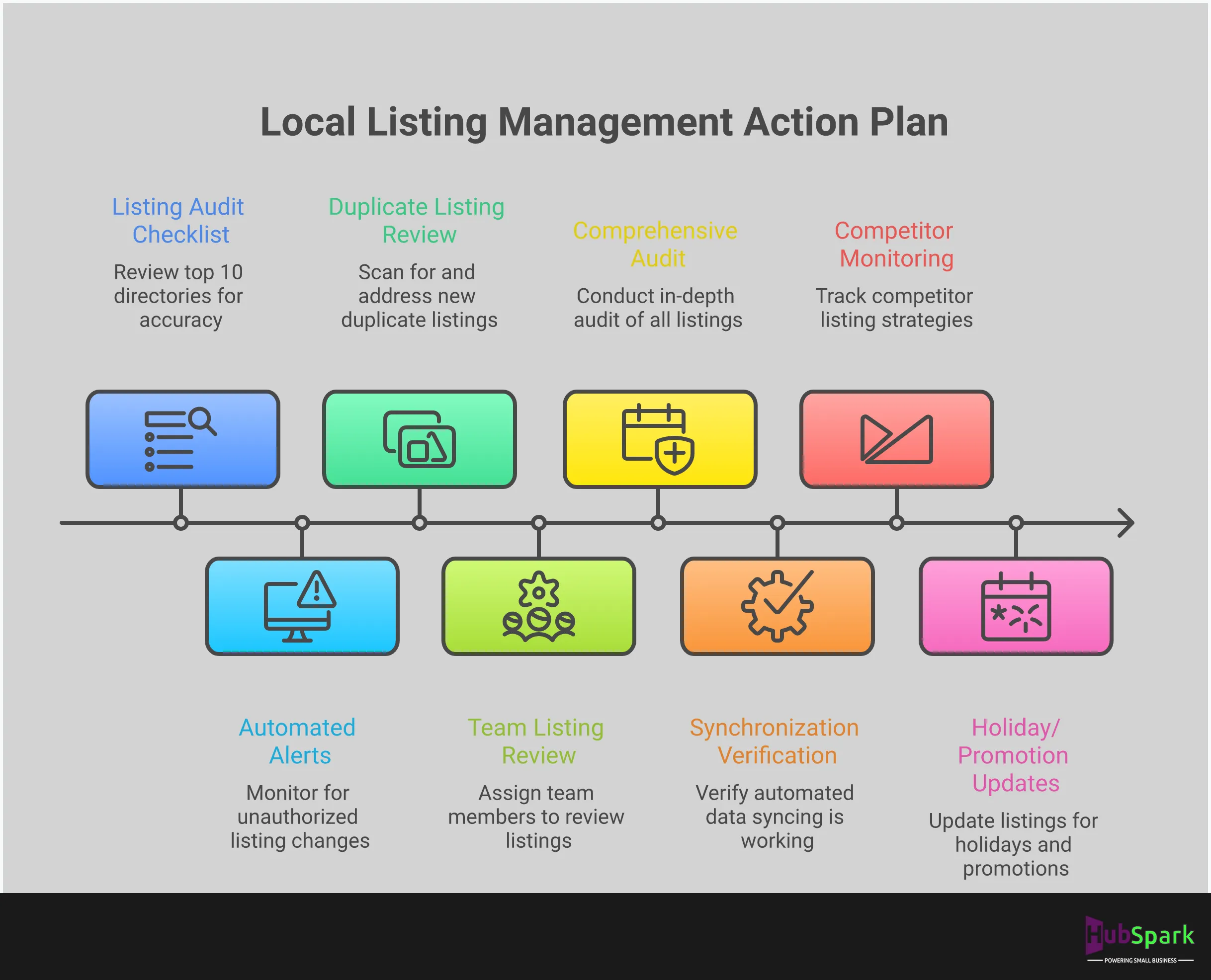
Selecting a tool is only the first step. A successful listing management strategy requires a clear execution plan to transform that tool into a customer-acquisition engine. Without a structured approach, even the most powerful software will fail to deliver results. The following three-step framework provides a direct path to centralizing your business information, eliminating inconsistencies, and establishing a dominant local presence. This is how you move from disorganized data to a streamlined system that drives measurable growth.
Audit Your Current Listing Status
Before you can fix your online presence, you must accurately diagnose its condition. Start by conducting a comprehensive audit of your existing business listings across all major directories, from Google and Yelp to industry-specific sites. Outdated or inconsistent listings quietly damage your local visibility, credibility, and customer trust. Search for discrepancies in your business name, address, and phone number (NAP), as well as incorrect operating hours, old photos, or broken website links. Keeping your listings fresh shows customers and search engines that your business is active and reliable. A robust tool can automate this audit, instantly identifying errors and duplicates that are costing you customers.
Choose Based on Your Specific Business Needs
Your audit will reveal the scope of the problem. The next step is to select a tool that directly solves it. For most small businesses, the primary need is efficiency. Manually updating dozens of individual listings is not a scalable or effective use of your time. The solution is a centralized platform that syncs your business information across every important directory from a single dashboard. This approach ensures consistent NAP data, allows for instant updates to hours or services, and removes harmful duplicate listings. By maintaining this consistency, you directly improve your local SEO for small businesses and make it easier for customers to find and contact you.
Establish Monitoring and Maintenance Schedules
Listing management is not a one-time task; it is an ongoing operational discipline. Failing to monitor your listings leads to missed business opportunities and can damage your company’s credibility. Competitors, data aggregators, or even well-meaning customers can suggest edits to your listings that introduce inaccuracies. Implement a recurring schedule, whether weekly or monthly, to review your listings for accuracy, update photos, and respond to new customer feedback. Integrating this process with your Reviews and Reputation Management Solutions creates a powerful feedback loop, turning customer engagement into a key part of maintaining a pristine and trustworthy online presence.
Related Articles
- Local Listing Management Software & Tools for Businesses | HubSpark
- 8 Top Business Listing Sites USA for Local SEO
Frequently Asked Questions
Why is having a consistent business name, address, and phone number (NAP) so important? Consistency in your NAP data is the foundation of trust for search engines and customers. When platforms like Google find the exact same information for your business across multiple credible directories, it confirms you are a legitimate, operational entity. This trust signal is a primary factor in how you rank in local search results. For customers, accurate information ensures they can find your location and contact you without frustration, which is the first step in any successful transaction.
Can’t I just manage my listings manually for free? While you can attempt to update listings manually, it is an inefficient and high-risk strategy. The time required to log into dozens of separate directories is substantial, and the potential for human error is high. A single typo can create a damaging inconsistency that confuses search engines and costs you customers. A centralized management tool eliminates these risks by automating the process, ensuring accuracy and freeing up your time to focus on running your business.
How quickly will I see my local search rankings improve after using a listing tool? Improving your local search ranking is a process, not an event. After correcting your listings, search engines need time to crawl and index the new, consistent information. While some positive changes can be seen relatively quickly, the most significant impact comes from maintaining that accuracy over time. Consistent, correct listings, combined with a strong reputation and positive reviews, build your authority and steadily improve your visibility in local search results.
My business has only one location. Do I still need a management tool? Yes, a management tool is critical regardless of how many locations you operate. Even a single-location business has its information scattered across dozens of online platforms, from major search engines to smaller, industry-specific directories. Any one of these listings can contain outdated or incorrect information that misleads customers. A management tool ensures your one location has a powerful, consistent, and accurate digital footprint everywhere customers are looking.
Beyond basic accuracy, what else should a listing management tool do for my business? A truly effective platform does more than just sync your address. It should integrate with other core business functions to give you a complete view of your local presence. Look for a tool that combines listing management with review and reputation management. This allows you to monitor customer feedback and respond directly from the same dashboard where you control your business information, creating a streamlined system for managing how customers find and perceive your brand.

I am a serial entrepreneur with a 20+ year background in marketing & advertising, with a specific focus on SEO/online/digital marketing. I have a passion for helping owners of small & medium sized businesses grow rapidly through organic search engine optimization & digital marketing. I am blessed to lead a team of some of the most hard working, brilliant, and passionate team to help all of our clients reach their revenue goals!
 App Today!