

Your local market is a battlefield, and your competitors are fighting for the same customers. If you aren’t tracking your performance with precision, you are already ceding ground. Winning requires more than just being online; it requires a strategic understanding of your position relative to your rivals. A local SEO report is your strategic weapon. It does more than just summarize your own activity; it provides the competitive intelligence needed to identify and exploit your competitors’ weaknesses. This guide explains how to structure a report that not only measures your progress but also gives you the insights to dominate your market.

Key Takeaways
- Connect SEO Performance Directly to Revenue: Eliminate vanity metrics and focus exclusively on data that proves financial impact. Your report must translate search rankings into tangible business outcomes like qualified leads, phone calls, and booked appointments.
- Design Reports to Drive Decisions, Not Just Display Data: Transform your report from a data summary into a strategic tool. Begin with a concise executive summary, use visuals to clarify trends, and always conclude with clear, actionable recommendations for the next period.
- Standardize Your Report Around Core Performance Indicators: Every report must consistently track the non-negotiable elements of local SEO: Google Business Profile actions, search visibility, citation accuracy, and reputation metrics. Automate this data collection to ensure accuracy and efficiency.
What Is a Local SEO Report?
A local SEO report is not just a collection of data; it is a critical business intelligence tool. It translates your marketing activities into a clear performance narrative, showing you precisely how your business gets found by local customers online. Think of it as the primary diagnostic for your online visibility. It moves beyond abstract metrics to answer the most important question: Is your marketing generating real-world results like phone calls, appointment bookings, and foot traffic? A well-structured report eliminates guesswork, providing a factual basis for strategic decisions and proving the return on your investment in local SEO. It transforms raw numbers into a story that shows what’s working, what isn’t, and where your next opportunity lies.
Define Its Purpose and Function
The fundamental purpose of a local SEO report is to measure the direct impact of your online presence on your business’s bottom line. Its function is to distill complex performance data into actionable insights. Instead of getting lost in vanity metrics like impressions, a proper report focuses on outcomes that drive revenue—more leads, more calls, and more customers walking through your door. It serves as your accountability partner, ensuring your marketing efforts are aligned with tangible growth goals. This document should clearly articulate your performance trajectory, highlighting successes to build on and pinpointing weaknesses that require immediate attention. It is the mechanism that connects your digital strategy to real-world business success.
The Core Components
An effective local SEO report is built on several core components that provide a complete picture of your performance. The foundation is Name, Address, and Phone (NAP) consistency across all online directories; inaccuracies here will undermine your credibility with search engines. The report must also track your visibility in local search results, including your ranking for critical keywords and your presence in the Google Map Pack. Furthermore, it should analyze customer actions, such as clicks to call, website visits, and requests for directions. Tracking these metrics requires the right tools, which is why a platform that integrates listings management with performance analytics is essential for accurate and efficient reporting.
Why Your Business Needs Local SEO Reports
Data is useless without interpretation. A local SEO report is the tool that translates raw performance data into a strategic roadmap for your business. It moves you from guessing what works to knowing exactly how your marketing efforts impact your bottom line. For any service business aiming to dominate its local market, these reports are not optional—they are the foundation of an intelligent growth strategy. They provide clear, undeniable answers to the most critical question: “Is my investment in local SEO actually generating more customers?”
Without consistent reporting, you are operating in the dark. You can’t identify what’s driving results, where your budget is being wasted, or how you stack up against the competition. A well-structured report illuminates the path forward, enabling you to make decisive, data-backed decisions that accelerate growth and maximize your return on investment. It is the ultimate accountability tool for your marketing. It separates professional operations from amateur efforts by creating a repeatable system for analysis and improvement. This systematic approach ensures that every marketing action is intentional and measured, turning your local search presence from a liability into a predictable engine for new business.
Measure Marketing ROI
Every dollar you spend on marketing must be justified. A local SEO report provides the evidence you need to connect your marketing activities directly to business results. It transforms abstract metrics like rankings and clicks into a clear story about revenue. Good reports show precisely how your improved online visibility leads to more phone calls, booked appointments, and paying customers. This isn’t just about feeling good about your marketing; it’s about proving its financial value. By tracking the right metrics, you can confidently allocate your budget to the strategies that deliver a tangible return and eliminate those that don’t.
Pinpoint Growth Opportunities
A strong local SEO report does more than just review past performance—it uncovers your next strategic move. By analyzing your data, you can identify exactly what you are doing well and where you can improve. The report might reveal that a specific service line is generating significant search traffic, indicating an opportunity to create more content around it. It can also show you how you rank compared to other local businesses, exposing gaps in your competitors’ strategies that you can exploit. This insight allows you to stop wasting resources on ineffective tactics and instead focus your efforts where they will have the greatest impact on your growth.
Establish Trust and Transparency
Clear reporting builds confidence. Whether you are evaluating your own efforts, updating your team, or reporting to stakeholders, transparency is key. Clients and team members need clear proof that marketing investments are helping the business. A report demystifies the technical work of SEO by translating it into understandable outcomes. It explains why behind-the-scenes work is important, even if it doesn’t produce dramatic results immediately. This process builds trust and justifies the long-term nature of a successful SEO strategy, ensuring everyone understands the value being created and remains committed to the plan.
The Non-Negotiable Elements of a Local SEO Report
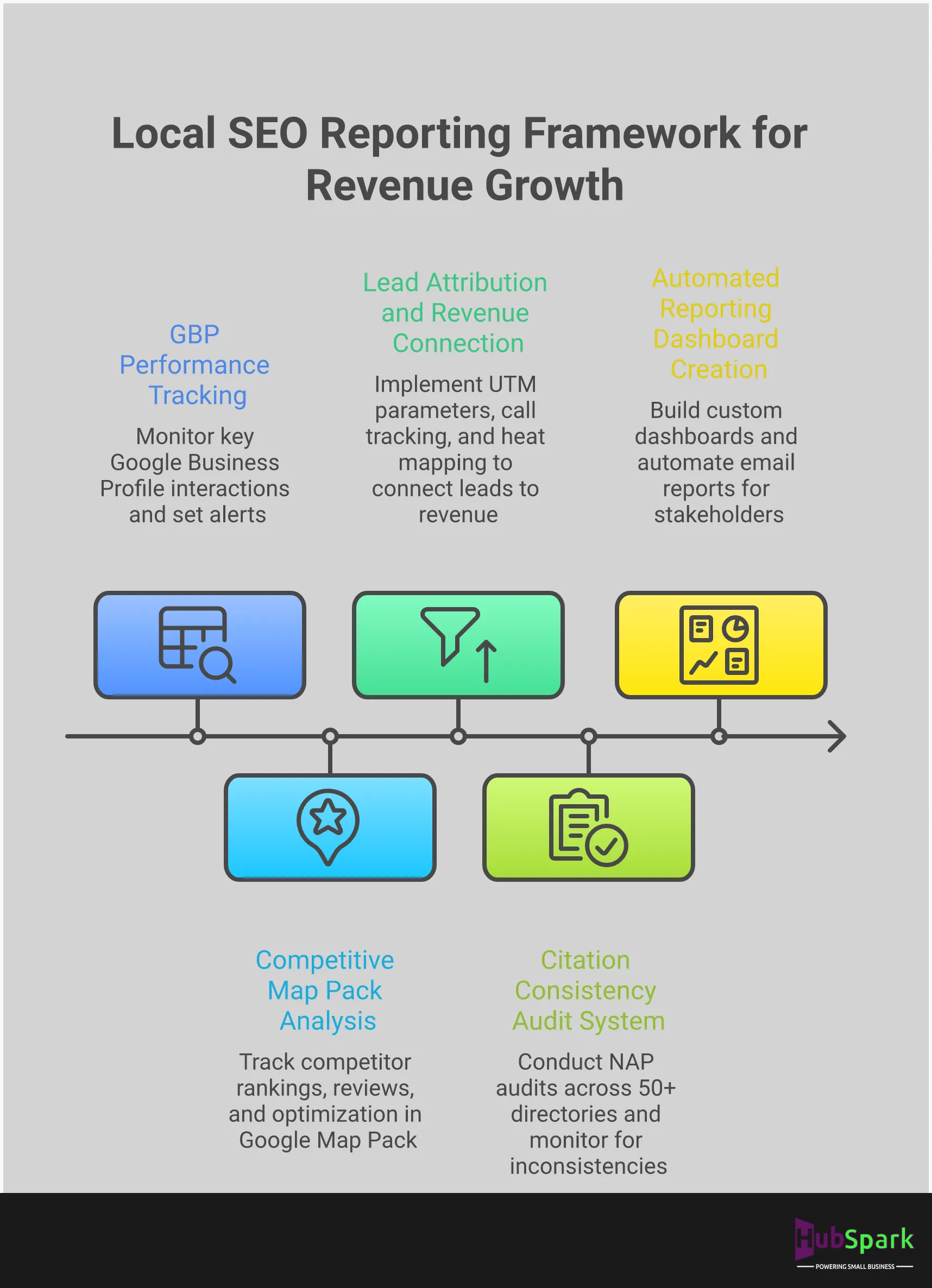
A report is only as valuable as the data it contains. To prove ROI and make strategic decisions, your local SEO report must include these six core components. Omitting any of them leaves you with an incomplete picture of your performance and misses critical opportunities for growth. These elements work together to show not just what is happening with your marketing, but why it’s happening and how it translates directly to your bottom line. A comprehensive report moves beyond vanity metrics and focuses on the data that drives real-world results, from phone calls to foot traffic.
Google Business Profile Performance
Your Google Business Profile is your digital storefront, and its performance is a direct measure of how local customers engage with your business online. Your report must track key GBP interactions, including how many people found you through Search versus Maps, and more importantly, what actions they took. Metrics like clicks to your website, requests for directions, and direct phone calls are not just numbers—they are leads. Analyzing this data shows exactly how your visibility on Google translates into tangible customer interest and provides a clear line from online presence to potential revenue. This is the frontline of your local SEO strategy.
Keyword Rankings and Search Visibility
Your report must show exactly how your SEO efforts help your business get found by local customers. Tracking keyword rankings is fundamental to this. Focus on the terms that your ideal customers use to find your services, such as “emergency HVAC repair in Dallas” or “best personal injury lawyer near me.” The report should detail your position for these core keywords in both traditional search results and the Google Map Pack, as this is where high-intent local customers make their decisions. Consistent monitoring of your search visibility confirms that your strategy is effective and that you are capturing critical market share from competitors.
Citation and Listing Accuracy
Inconsistent business information online erodes trust with both customers and search engines. Your report must include a section on citation and listing accuracy. This involves auditing your business’s Name, Address, and Phone number (NAP) across all major online directories to ensure it is identical everywhere. Discrepancies create confusion and harm your search rankings. A proper report will show the status of your key listings, identify any inaccuracies, and track the progress of cleanup efforts. HubSpark’s listings management solutions centralize this process, guaranteeing the consistency required to build a strong foundation for your local search authority.
Review and Reputation Metrics
Online reviews are non-negotiable for local businesses. With 86% of people using reviews to determine a business’s trustworthiness, your reputation directly impacts your revenue. Your SEO report must track key reputation metrics, including your average star rating, the total number of reviews, and the rate at which you are acquiring new ones. It should also measure your team’s response rate to new reviews, as engagement shows both customers and Google that you are an active, attentive business. Use a system for reviews and reputation management to streamline this process and turn customer feedback into a powerful marketing asset.
Website Traffic and Conversions
Ultimately, business owners care about real-world impact—phone calls, form submissions, and sales—not just numbers on a spreadsheet. Your report must connect your SEO performance to tangible business outcomes. This section should analyze organic traffic from local searchers and, more importantly, track conversion actions. Measure how many visitors completed a contact form, clicked to call from your website, or booked an appointment. By tracking these conversions, you can optimize your website lead management and assign a clear monetary value to your SEO campaigns. This is how you prove that your investment is generating a positive return.
Competitor Benchmarks
Your performance data is meaningless without context. To understand if you are winning, you must know how you stack up against the competition. Your report needs to include competitor benchmarks, comparing your key metrics against your top local rivals. Analyze their keyword rankings, review volume and ratings, and visibility in the Google Map Pack. This analysis reveals where you are ahead and where you are falling behind, highlighting strategic opportunities to capture more market share. Benchmarking transforms your report from a simple performance summary into a strategic tool for dominating your local market.
How to Structure a Report for Maximum Impact
A report is useless if it isn’t understood. The structure of your local SEO report determines whether it becomes a strategic tool or a document that collects dust. Effective reports eliminate confusion by turning raw data into a clear story about what’s working, what isn’t, and what to do next. The goal is to present information in a logical flow that starts with the big picture and drills down into the specifics that prove your return on investment. A well-structured report doesn’t just show numbers; it guides decisions and demonstrates progress toward your business objectives. This framework ensures that anyone, from your marketing team to your C-suite, can grasp the impact of your local SEO efforts instantly.
Start with an Executive Summary
Place the most critical information at the very beginning. Business owners are short on time, and an executive summary delivers the bottom line immediately. This section should be a concise, high-level overview of the reporting period’s performance. Highlight major achievements, such as a significant increase in leads or a top-three ranking for a high-value keyword. Also, identify any challenges or areas that require attention. Conclude with a clear statement on the overall health of your local SEO strategy and the key takeaways. Think of it as the 30-second version of the entire report—it should provide a complete picture on its own.
Design a Clear Performance Dashboard
Your report needs a central dashboard that presents the most important key performance indicators (KPIs) at a glance. This is not the place for granular data; it’s for the high-impact metrics that directly reflect business health. Use clean visuals to display trends in website traffic, lead volume, Google Business Profile actions, and overall search visibility. A well-designed dashboard acts as a visual scorecard, allowing you to quickly assess performance without digging through pages of data. This centralized view should connect directly to your primary goals, showing how your reviews and reputation management efforts are translating into tangible results.
Visualize Data for Clarity
Raw numbers in a spreadsheet are difficult to interpret. Use charts, graphs, and other visuals to make complex data digestible and reveal trends over time. A line graph can instantly show the growth of organic traffic from local search, while a bar chart can compare call volumes month-over-month. Visuals make it easier to spot patterns, successes, and potential issues. For example, a pie chart can break down your lead sources, showing exactly how many customers are coming from local map searches versus organic results. This approach transforms abstract data points into a compelling and easy-to-understand narrative of your performance.
Connect Data to Business Goals
Every metric in your report must answer the question: “How does this affect the bottom line?” Vanity metrics like impressions are secondary to the data that matters—phone calls, form submissions, and booked appointments. Your report must explicitly link online activity to real-world business outcomes. Show how improved keyword rankings led to more clicks on your Phones and Calling button or how optimized location pages drove more requests for directions. This is how you prove ROI. By tying every piece of data back to revenue-generating activities, you demonstrate the direct financial impact of your local SEO investment.
The Critical Metrics to Track in Your Report
A report filled with data is useless. A report filled with the right data is a roadmap to growth. Your local SEO report must eliminate vanity metrics and focus exclusively on the numbers that directly impact your revenue. These are the metrics that show how your marketing efforts help your business get found by local customers online and convert them into paying clients. We will focus on four critical areas: visibility, engagement, leads, and traffic. Each one tells a part of the story, and together, they prove your return on investment. Forget spreadsheets cluttered with meaningless figures; these are the numbers that matter.
Search Visibility and Map Pack Rankings
Your report must answer one fundamental question: Are more local customers finding you? This is measured by your search visibility, specifically your position in Google’s Map Pack. For a local business, the Map Pack is prime real estate. It’s the block of three businesses shown below the map in a local search result, and it’s where the most qualified customers look first. Your report should track your ranking for core keywords in your service area. Even a small improvement in local search ranking can have a significant effect on a local business. Centralize your local SEO efforts to dominate these critical search results and ensure your business is the first one customers see.
Customer Engagement Metrics
Visibility is only the first step. The next is engagement. This metric shows how customers interact with your online listings once they find you. Key engagement signals include clicks to your website, requests for directions, and messages sent through your Google Business Profile. Most importantly, track your reviews. Since 86% of people say online reviews help them decide if they trust a business, this is a non-negotiable metric. A steady stream of positive reviews directly correlates with higher trust and more conversions. Your report must show the volume, velocity, and average rating of your reviews to demonstrate how you are building a trustworthy reputation management system.
Lead and Conversion Performance
This is where you connect SEO performance to revenue. Business owners care most about real-world impact, like phone calls, form submissions, and sales—not just numbers on a spreadsheet. Your report must translate rankings and clicks into tangible leads. Track how many quote requests, contact form fills, and appointment bookings originate from your local search channels. This requires a system to optimize website lead management and attribute every new customer to the marketing activity that generated them. This is the ultimate proof of ROI, demonstrating precisely how your local SEO strategy is filling your sales pipeline and accelerating business growth.
Call and Foot Traffic Data
For many service-based businesses, a phone call is the most valuable type of lead. Your report must include call tracking data from your Google Business Profile and other local listings. This shows exactly how many potential customers are picking up the phone because of your online visibility. If you have a physical location, tracking requests for driving directions is a direct indicator of foot traffic and purchase intent. These metrics represent high-intent customers who are past the research phase and are ready to take action. Integrating your business phone system with your reporting allows you to capture this critical data and prove the immediate value of your local marketing.
How to Present Report Insights Effectively
A report full of data is just noise. A report that drives action is a strategic asset. The difference lies in how you present the information. Effective reporting isn’t about showing every metric you can find; it’s about telling a clear story that connects marketing efforts to business results. Your report must answer the fundamental question every business owner has: “Is this working?”
To make your local SEO report a powerful tool, you must translate complex data into a clear narrative. This means ditching the technical jargon, focusing on the metrics that directly impact your bottom line, and providing a clear path forward. The goal is to transform raw numbers into strategic decisions that accelerate growth. By presenting insights effectively, you build trust, demonstrate value, and create a clear roadmap for dominating your local market.
Translate Technical Data into Plain English
Stop using industry jargon that obscures your results. Your team or clients don’t care about “SERP volatility” or “domain authority.” They care about getting more customers. Explain your SEO results using simple language that connects directly to business operations. Instead of discussing keyword ranking fluctuations, talk about how many more people can find your business on Google Maps for “emergency plumber near me.” Frame your local SEO efforts in terms of real-world outcomes, like an increase in phone calls or appointment bookings. This approach makes the value of your work immediately obvious to anyone, regardless of their technical expertise.
Focus on Bottom-Line Impact
Vanity metrics don’t pay the bills. While a #1 ranking is great, it’s meaningless if it doesn’t lead to new business. Your reports must prioritize the metrics that have a tangible impact on revenue. Connect every piece of data back to a key performance indicator (KPI) that matters to the business, such as qualified leads, phone calls, in-store visits, or completed sales. For example, show how improved visibility in the Google Map Pack led to a 20% increase in calls through your Google Business Profile. This focus on bottom-line results proves your ROI and shifts the conversation from marketing activities to business growth and payment solutions.
Provide Actionable Recommendations
A report should be a catalyst for action, not a historical document. After presenting the data, you must outline clear, specific next steps. If the report shows a decline in online reviews, the recommendation is to launch a targeted SMS campaign to solicit feedback from recent customers. If a competitor is outranking you for a key service, the action is to build out a new location page targeting that term. Each recommendation should be a direct response to the data presented. This demonstrates strategic thinking and turns your report into a forward-looking plan for improving your reputation management.
Preempt Common Questions
Structure your report to tell a compelling story about your progress. A good narrative anticipates and answers questions before they are even asked. Start with a high-level summary of wins and challenges, then drill down into the data that supports your story. If there was a seasonal dip in traffic, address it proactively with data and explain your plan to recover. By turning numbers into a clear story, you show what’s working, what needs to change, and why. This builds confidence and establishes you as a strategic partner who understands the complete customer relationship.
Tools to Create Professional Local SEO Reports
Manually pulling data from a dozen different sources is inefficient and prone to error. The right tools automate data collection, ensuring your reports are built on accurate, up-to-date information. Your choice of software will depend on your budget and the level of detail required, but the goal remains the same: to create a professional report that clearly demonstrates value without wasting your time.
Free Reporting Options
When operating on a lean budget, free tools provide essential insights without the financial commitment. You can use a Local Rank Checker to monitor your visibility on Google or a free SEO audit tool to analyze your website for improvements. While these are excellent for spot-checking specific metrics, they lack the ability to consolidate data into a single, comprehensive report. This forces you to piece together the narrative yourself, which consumes valuable time.
Premium Local SEO Software
As your business grows, investing in premium software becomes necessary. Dedicated platforms offer comprehensive suites of local SEO tools to optimize your online presence, track detailed analytics, and generate professional reports. These systems gather in-depth data on everything from keyword performance to citation consistency, allowing you to demonstrate ROI with precision. However, these tools often operate in a silo, representing another subscription and another dashboard to manage. They show marketing performance but struggle to connect it directly to closed deals without manual effort.
HubSpark’s Integrated Reporting Features
The fundamental problem with separate reporting tools is data fragmentation. You are still left piecing together information from different sources to understand the full story. HubSpark eliminates this operational bottleneck. Our platform integrates all critical business functions into a single dashboard, making reporting seamless. Your local SEO performance is tracked directly alongside customer communications, online reviews, and payment history. This allows you to instantly see how improved search visibility translates into actual revenue—without exporting a single spreadsheet. This centralized approach provides a direct line of sight from marketing activity to bottom-line growth.
Establish Your Reporting Cadence
A local SEO strategy without a consistent reporting schedule is like driving without a map. You are moving, but you have no way to confirm you are heading toward your destination. Establishing a reporting cadence is not an administrative task; it is a strategic imperative. The right frequency ensures you have the data to make tactical adjustments while keeping your eyes on long-term growth. It transforms raw data into a predictable system for measuring progress and proving return on investment.
The optimal cadence depends on your business objectives, the speed of your market, and how you need to communicate results. For most businesses, a combination of monthly and quarterly reports provides the ideal balance between granular performance tracking and high-level strategic review. This rhythm allows you to react to immediate opportunities and threats without losing sight of your overarching goals. With an integrated platform like HubSpark, generating these reports ceases to be a manual chore and becomes a streamlined part of your operational workflow, delivering critical insights on a reliable schedule.
Monthly Reports for Performance Tracking
Monthly reports are your tactical check-ins. They are essential for tracking performance and demonstrating the immediate impact of your local SEO efforts. Think of this report as the pulse of your marketing. It provides a snapshot of key metrics, allowing you to make data-driven decisions and course-correct quickly. Each month, you should analyze short-term changes in keyword rankings, Google Business Profile interactions like calls and direction requests, website traffic from local search, and the volume and sentiment of new customer reviews. This frequent analysis ensures you can capitalize on what’s working and address underperforming areas before they become significant problems.
Quarterly Reports for Strategic Planning
If monthly reports are the pulse, quarterly reports are the comprehensive physical. These reports are vital for strategic planning, as they allow you to assess the effectiveness of your long-term SEO strategies. Here, you zoom out from the week-to-week fluctuations to identify meaningful trends. Analyze performance over the 90-day period to see how your efforts are impacting lead generation, customer acquisition, and revenue. This is the time to evaluate your overall reputation management trends, compare your growth against competitor benchmarks, and confirm that your strategy aligns with your primary business goals. Use these insights to refine your plan for the upcoming quarter.
Custom Schedules for Unique Business Needs
While monthly and quarterly cadences work for most, every business has unique needs. A rigid reporting schedule may not serve a company launching a new service or a business with high seasonality, like an HVAC contractor. In these cases, a custom schedule provides the necessary flexibility. You might require bi-weekly reports during a major marketing campaign or shift to a lighter schedule during your slow season. The key is to align the reporting frequency with your operational tempo and decision-making needs. The goal is not just to produce reports but to deliver actionable intelligence precisely when it can have the greatest impact on your business.
Critical Reporting Mistakes to Avoid
An effective local SEO report is as much about what you exclude as what you include. A report that is unfocused or misaligned with business objectives is not just unhelpful—it’s a liability. It wastes time, obscures real performance, and can lead to poor strategic decisions. To ensure your reports drive growth instead of confusion, you must avoid several common but critical errors. These mistakes dilute the value of your data and prevent you from seeing a clear picture of your return on investment. By steering clear of these pitfalls, you transform your report from a simple data dump into a powerful tool for strategic decision-making.
Overloading with Irrelevant Data
Your local SEO report should be a strategic document, not a data encyclopedia. Including every possible metric, from server response times to every single keyword variation, creates noise that drowns out what truly matters. Many businesses get lost in technical details and forget that the primary goal is to connect with customers. Your report must be streamlined to focus on the data that directly impacts your business operations and revenue. Eliminate vanity metrics and technical jargon. Instead, concentrate on the information that answers the most important question: Is our local SEO strategy attracting more customers and growing the business?
Prioritizing Rankings Over Revenue
Achieving a top ranking on Google is a means to an end, not the end itself. The ultimate goal of any marketing effort is to generate revenue. A report that celebrates a #1 ranking for a keyword that drives zero phone calls or form fills is a report focused on the wrong outcome. Your clients and stakeholders care about real-world impact—more appointments, increased foot traffic, and higher sales. A successful report must directly connect SEO performance to these bottom-line results. Use tools that provide clear call and conversion tracking to prove that your search visibility is translating into tangible business growth.
Ignoring Market and Seasonal Trends
Your business does not operate in a vacuum, and neither does your SEO performance. A sudden dip in website traffic might seem alarming until you realize it aligns with a predictable seasonal slowdown for your industry. Failing to account for market dynamics and seasonality leads to misinterpretation of data and flawed strategies. An HVAC company will naturally see different search trends in July than in January. Your reports must provide this context. Analyze performance against historical data and industry benchmarks to distinguish between a strategic failure and a normal market fluctuation. This context is essential for making informed decisions.
Lacking Clear Goals and Context
Data without a narrative is just a collection of numbers. An effective report tells a clear story about what’s working, what isn’t, and what to do next. This is impossible without first establishing clear business goals. Before you track a single metric, define what success looks like. Is the goal to increase appointment bookings by 20%? Or to drive more traffic to a specific high-value service page? Every metric in your report should serve to measure progress against these predefined objectives. This approach turns your report into an actionable roadmap, providing the insights needed to refine your local SEO strategy and accelerate growth.
Define Your Local SEO Reporting Strategy
A reporting strategy is not an afterthought; it is the blueprint for measuring success. Without a defined approach, you are simply collecting data instead of generating intelligence. An effective strategy transforms raw numbers into a clear story that demonstrates what is working, what needs to be fixed, and where your next opportunity lies. It ensures that every marketing action is tied directly to a measurable business outcome. This is how you move from guessing to knowing.
Your strategy must be built on three pillars: automation, standardization, and benchmarking. Automation eliminates manual effort and errors, freeing you to focus on analysis. Standardization through templates ensures consistency and professionalism, making your performance easy to track over time. Finally, establishing performance benchmarks gives your data context, connecting abstract metrics like rankings to tangible results like phone calls and revenue. A disciplined reporting strategy is the foundation for accelerating growth and proving the return on your investment in local SEO.
Automate Your Reporting System
Manual reporting is a critical bottleneck that consumes valuable time and invites human error. Automate your reporting system to reclaim those hours and ensure data accuracy. An automated platform centralizes information from Google Business Profile, your website analytics, and call tracking into a single, cohesive dashboard. This eliminates the tedious task of logging into multiple accounts and manually compiling spreadsheets. Instead of spending your time on data entry, you can immediately begin analyzing performance and making strategic decisions. This efficiency is essential for any business serious about scaling its local marketing efforts and managing its online reputation effectively.
Create Client-Specific Templates
One-size-fits-all reports fail because they don’t address specific business objectives. Create standardized templates to deliver consistent, professional, and relevant reports every time. A template ensures you are always tracking the same core metrics, which provides a clear view of progress month over month. More importantly, it allows you to focus the report on what matters most to your bottom line. For an HVAC company, that might be emergency call leads. For a law firm, it’s consultation bookings. Templates enforce discipline and keep the report centered on the key performance indicators that directly impact your business goals, such as securing more appointments through your management software.
Establish Performance Benchmarks
Data without context is meaningless. You must establish performance benchmarks to understand what your metrics are actually telling you. Benchmarks turn numbers into a narrative of progress. Instead of just reporting that you received 50 phone calls, a benchmarked report shows this is a 20% increase from last month and 15% above your quarterly goal. Business owners care about real-world impact—more calls, increased foot traffic, and higher sales—not abstract rankings. Good reports connect every metric back to these bottom-line results, proving how your local SEO work is directly contributing to finding more customers and generating revenue.
Related Articles
- Why Local SEO Is So Important – HubSpark
- Local SEO Benefits: Boost Visibility & Trust for Your Business | HubSpark
Frequently Asked Questions
How often should I review my local SEO report? You should establish a consistent rhythm for reviewing your reports. A monthly check-in is ideal for tracking performance and making tactical adjustments, like responding to a sudden dip in calls or a surge in competitor reviews. A deeper, quarterly review is necessary for strategic planning. This is when you analyze long-term trends to confirm your overall strategy is generating a return and to set goals for the next 90 days.
My report shows high rankings, but I’m not getting more customers. Why? This is a classic case of focusing on the wrong metric. A high ranking is only valuable if it leads to revenue. Your report must connect that visibility to actual business outcomes like phone calls, form submissions, or appointment bookings. If your phone isn’t ringing, it could mean you’re ranking for keywords that don’t attract paying customers, or that your Google Business Profile and website aren’t effectively converting visitors into leads.
What’s the difference between a local SEO report and my Google Analytics report? While both are important, they serve different functions. Google Analytics gives you a broad view of all your website traffic from various sources. A local SEO report is highly specialized; its purpose is to measure how effectively you are attracting and converting customers in your specific service area. It focuses on metrics directly tied to local search, such as your Google Map Pack visibility, customer actions on your Google Business Profile, and the accuracy of your business listings across the web.
If I can only track one thing in my report, what should it be? Focus on your lead and conversion performance. While rankings and traffic are important indicators, leads are the metric that directly translates to revenue. Track the number of qualified phone calls, contact form submissions, and appointment bookings that originate from your local search efforts. This is the ultimate proof that your investment is working and provides the clearest picture of your marketing ROI.
Do I really need special software to create these reports? While you can manually gather data from free tools, it’s an inefficient process that is prone to error. Using dedicated software is a necessity for any serious business. The most effective approach is an integrated platform like HubSpark, which eliminates the need to piece together data from multiple sources. When your SEO performance is tracked in the same system as your customer communications and sales, you get a direct, undeniable line of sight from marketing activity to actual revenue.

I am a serial entrepreneur with a 20+ year background in marketing & advertising, with a specific focus on SEO/online/digital marketing. I have a passion for helping owners of small & medium sized businesses grow rapidly through organic search engine optimization & digital marketing. I am blessed to lead a team of some of the most hard working, brilliant, and passionate team to help all of our clients reach their revenue goals!
 App Today!