

Your competitors are actively taking customers that should be yours. They achieve this not through bigger budgets or better equipment, but by systematically dominating local search results. Every time a potential client in your service area searches for a solution and finds a competitor first, you lose revenue. This is a battle for visibility, and failing to engage is a direct path to stagnation. Local SEO is the strategic framework for reclaiming your market share and establishing your business as the primary authority in your area. This article is the operational playbook for outmaneuvering the competition, providing a clear path to ensure your business captures the high-intent leads you are currently missing. Winning in your market requires a superior approach to local SEO services for small business.

Key Takeaways
- Master the Core Components for Market Dominance: Your local visibility depends on three critical pillars: an optimized Google Business Profile, consistent business information (NAP) across all platforms, and a systematic approach to generating and managing online reviews.
- Measure What Matters: Leads and Revenue: Stop chasing vanity metrics like rankings. The true measure of local SEO success is its direct impact on your bottom line—track phone calls, form submissions, and new customer acquisitions to calculate a clear ROI.
- Unify Your Strategy for Total Control: Eliminate the chaos of disconnected tools. Centralizing your local SEO efforts on a single platform ensures data accuracy, streamlines lead management, and provides a direct line of sight from initial search to final sale.
What is Local SEO and Why Does It Matter?
Local Search Engine Optimization (SEO) is the process of making your business more visible in local search results on Google. For service-based businesses like HVAC, plumbing, or roofing, local SEO is not just a marketing strategy—it is a fundamental business requirement. When a homeowner’s air conditioner fails or a pipe bursts, they search for immediate, local help. If your business doesn’t appear in those search results, you are invisible to your most valuable customers. Effective local SEO ensures that when potential customers search for your services, your business is the one they find—and the one they call.
Local SEO vs. Traditional SEO: What’s the Difference?
Traditional SEO aims to attract a national or global audience. Local SEO is different; it focuses on optimizing your online presence to dominate search results within a specific geographic area. For a local contractor, ranking for “plumbing services” in another state is a wasted effort. You need to rank for “plumber near me” or “emergency HVAC repair in [Your City].” The metrics for success also differ. While traditional SEO might track broad website traffic, local SEO prioritizes tangible actions like phone calls, direction requests, and messages. These are the high-value conversions that directly translate into appointments and revenue for your service business.
Why Local Search Is Non-Negotiable for Growth
Failing to invest in local search is a direct path to stagnation. Your competitors are already using it to capture customers you could be serving. The growth of your business depends on a steady stream of local leads, and search engines are the primary source. Your Google Business Profile is a critical asset, and effective listings management offers a direct view into how customers find and interact with your business. Tracking metrics like how many people called you directly from your profile provides undeniable proof of your local visibility. Strong local search performance is essential for building a predictable pipeline of new customers and achieving sustainable growth.
Capturing High-Intent Local Customers
Local search connects you with customers at the precise moment they need you. These are not passive browsers; they are people with urgent problems who are actively seeking a solution. A search for “emergency roofer” indicates a high-intent customer who is ready to hire immediately. Your goal is to ensure your business appears at the top of those results. By focusing on metrics that matter—like inbound phone calls from your local SEO efforts—you directly measure your success in capturing these valuable leads. This is the most efficient method of customer acquisition, eliminating guesswork by targeting individuals who are ready to hire.
Defining the Core Components of Local SEO
To dominate local search, you must master its core components. These are not optional tactics; they are the foundational pillars that determine whether a potential customer finds you or your competitor. Effective local SEO for small businesses is a system, and each part must function correctly for the whole to produce results. Neglecting even one of these areas creates a weakness that competitors will exploit.
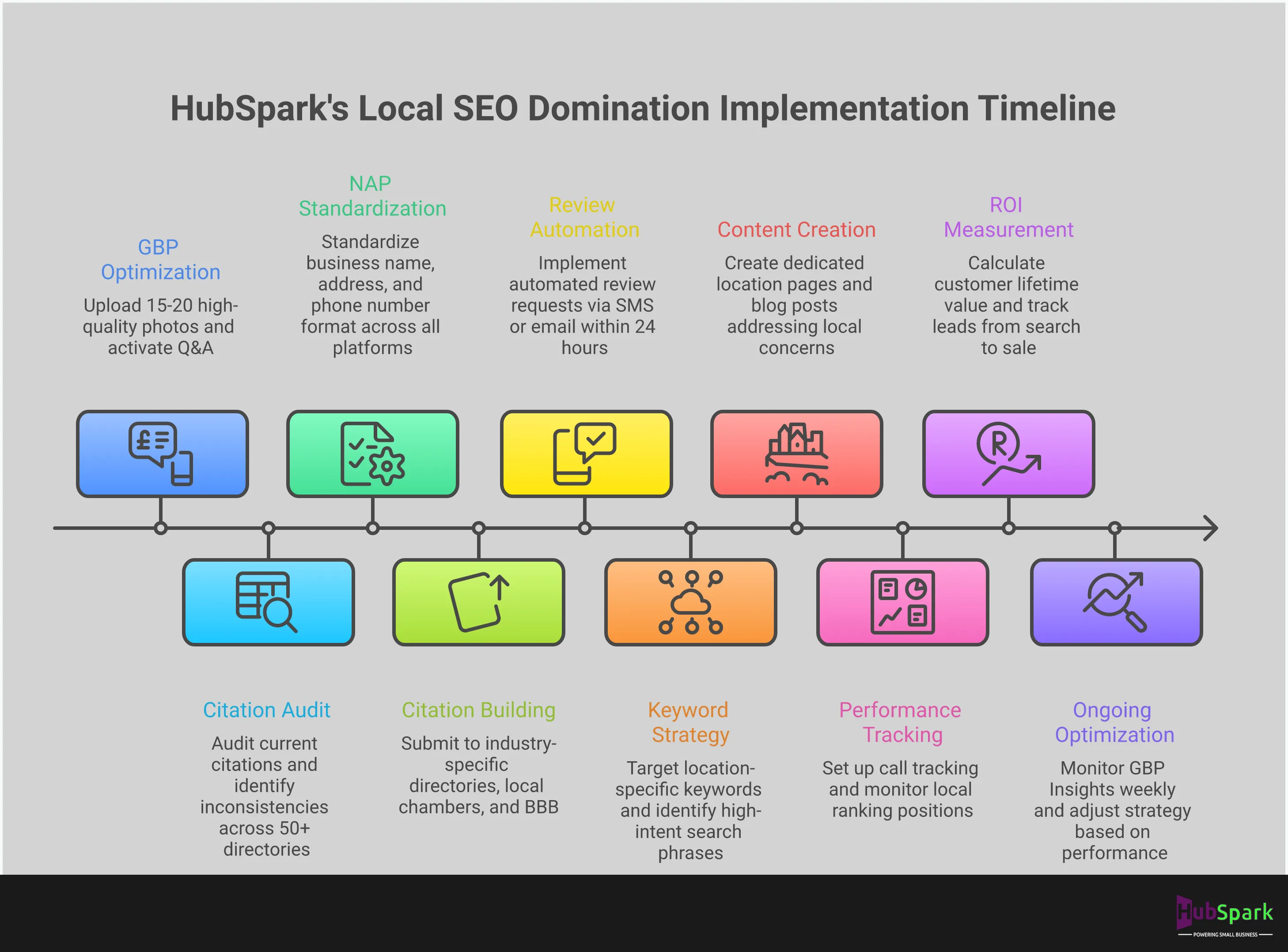
The five critical components are Google Business Profile optimization, a targeted local keyword and content strategy, consistent citation and NAP management, proactive online review management, and strategic local link building. Each one sends a distinct signal to search engines about your business’s relevance, prominence, and authority within your specific service area. Mastering these elements is the only way to build a durable competitive advantage and ensure a steady stream of high-intent local customers. We will break down each component so you can execute with precision.
Google Business Profile Optimization
Your Google Business Profile (GBP) is your most valuable asset in local search. It is the digital storefront that customers see first, and its optimization is non-negotiable. A complete and accurate profile is the bare minimum. To win, you must treat it as a dynamic marketing channel. This means uploading high-quality photos and videos regularly, publishing weekly posts with updates and offers, and activating features like Q&A and Messaging. The data from your GBP Insights provides a direct window into how customers find you. A fully optimized profile signals to Google that you are an active, legitimate business worthy of a top spot in the local map pack.
Local Keyword and Content Strategy
To attract local customers, you must speak their language. This requires a content strategy built on relevant local keywords—the exact phrases people type when they need your services, like “emergency HVAC repair in Dallas” or “best plumber near me.” Your website’s service pages, blog posts, and dedicated location pages must be built around these terms. Your goal is to create content that directly answers the urgent questions of your local audience. A successful strategy doesn’t just chase rankings; it establishes your business as the most relevant and helpful solution in your service area, converting searchers into paying customers.
Citation Building and NAP Management
Search engines demand consistency. A citation is any online mention of your business’s Name, Address, and Phone number (NAP). Inconsistent NAP details across different directories and websites create confusion for search engines and erode trust, directly harming your rankings. Effective listings management involves auditing your existing citations, correcting inaccuracies, and building new ones on high-quality local and industry-specific directories. This meticulous process proves to Google that your business is established and located exactly where you claim to be, solidifying your geographic relevance and authority. Don’t let sloppy data cost you customers.
Online Review and Reputation Management
Your online reviews are a primary driver of both rankings and revenue. They serve as powerful social proof and are a significant factor in how Google assesses your business’s prominence. A passive approach to reviews is a losing strategy. You must implement a systematic process to request reviews from every satisfied customer. Equally important is responding professionally to all feedback, both positive and negative. Proactive reviews and reputation management demonstrates that you are an engaged and customer-focused business, building the trust that turns prospects into loyal clients and signals your market leadership to search engines.
Local Link Building and Outreach
Links from other reputable local websites are a powerful vote of confidence for your business. Local link building is the process of earning these endorsements from sources within your community, such as the local chamber of commerce, event sponsorships, neighborhood blogs, or other non-competing local businesses. For home service providers like plumbers and HVAC contractors, where trust is paramount, these local signals are especially critical. Each quality local link tells search engines that your business is a legitimate, respected, and integral part of the community, directly strengthening your authority and improving your ability to rank for competitive local search terms.
Budgeting for Local SEO: What to Expect
Investing in local SEO is not an expense; it is a direct investment in customer acquisition and market dominance. To budget effectively, you must first understand how agencies and consultants structure their pricing. The right model depends entirely on your business objectives, your current digital footprint, and the competitive landscape of your service area. Most pricing falls into two categories: ongoing monthly retainers for sustained growth or project-based fees for specific, one-time tasks. A clear understanding of these models will allow you to allocate resources efficiently and select a partner who can deliver a measurable return.
Understanding Monthly Retainer Models
A monthly retainer is the standard for any serious local SEO campaign. This model involves a fixed monthly fee for a continuous, comprehensive strategy that includes everything from content creation and citation management to performance tracking. For most businesses, effective SEO costs between $1,500 and $5,000 per month. Local service businesses, like HVAC companies or law firms, should expect to invest $2,000 to $4,000 per month to achieve significant results. This consistent investment allows your SEO partner to build momentum, adapt to algorithm changes, and systematically improve your visibility. It transforms your marketing from a series of isolated tasks into a cohesive growth engine that drives consistent local SEO for your small business.
When to Use Project-Based Pricing
Project-based pricing is best suited for isolated, well-defined tasks. This model is ideal for one-time fixes, such as a technical website audit to correct critical errors, a comprehensive cleanup of inconsistent business listings, or the initial setup and optimization of a Google Business Profile. While this approach can solve immediate problems, it is not a strategy for long-term growth. Think of it as a tactical repair, not a strategic overhaul. Once foundational issues are addressed, a sustained effort is required to outrank competitors and capture local market share. Project-based work can lay the groundwork, but a retainer model is what builds the skyscraper.
Key Factors That Determine Your Investment
Your local SEO investment is not arbitrary. The cost is directly influenced by several critical business factors. A reputable agency will analyze these variables to build a custom proposal. The price of SEO changes based on your business size, the complexity of your website, and the number of competitors you face online. Key determinants include your industry’s competitiveness, the number of physical locations or service areas you manage, and the current health of your online presence. Aggressive growth goals and a shorter timeline will naturally require a more significant investment. Centralizing your data with effective listings management solutions is a foundational step that can streamline these efforts, especially across multiple locations.
How to Select the Right Local SEO Partner
Choosing a local SEO partner is a critical decision that directly impacts your revenue and market position. The right partner functions as an extension of your operations, systematically driving qualified leads and measurable growth. The wrong one becomes a resource drain, delivering vanity metrics instead of actual customers. Your goal is to find a provider who understands the operational realities of a service-based business and can execute a strategy that aligns with your objectives.
This requires a structured evaluation process. You are not just buying a service; you are investing in a strategic asset. Whether you partner with a specialized agency, a freelancer, or implement a powerful platform like HubSpark, your vetting process must be rigorous. The following steps will help you cut through the noise, identify competent partners, and avoid costly mistakes. Treat this process with the same diligence you would apply to hiring a key employee.
Critical Questions to Ask Any Agency
Before signing any contract, demand clear answers to these fundamental questions. Vague responses are a clear indicator of an inexperienced or ineffective agency.
- What is your strategy for my specific industry? A generic SEO plan is useless. A competent partner will outline a strategy tailored to your business, whether you’re a plumber, roofer, or lawyer. They should be able to discuss local keyword intent, service area targeting, and competitor analysis relevant to your market.
- How do you measure and report on success? Insist on seeing sample reports. The metrics should focus on business outcomes—leads, phone calls, and appointment bookings—not just traffic and rankings. Effective reviews and reputation management should also be a core component of their reporting.
- What are the exact deliverables and timeline? Get a precise list of what will be done each month and a realistic timeline for seeing initial results.
Red Flags That Signal a Bad Fit
Identify and eliminate subpar agencies quickly by watching for these unmistakable warning signs. Wasting time on unproductive discovery calls is a bottleneck you cannot afford.
- Guaranteed #1 Rankings: This is the most common sign of a fraudulent provider. No one can guarantee a specific Google ranking. Honest agencies focus on proven strategies and transparent reporting, not impossible promises.
- Unrealistically Low Prices: Effective local SEO is labor-intensive and requires expertise. A price point under $1,000 per month is a major red flag, often indicating the work is outsourced to low-quality content farms or relies on automated, ineffective tactics.
- Lack of Transparency: If an agency is secretive about their methods or refuses to provide clear, data-driven reports, walk away. A true partner operates with full transparency, giving you access to your data and explaining their strategy in clear terms.
How to Vet an Agency’s Expertise and Results
Once a potential partner has passed the initial screening, you must verify their expertise and track record. Do not rely on their sales pitch alone; demand concrete proof of their capabilities.
Start by requesting case studies from businesses similar to yours. An agency that has successfully executed local SEO for small businesses in the home services sector will have a significant advantage in understanding your operational needs and customer acquisition funnels. Review their client list and check their clients’ online presence. Do their clients rank well for relevant local terms? Is their Google Business Profile optimized and active? This real-world evidence is far more valuable than any proposal. Finally, confirm they have a deep understanding of the entire local search ecosystem, from citation management to building effective location pages.
Measuring Success: What Results to Expect from Local SEO
Investing in local SEO is a strategic business decision, not a shot in the dark. Success isn’t measured by vague metrics or gut feelings; it’s defined by tangible outcomes that directly impact your bottom line. To effectively manage your strategy, you must move beyond simply “doing SEO” and start measuring its direct contribution to your growth. This means tracking specific key performance indicators (KPIs) that show how your online visibility translates into new customers and increased revenue.
The goal is to create a clear line of sight from your optimization efforts to your bank account. Are you getting more phone calls? Is foot traffic to your location increasing? Are more qualified leads coming through your website? These are the questions that matter. By focusing on the right metrics, you can accurately assess the performance of your local SEO strategy and make informed decisions to accelerate your results. A data-driven approach eliminates guesswork and ensures your marketing dollars are working as hard as you do.
A Realistic Timeline for Tangible Results
Local SEO is a long-term strategy, not an overnight fix. Expect to see meaningful results within three to six months. In the initial phase, the focus is on foundational work: optimizing your Google Business Profile, cleaning up online citations, and refining your website. While these actions are critical, their impact isn’t immediate. Google’s algorithms need time to crawl, index, and validate these changes. After this initial period, you should begin to see measurable improvements in local search rankings, followed by an increase in website traffic, phone calls, and qualified leads. Patience is essential; consistent effort over several months is what builds sustainable local authority.
The KPIs That Actually Drive Business Growth
Forget vanity metrics like impressions. Focus on the KPIs that directly correlate with business growth. The most important metrics for measuring local SEO success are phone calls, form submissions, direction requests, and website clicks originating from your Google Business Profile. These actions represent high-intent customers actively seeking your services. You should also monitor your local search rankings for target keywords to gauge visibility. Finally, track the quantity and quality of new customer reviews, as they are a powerful indicator of both reputation and search performance. Effective reputation management is a core component of any successful local strategy.
Calculating Your Return on Investment (ROI)
To calculate your local SEO ROI, you must connect your marketing efforts to actual revenue. The first step is to track the source of every new lead. This requires a system to attribute calls, form fills, and walk-ins back to your local search presence. Once you know how many leads local SEO generates, determine your lead-to-customer conversion rate and the average lifetime value of a customer. With this data, you can assign a dollar value to your SEO results. A robust CRM for your business is essential for tracking this entire customer journey, from initial search to final sale, giving you a precise ROI calculation.
How to Track and Measure Local SEO Performance
Executing a local SEO strategy without measuring its performance is operating blind. To justify your investment and make intelligent decisions, you must track the right metrics. Effective measurement moves beyond vanity numbers like website traffic and focuses on data that directly impacts your bottom line: leads, calls, and paying customers. A successful local SEO campaign generates tangible business, and the only way to confirm this is through diligent tracking.
The key is to connect your marketing efforts to real-world outcomes. This requires monitoring four critical areas: how customers engage with your Google Business Profile, where you rank for valuable local keywords, what traffic sources generate leads, and how many of those leads become customers. By analyzing these key performance indicators (KPIs), you can identify what’s working, find opportunities for optimization, and calculate a clear return on your investment. Centralizing this data in a single dashboard eliminates the guesswork and provides a clear view of your growth engine.
Tracking Google Business Profile Engagement
Your Google Business Profile (GBP) is often the first interaction a local customer has with your business. Its performance insights are a direct window into how people find and engage with you. Stop guessing and start analyzing the data Google provides. Key metrics to monitor include how customers search for you (direct vs. discovery), the specific search queries they use, and the actions they take, such as website clicks, direction requests, and—most importantly—phone calls.
A spike in calls after updating your GBP services or adding new photos is a clear indicator of success. These are not just numbers; they represent high-intent customers actively seeking your services. Effective listings management solutions centralize this data, allowing you to see precisely how your profile drives leads without having to piece together reports from different sources.
Monitoring Local Search Rankings and Conversions
Tracking your rank for relevant local keywords is essential, but it’s only half the battle. A number one ranking is meaningless if it doesn’t convert into business. Your focus must be on monitoring your position for high-intent keywords—phrases like “emergency HVAC repair near me” or “best personal injury lawyer in [City]”—that qualified customers use when they are ready to buy. Observe your visibility in the Google Map Pack and the local organic results.
The ultimate goal is to turn those rankings into conversions. Are searchers who find you for a target keyword clicking through to your site and then calling your office or booking an appointment? This requires connecting your ranking data to your lead data. A comprehensive local SEO strategy ensures you are not just visible, but that your visibility translates directly into measurable business growth.
Analyzing Local Traffic and Lead Sources
To understand the effectiveness of your local SEO, you must know where your leads come from. Use analytics to segment your website traffic and identify which channels are performing best. Is your organic search traffic increasing month-over-month? Are you getting more direct traffic from people clicking the link in your Google Business Profile? Answering these questions allows you to double down on what works and refine underperforming channels.
Effective lead management means attributing every new prospect to its source. When a new lead comes in, you should know if it originated from a Google search, a local directory, or a social media profile. This clarity is critical for calculating ROI and making informed budget decisions. When you optimize website lead management, you create a system where every marketing dollar can be tracked from click to close.
Measuring Customer Acquisition from Local Search
The most important local SEO metric is customer acquisition. How many paying customers did your efforts generate? This is the bottom-line result that determines the success of your entire strategy. To measure this accurately, you must have a system in place to track leads from the initial search query all the way through to a paid invoice. This is where call tracking and a robust CRM become indispensable.
By assigning unique tracking numbers to your GBP, website, and other local listings, you can attribute every inbound call to its exact source. Integrating these leads into your CRM for business growth allows you to follow their journey from prospect to loyal customer. This closed-loop reporting provides undeniable proof of your SEO’s financial impact and empowers you to invest with confidence.
Overcoming Common Local SEO Challenges
Local SEO presents a clear path to customer acquisition, but it’s not without operational hurdles. Many business owners encounter the same set of challenges that can stall growth if left unaddressed. The key is not to avoid these problems but to implement a systematic approach to solve them. By confronting these issues head-on with the right strategy and tools, you can build a dominant local presence that consistently attracts high-intent customers. These are the most common obstacles and the direct methods to eliminate them.
Managing Multiple Locations or Service Areas
If your business operates in multiple cities or has several physical storefronts, you cannot treat them as a single entity online. Each location requires its own distinct local SEO strategy to attract customers in that specific area. The most effective approach is to create dedicated Location Pages on your website for every service area or physical address. Each page must feature unique content, including local landmarks, specific services offered, and customer testimonials from that area. This strategy tells search engines that you are a legitimate local authority in each market, preventing confusion and maximizing your visibility where it counts.
Competing with Larger, Established Businesses
Competing against national chains or long-standing local giants with massive marketing budgets can feel impossible. However, your advantage as a small business is your agility and deep community connection. Local SEO levels the playing field. Your target audience is often searching for immediate, reliable solutions, making a strong local presence critical. Double down on what larger companies cannot replicate: authentic local engagement and superior service. A robust reviews and reputation management strategy is your most powerful weapon here. Genuine, positive reviews from local customers build trust and authority that money can’t buy, allowing you to outmaneuver larger, less personal competitors in local search results.
Maintaining Data Consistency Across All Platforms
Inconsistent business information scattered across the internet is a major red flag for both search engines and potential customers. Discrepancies in your business name, address, or phone number (NAP) across directories like Google, Yelp, and industry-specific sites erode trust and severely damage your local search rankings. Manually tracking and updating every listing is inefficient and prone to error. The only viable solution is to centralize your data with a Listings Management tool. This ensures that your information is accurate and consistent everywhere online, establishing your business as a reliable and authoritative local entity. Don’t let simple data errors cost you customers.
Juggling Multiple Services Under One Profile
Many service-based businesses, like an HVAC company that also offers plumbing and electrical work, make the mistake of trying to be everything to everyone on a single Google Business Profile. This approach dilutes your SEO efforts and confuses your core message, making it difficult to rank for any specific service. Your primary GBP should be optimized for your main service category. For all other offerings, create distinct, highly-detailed service pages on your website. This allows you to optimize website lead management by directing users to pages that speak directly to their needs. This targeted approach clarifies your expertise to Google and ensures potential customers find exactly what they are looking for.
In-House vs. Agency: Making the Right Local SEO Decision
Deciding whether to manage local SEO internally or hire an agency is a critical operational choice. This isn’t just a marketing decision; it’s a question of resource allocation. The right path depends on your budget, your available time, and your team’s existing expertise. An agency brings specialized knowledge and established processes, while an in-house approach offers direct control and lower upfront costs. Neither path is inherently superior, but one will be a better fit for your business’s current stage and long-term growth objectives. To make the right call, you must conduct a realistic assessment of your internal capacity against the demands of a consistent and effective local SEO strategy. The goal is to choose the model that delivers the best return on your investment, whether that investment is time or money.
When to Manage Local SEO In-House
For small businesses with tight budgets, managing local SEO in-house can be a cost-effective solution. This approach puts you in direct control of your strategy, allowing you to make immediate adjustments based on performance and customer feedback. If you have more time than capital, taking on SEO yourself is a viable path. This requires a commitment to learning the fundamentals, from optimizing your Google Business Profile to building local citations. Using a centralized platform is essential to make this manageable. Tools that streamline local SEO for small businesses can consolidate your tasks, giving you the power to execute a professional strategy without the high cost of an agency retainer.
The Strategic Advantage of Hiring an Agency
Hiring an agency is an investment in expertise and efficiency. It provides immediate access to a team of specialists who live and breathe local search. These professionals already have the advanced tools, industry knowledge, and proven systems to implement effective strategies quickly, accelerating your results. This frees you and your team to focus on core business operations—serving customers and closing sales—instead of trying to keep up with constant algorithm changes. An agency brings a breadth of experience from working with numerous businesses, offering insights and strategies you might not discover on your own. For businesses ready to scale, delegating SEO to an expert partner is a powerful growth lever.
Evaluating the Resource Demands of DIY SEO
Managing local SEO in-house is not free; you pay with your time. This path requires a significant and ongoing commitment. You must be prepared to learn SEO best practices, consistently monitor performance metrics, and stay updated on Google’s algorithm changes. This work includes technical optimization, content creation, and active reviews and reputation management. For a busy owner, these tasks can become overwhelming and pull focus from revenue-generating activities. Before committing to a DIY approach, honestly evaluate if you have the dedicated hours required each week to execute it correctly. A poorly managed SEO strategy will fail to produce results and waste your most valuable asset.
Critical Local SEO Mistakes to Avoid
Executing a local SEO strategy requires precision. Minor errors can undermine your efforts, making your business invisible to the customers searching for your services right now. To dominate your local market, you must avoid the common operational mistakes that cause most businesses to fail. These errors aren’t just technical missteps; they are fundamental business problems that damage credibility, repel potential customers, and waste marketing dollars. By identifying and correcting these issues, you can build a powerful local presence that not only ranks well but also drives tangible growth. Focus on eliminating these four critical mistakes to ensure your investment in local SEO produces measurable results.
Inconsistent Business Information (NAP)
Inconsistent business details are the fastest way to erode trust with both search engines and customers. Your Name, Address, and Phone number (NAP) must be identical across every single online directory, social media profile, and website mention. Even a small variation, like “St.” versus “Street,” creates confusion and signals to Google that your data is unreliable, which directly harms your search rankings. This isn’t just an SEO issue; it’s a customer experience problem. A potential client who calls a wrong number or drives to an old address is a lost lead. Centralizing your business information with a listings management solution is the only way to guarantee accuracy and build the consistency required for high local visibility.
Neglecting the Mobile User Experience
The majority of local searches happen on a smartphone. If a customer lands on your website and can’t immediately find your phone number or book an appointment, they will leave and contact your competitor. A website that is slow to load, difficult to read, or hard to use on a mobile device is a liability. Your site must be designed for the on-the-go user who needs immediate answers. This means large, clickable buttons, simple navigation, and a prominent call-to-action. A seamless mobile experience is non-negotiable for converting search traffic into paying customers. Your goal is to optimize website lead management by removing every point of friction between a user’s search and their first contact with your business.
Ignoring Online Reviews and Reputation
Your online reviews are a direct reflection of your business and a primary factor in how customers and search engines perceive you. Ignoring them is not an option. Every review—positive or negative—is an opportunity to engage with your audience and demonstrate your commitment to customer service. Actively managing your online reputation builds social proof and credibility, which heavily influences both purchasing decisions and local search rankings. You need a systematic process for requesting feedback from satisfied clients and responding professionally to all comments. A strong portfolio of recent, positive reviews is one of the most powerful assets for local growth. Implement a reputation management system to control the narrative and turn customer feedback into a competitive advantage.
Chasing Rankings Instead of Conversions
Ranking number one for a keyword is a vanity metric if it doesn’t generate leads and revenue. The ultimate goal of local SEO is not just to attract traffic but to acquire customers. Many businesses make the mistake of targeting broad, high-volume keywords instead of focusing on search terms with clear commercial intent—the phrases customers use when they are ready to buy. Your entire strategy, from content creation to website design, should be engineered to drive action. This means clear calls-to-action, easy-to-use contact forms, and a simple process for booking appointments. Stop measuring success by your position in search results and start tracking what matters: phone calls, form submissions, and closed deals. Your SEO efforts must directly support your appointment management and sales pipeline.
Centralize Your Local SEO with HubSpark
Managing local SEO with a dozen different tools is inefficient. It creates data silos, complicates your workflow, and makes it impossible to see the full picture of your customer journey. Your local SEO strategy shouldn’t live in a separate silo; it should be the engine at the core of your operations. When you centralize your efforts, you transform SEO from a marketing task into a powerful business driver that directly impacts your bottom line.
HubSpark is designed to be the single operating system for your business, consolidating all the critical components of a successful local strategy. Instead of logging into separate platforms for reviews, business listings, and lead management, you can control everything from one dashboard. This integrated approach ensures your online presence is consistent, your customer interactions are seamless, and your marketing efforts are directly tied to revenue. With a unified platform, you can finally get a clear view of how local SEO for small businesses generates leads, appointments, and sales.
Integrate Local SEO into Your Business Operations
Effective local SEO isn’t just about rankings; it’s about turning visibility into tangible business results. Understanding and tracking essential local SEO metrics empowers you to make more informed decisions across your entire operation. When a customer calls you directly from your Google Business Profile, that interaction shouldn’t be a dead end. That lead needs to be captured, tracked, and nurtured.
HubSpark connects your local search performance directly to your daily workflow. A new review alert prompts an immediate response. A message from your listings flows into your unified inbox. A call from a potential customer is logged in your CRM. This integration provides a clear line of sight from initial search to final sale, proving the ROI of your efforts and improving the benefits of a CRM by populating it with high-intent leads.
Eliminate the Need for Disconnected SEO Tools
Most small businesses don’t need a suite of complex, dedicated SEO tools to succeed. The core requirements for local visibility—accurate listings, consistent reviews, and responsive communication—are straightforward. The challenge arises when you try to manage these functions with disconnected applications. Juggling multiple subscriptions and logins wastes time and increases the risk of inconsistent business information across the web, which can damage your rankings.
HubSpark eliminates this complexity by providing one platform to manage all your essential local marketing tasks. You can update your business hours across dozens of directories at once, respond to reviews as they come in, and manage leads from every channel. This streamlined approach not only saves you money on redundant software but also ensures your brand presence is accurate and professional everywhere. Centralizing your listings management solutions is the first step toward operational efficiency and dominating your local market.
Related Articles
- Why Local SEO Is So Important – HubSpark
- Local SEO Benefits: Boost Visibility & Trust for Your Business | HubSpark
Frequently Asked Questions
What is the single most important thing I can do for my local SEO today? Claim and completely optimize your Google Business Profile. This is your digital storefront and the most critical asset for local search visibility. A fully built-out profile, complete with accurate service categories, high-quality photos, and consistent business hours, is the foundation of any successful local strategy. Treat it as a non-negotiable first step before you invest time or resources anywhere else.
Why does local SEO take three to six months to show results? Local SEO is a strategic investment in building authority, not a short-term tactic. It takes time for search engines to recognize, index, and trust the changes you make. The initial months are spent building a solid foundation by correcting inconsistent data across the web, optimizing your website, and establishing a pattern of positive reviews. This consistent effort signals to Google that you are a legitimate and prominent local business, which leads to sustainable, long-term rankings.
Do I still need a website if I have a fully optimized Google Business Profile? Yes, a website is essential. Your Google Business Profile acts as the entry point, but your website is where you control the customer journey and convert leads. It allows you to build out detailed service and location pages that establish your expertise on topics your GBP cannot cover in depth. Your website is the central hub of your online presence, and your GBP is one of its most powerful channels for driving qualified traffic.
How can I get more customer reviews without annoying my clients? Implement a systematic, automated process for requesting feedback. The most effective method is to send a simple text or email request immediately after a service is completed, when the positive experience is still fresh in the customer’s mind. This removes the awkwardness of asking in person and makes it easy for them to leave a review with a single click. The key is consistency, not pressure.
My competitors dominate local search results. Is it too late for me to compete? It is never too late, but you must be more strategic. Your competitors’ dominance is likely the result of consistent effort over time, not a single tactic. You can close the gap by executing the fundamentals with greater precision. Focus on building a superior reputation through reviews, creating highly specific local content that they have overlooked, and ensuring your business data is perfectly consistent across all platforms. A focused, disciplined strategy will always find opportunities to outperform established competition.

I am a serial entrepreneur with a 20+ year background in marketing & advertising, with a specific focus on SEO/online/digital marketing. I have a passion for helping owners of small & medium sized businesses grow rapidly through organic search engine optimization & digital marketing. I am blessed to lead a team of some of the most hard working, brilliant, and passionate team to help all of our clients reach their revenue goals!
 App Today!