

An unmanaged Google Business Profile is a liability. It allows inaccurate information, negative reviews, and competitor actions to define your company online. Taking control of this asset is not just about marketing; it is about commanding your brand’s reputation where it matters most. The process of google business profile optimization is how you seize that control. It involves a systematic approach to managing your business information, customer reviews, and service details with absolute precision. This guide details the non-negotiable tactics you must execute to ensure your profile acts as a digital storefront, giving potential customers a clear and compelling reason to choose you.
Key Takeaways
- Build on a Foundation of Accuracy: Your profile must be built on a foundation of absolute precision. Claim your listing and ensure your business name, address, and phone number are 100% consistent across every online platform to establish trust with Google and customers.
- Maintain Your Profile with Active Management: A static profile is an invisible one. Consistently publish Google Posts, upload fresh photos, and systematically manage all customer reviews to signal ongoing relevance and dominate local search results.
- Integrate GBP into Your Central Operations: Connect your profile to a unified system like a CRM to transform it into a lead generation machine. This allows you to capture every lead, manage all communications, and control your reputation from a single dashboard.
What is Google Business Profile Optimization?
Google Business Profile (GBP) is a free tool that allows your business to appear on Google Search and Google Maps. Optimization is the process of enhancing your profile with complete, accurate, and engaging information to convert online searchers into new customers. For any service-based business, from HVAC contractors to law firms, optimizing your Google Business Profile is one of the most direct and impactful actions you can take to strengthen your local SEO. It is not an optional task; it is a fundamental requirement for competing in your local market.
This process involves more than just listing your business name and address. It requires a strategic approach to managing your business information, customer reviews, photos, and service details. Your objective is to provide Google with every piece of information it needs to confidently match your business with people actively searching for your services. A fully optimized profile acts as a digital storefront, giving potential customers a clear and compelling reason to choose you over the competition. Integrating this process into your daily operations ensures your business remains visible and relevant to the customers who matter most.
Why Your GBP Is a Critical Local Marketing Asset
Your Google Business Profile is your most valuable asset in local search. When customers search for services “near me,” Google displays local results directly on Maps and in the Search results. A complete and active profile significantly increases the likelihood that your business will appear in these prominent positions. This visibility is not just about being seen; it is about establishing credibility. A well-maintained GBP signals to potential customers that your business is legitimate, professional, and trustworthy.
Think of your profile as the first handshake with a new customer. It provides immediate answers to their most pressing questions: Are you open? What services do you offer? What do other customers say about you? Answering these questions effectively builds the confidence a customer needs to take the next step, whether that’s calling your business or booking an appointment. This is where effective reputation management becomes a critical part of your GBP strategy, turning positive customer experiences into powerful social proof.
The Direct Link Between GBP and Local Search Dominance
Google determines local search rankings based on three primary factors: relevance, distance, and prominence. Optimizing your GBP gives you direct control over these factors. Relevance is how well your profile matches a search query. Distance is how far your business is from the searcher. Prominence is how well-known your business is, based on factors like reviews, citations, and overall online presence. Your mission is to ensure your profile information is so complete and accurate that Google has no doubt about your relevance and prominence.
The more comprehensive your business information is, the better Google can understand and rank your business. This means meticulously filling out every applicable section of your profile, from service categories to business attributes. Consistency is also critical. The information on your GBP must match the information across all your other online directories. Using a tool for listings management eliminates inconsistencies and solidifies your authority with Google, creating a direct path to dominating local search results.
Set Up Your Google Business Profile for Maximum Impact
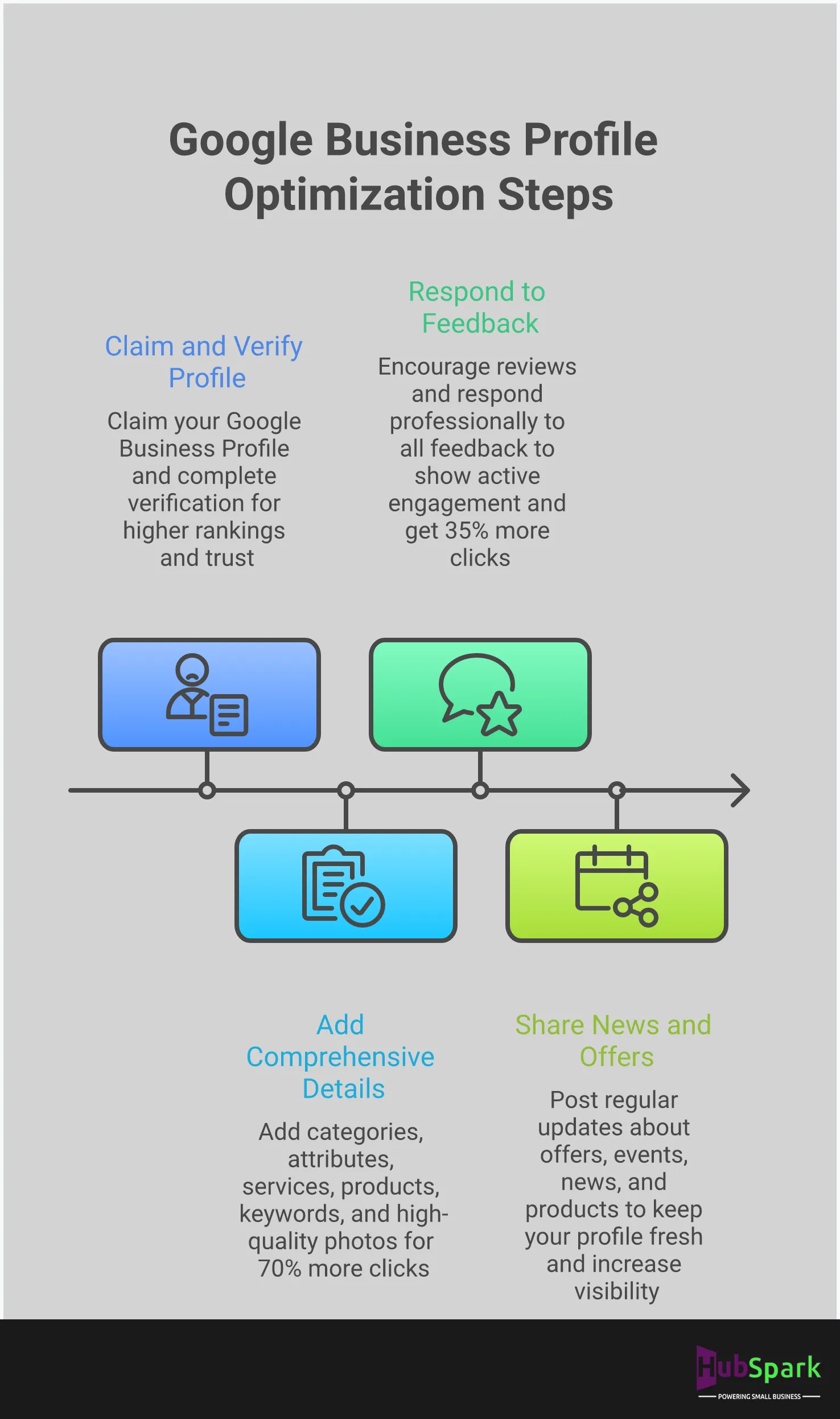
A powerful Google Business Profile (GBP) begins with a flawless foundation. Before you can dominate local search, you must establish your profile with absolute precision. Treating this initial setup as a minor task is a direct path to invisibility online. Your GBP is not a static directory listing; it is a dynamic asset that requires a strategic framework to attract and convert high-intent customers searching for your services right now. The process is straightforward but demands meticulous attention to detail. It involves three non-negotiable actions: officially claiming ownership of your listing, populating it with exact business data, and ensuring that information is consistent across the entire web.
Executing these steps correctly from the start eliminates future problems and positions your business for maximum visibility and growth. This initial setup is the bedrock of your entire local SEO strategy. Get it right, and you create a powerful, automated engine for lead generation. Get it wrong, and you’re giving competitors a permanent head start. A poorly configured profile actively works against you, creating customer confusion and signaling to Google that your business may not be reliable. We will now break down exactly how to build this foundation correctly, ensuring your business is seen by the right customers at the right time.
Claim and Verify Your Business Listing
This is the first and most critical step. You cannot manage your profile until you prove to Google that you are the legitimate owner. An unverified listing is vulnerable to unauthorized edits and will not rank effectively. The verification process establishes your authority and unlocks all GBP management features. Google typically sends a postcard with a verification code to your physical business address to confirm your location. In some cases, phone or email verification is available. Do not delay this process. Verify your business immediately to secure your listing, protect your brand, and begin optimizing your presence for local search.
Input Core Business Information with Precision
Inaccurate information is a primary reason businesses fail to attract customers through their GBP. Every detail must be correct, complete, and current. This includes your official business name, full address, primary phone number, and website URL. A single wrong digit in your phone number or a typo in your street name can prevent a customer from contacting you. Review every field for absolute accuracy. This data forms the core of your digital identity, and any inconsistency erodes trust with both potential customers and Google’s algorithm. A centralized system is the most effective way to maintain this precision across all platforms, preventing data decay over time.
Master Category Selection and NAP Consistency
Your business category tells Google exactly what you do and which searches you should appear for. Selecting the wrong primary category is a costly mistake that makes you invisible to relevant customers. Choose the most specific primary category that defines your core business, then add secondary categories for other services you offer. Equally important is NAP (Name, Address, Phone number) consistency. This data must be identical across your website, social media, and all other online directories. Discrepancies signal untrustworthiness to search engines, damaging your rankings. HubSpark’s Listings Management solutions eliminate this problem by syncing your correct information across dozens of platforms automatically.
Optimize the Core Elements of Your Google Business Profile
Once you have established the foundation of your Google Business Profile, the next operational phase is enrichment. This is where you move beyond basic data entry and begin to strategically position your business to win customer attention. The core elements of your profile, including your business description, attributes, and hours, are the first points of contact a potential customer has with your brand in a local search. Getting these details right is not optional; it is essential for building trust and improving your ranking.
Think of your profile as a digital storefront. A vague description, missing service details, or incorrect hours are the equivalent of a dusty, uninviting window display. Customers will move on to a competitor who presents a more professional and complete picture. Optimizing these elements sends powerful signals to both Google and your customers that your business is active, reliable, and the best solution for their needs. This is not a one-time task but a continuous process of refinement to ensure your profile accurately reflects your operations and actively works to convert searchers into paying customers.
Write a Business Description That Converts
Your business description is your 750-character sales pitch. Do not waste it. Open with a powerful statement that defines what you do and for whom. Immediately follow with the primary problems you solve. Weave your most important keywords and service locations into the text naturally, writing for a human, not an algorithm. For example, instead of listing “Plumber, Dallas, Drain Cleaning,” write “We provide expert drain cleaning and emergency plumbing services for homeowners across the Dallas area.” Conclude with a direct call to action, such as “Call us today for a free estimate” or “Visit our website to book an appointment.” This description is a critical tool to optimize website lead management by pre-qualifying customers before they even click.
Add High-Value Attributes and Service Listings
Attributes are searchable tags that allow customers to filter businesses based on specific needs. Failing to add them means you are invisible to anyone using those filters. Go through the complete list of attributes Google provides and select every single one that applies to your business. This includes details like “Veteran-led,” “24-hour emergency service,” or “Online appointments available.” These details differentiate you from competitors and directly answer specific customer questions. Beyond attributes, meticulously list every individual service you offer in the “Services” section. This level of detail improves your visibility in searches for niche services and demonstrates the full scope of your expertise. Effective listings management solutions ensure this data remains consistent everywhere online.
Manage Business Hours and Service Areas Accurately
Incorrect business hours are a primary source of customer frustration and negative reviews. They also signal to Google that your listing is unreliable, which can harm your ranking. Your hours must be precise at all times. Set your standard operating hours and be vigilant about updating special hours for holidays, events, or any other deviation from your normal schedule. For businesses that serve customers at their location, defining your service area is equally critical. Specify the exact cities, zip codes, or radius you cover. This ensures you appear in relevant “near me” searches and do not waste time on leads outside your operational zone. Accuracy in these details is fundamental to local SEO for small businesses.
What Media Should You Add to Your Google Business Profile?
Your Google Business Profile is a visual introduction to your company. A profile rich with photos and videos engages users and signals to Google that your listing is active and relevant. Treat your media uploads as a strategic component of your marketing. Each image and video should serve a purpose: to showcase your work, introduce your team, and prove you are the premier service provider in your area. This visual evidence is critical for converting searchers into paying customers.
Implement Photo Strategies for Higher Engagement
High-quality photos provide tangible proof of your skills. Start with a professional logo and a cover photo, then build a gallery with pictures of your team, branded vehicles, and before-and-after shots of completed projects. For an HVAC company, show a newly installed unit; for a roofer, a finished roof. These images are essential assets for your reviews and reputation management, showing prospects the quality you deliver. Consistently add new photos to keep your profile fresh and active, reinforcing your credibility with every upload.
Follow Video Best Practices to Stand Out
Video connects with customers on a deeper level. Upload three to five short videos (under 60 seconds) to showcase your business in action. Effective content includes brief customer testimonials, a walkthrough of a complex job, or an introduction to your owner. This approach humanizes your brand and establishes authority. A well-executed video can be the deciding factor for a customer, directly impacting your ability to optimize website lead management by sending more qualified traffic your way from your profile.
Use Geotagged Media to Solidify Local Authority
To dominate local search, send clear location signals to Google. Geotagging your photos and videos is a powerful way to do this. Geotagging embeds GPS coordinates into the media file, proving a photo was taken within your service area. When you upload a geotagged photo of a completed job, you provide Google with verifiable proof of your local activity. This practice reinforces your geographic relevance and strengthens your entire local SEO strategy. Use online tools to add geotags to your media before uploading.
How to Master Customer Review Management on GBP
Your Google Business Profile is not a static directory listing; it is a dynamic, public-facing measure of your business’s reputation. Customer reviews are the single most influential factor in this equation. They directly impact your local search ranking, customer trust, and conversion rates. Mastering review management is not optional for a business intent on growth. It requires a disciplined, systematic approach to responding, collecting, and handling all forms of customer feedback. A disorganized approach leaves your reputation to chance, while a strategic one turns customer feedback into a powerful asset for attracting new business and solidifying your market position.
Execute Review Response Strategies That Build Trust
Every single review on your profile demands a response. This is a non-negotiable operational task. Responding demonstrates that you are an engaged business owner who values customer feedback, which immediately builds trust with prospects reading your reviews. For positive reviews, thank the customer by name and reference a specific detail from their feedback. This personalizes the interaction and reinforces the positive experience for future customers. For all responses, maintain a professional and consistent brand voice. A well-managed review section, complete with thoughtful replies, makes your business stand out from competitors who neglect this critical touchpoint. Centralizing this process with a reputation management solution eliminates the risk of missed reviews and ensures timely, professional engagement.
Systematize Your Review Collection Process
Passively waiting for customers to leave reviews is an ineffective strategy that yields slow, inconsistent results. To dominate your local market, you must implement a systematic process for actively requesting feedback. Integrate the review request into your standard workflow immediately after a service is completed. The goal is to make leaving a review as frictionless as possible for your customer. Use automated text marketing or email follow-ups that include a direct link to your GBP review page. This simple action removes barriers and significantly increases the volume of reviews you receive. A steady stream of recent, positive reviews is a powerful signal to both Google’s algorithm and potential customers that your business is active, reliable, and a leader in its service area.
Address Negative Feedback with Authority
A negative review is not a crisis; it is an opportunity to publicly demonstrate your commitment to customer satisfaction. Address negative feedback promptly and professionally, following a clear protocol. First, acknowledge the customer’s complaint and apologize for their experience without making excuses. Second, state your commitment to resolving the issue and provide a direct, offline contact method (like a phone number or email) to discuss the specifics. This moves the conflict out of the public eye while showing prospects that you take accountability. In your public reply, you can strategically mention your service and location (e.g., “We are sorry your HVAC installation in Dallas did not meet expectations”). This turns a negative situation into a relevant, keyword-optimized asset that showcases your professionalism.
Execute Advanced GBP Tactics for Unbeatable Results
A complete and accurate Google Business Profile is the baseline for local search visibility. While essential, it is only the starting point. To dominate your market, you must move beyond the basics and implement advanced strategies that give you a decisive edge. These tactics signal to Google that you are not just a participant but an authority in your local industry, worthy of the top search positions. This means treating your profile as a dynamic marketing channel, not a static business card that you set and forget. Your competitors are actively managing their profiles, and standing still means falling behind.
By actively managing dynamic content like Google Posts, engaging with customer questions, and leveraging technical SEO like schema markup, you transform your profile from a simple listing into a powerful customer acquisition engine. This proactive approach directly addresses the signals Google uses to rank local businesses. It demonstrates relevance, authority, and trustworthiness. The following strategies are not optional for businesses serious about growth; they are the necessary steps to solidify your position at the top of local search results and capture high-intent customers before your competitors do. Integrating these advanced tactics into your operational workflow ensures your business remains visible and competitive.
Capitalize on Google Posts and the Q&A Section
Your GBP is not a static directory listing; it is a dynamic channel for customer engagement. Use Google Posts to share timely updates, promotions, and service highlights directly on your profile. Consistent posting keeps your listing fresh and signals to Google that your business is active. Avoid generic content; each post should provide clear value to a potential customer.
The Q&A section is equally critical. Customers use this feature to ask specific questions, and your response time matters. Proactively populate this section by asking and answering common questions yourself. This allows you to control the narrative and provide accurate information before anyone else does. Effective reputation management requires monitoring this section to ensure all inquiries receive a prompt, professional answer.
Optimize for Voice Search to Capture More Leads
Voice search is no longer a future trend; it is a current reality. When customers ask devices like Google Assistant or Siri to “find a plumber near me,” the results are pulled directly from top-ranking Google Business Profiles. To capture this traffic, your profile must be optimized for conversational queries. Think about the questions customers ask and ensure your business description, services, and Q&A section provide direct answers.
Optimizing your Google Business Profile is one of the most impactful steps you can take to strengthen your local SEO. Accurate hours, a precise address, and a complete list of services are non-negotiable. This data makes it easy for voice assistants to identify your business as the best solution for a user’s immediate need.
Implement Local Business Schema for a Technical Edge
To gain a technical advantage, implement Local Business schema markup on your website. Schema is a piece of code that translates your website’s content into a language search engines can easily understand. It explicitly confirms your business name, address, phone number, hours, and service areas, creating a powerful layer of verification for the information on your GBP. This consistency across your digital assets builds immense trust with Google.
While schema is added to your website, its impact on your GBP is direct. It eliminates any ambiguity about your business details, reinforcing your local authority. This is particularly effective when paired with dedicated location pages for each service area, creating an airtight case for why your business should rank at the top of local search results.
How to Track Your Google Business Profile Performance
An optimized Google Business Profile attracts potential customers. A measured profile turns that attention into predictable revenue. If you are not tracking your GBP performance, you are operating without critical business intelligence. Monitoring your profile’s effectiveness is not optional; it is essential for making strategic decisions that drive growth. Stop guessing what works and start using data to build a profile that consistently delivers results.
Analyze Key GBP Insights and Metrics
Your GBP Performance report contains the data you need to understand exactly how customers find and interact with your business. Focus on the metrics that translate directly to customer action. These include search views, which show how many people saw your profile, and keyword queries, which reveal the exact terms customers used to find you. Pay close attention to engagement metrics: website clicks, direction requests, and phone calls. These are not vanity numbers; they represent high-intent actions from potential customers who are ready to engage. Analyzing this data provides a clear picture of your audience and is a foundational part of an effective local SEO strategy.
Utilize Performance Tracking Tools and Strategies
Accessing your data is straightforward. Simply navigate to your Google Business Profile and select “Performance” to view your insights dashboard. Here, you can monitor trends over time and identify which customer actions are most common. While Google provides the raw data, a unified platform is required to make it actionable. Monitoring calls from your GBP is a start, but a system that integrates those interactions is better.
Use Data to Continuously Refine Your Strategy
Treat your GBP not as a static listing but as a dynamic marketing asset. Your performance data is the key to continuous improvement. If you see a spike in searches for a service you offer but rarely promote, create a Google Post about it. If your photos get thousands of views but few website clicks, your call to action needs to be stronger. Use these insights to refine your strategy monthly. High-performing photos should inform your future uploads. Popular Q&A topics should be addressed in your business description. Every piece of data is a directive for how to better serve your customers and capture more leads. Integrating these leads directly into your workflow demonstrates the powerful benefits of a CRM that connects every part of your business.
Avoid These Critical Google Business Profile Mistakes
A fully optimized Google Business Profile requires more than just a correct setup; it demands avoiding the critical errors that undermine your local search authority. These common mistakes are not minor oversights. They are operational failures that cost you customers and revenue. Systematically eliminating these pitfalls ensures your profile operates at peak performance and consistently attracts new leads.
Eliminate Information Inconsistencies and Duplicates
Inaccurate information is the fastest way to lose a customer. Duplicate listings and inconsistent business details across the web create confusion and erode trust. Your name, address, and phone number (NAP) must be identical everywhere, from your GBP to your website and other directories. Any variation signals a lack of professionalism to customers and search engines. Centralize your business information to ensure absolute consistency. Using a dedicated platform for listings management eliminates these errors by synchronizing your data across all critical sites and solidifying your digital footprint.
Commit to Regular Updates and Maintenance
A static Google Business Profile is an ineffective one. Failing to update your profile regularly leads to outdated information and signals to Google that your business may be inactive. Treat your GBP as a dynamic marketing channel, not a one-time setup. Consistently publishing posts, adding fresh photos of your work, and updating holiday hours demonstrates that you are active and engaged. This activity keeps customers informed and contributes to your visibility in local search results. Schedule weekly maintenance into your operational workflow to maintain momentum and connect with your audience.
Sidestep Common Review Management Pitfalls
Your reviews are a direct reflection of your business, and ignoring them is not an option. A critical mistake is failing to respond to all feedback, both positive and negative. Responding shows you value customer input and are committed to service excellence. Another pitfall is not having a system to generate new reviews. You must make it easy for satisfied customers to share their experiences. Implement a process to request feedback after every job. A robust reputation management strategy turns customer feedback into a powerful asset for attracting new business.
Integrate GBP into Your Central Business Operations
Your Google Business Profile is not an isolated marketing tool; it is a primary source of leads, customer interactions, and business intelligence. Managing it separately from your core operations creates data silos and operational friction that directly impact your bottom line. Every call, message, and review generated by your profile is a critical touchpoint that demands immediate, organized action. When your GBP exists in a vacuum, you are forced to manually track interactions, which leads to lost leads, delayed responses, and a damaged reputation. This fragmented approach is unsustainable for any business serious about growth.
To operate at maximum efficiency, you must integrate your GBP data directly into your central business management system. This transforms your profile from a passive listing into an active, integrated component of your growth engine. Centralizing this information eliminates the need to switch between multiple tabs and platforms, ensuring that every customer interaction is captured, tracked, and managed from a single dashboard. This consolidation is the key to converting local search visibility into measurable business results. With an integrated system like HubSpark, you can automate follow-ups, manage communications, and control your online reputation with precision, turning what was once a chaotic process into a streamlined, revenue-generating machine.
Connect GBP to Your CRM for Seamless Lead Management
Your GBP generates high-intent leads through calls, direction requests, and website clicks. Leaving this data siloed on Google is a critical error. Manually transferring contact information and interaction details into a separate CRM is inefficient and prone to human error, resulting in lost opportunities. To capitalize on every lead, you must directly connect your GBP to your CRM.
This integration automates lead capture, ensuring every prospect who contacts you via your profile is immediately entered into your sales pipeline. An integrated system provides the benefits of a CRM by allowing you to track lead sources, automate follow-up sequences, and analyze which GBP interactions generate the most valuable customers. Stop letting leads fall through the cracks and start converting local search interest into closed deals.
Streamline Customer Communications Across Platforms
Customers will contact you through your GBP messages, the Q&A feature, and direct calls. These interactions happen alongside inquiries from your website, social media, and SMS texts. Managing these disparate channels separately guarantees missed messages and slow response times, which damages customer trust. You need a single, unified inbox to manage all conversations.
A unified messaging solution consolidates every customer interaction, regardless of its origin, into one streamlined feed. This allows you to respond instantly to GBP messages, website chats, and texts from the same dashboard. Centralizing communications eliminates the chaos of multiple platforms, ensures consistent brand messaging, and provides a complete history of every customer conversation. Take control of your communications to deliver a superior customer experience.
Centralize Reputation Management for Total Control
Your online reputation is dictated by customer reviews, and your GBP is the most visible place they appear. Responding to reviews directly on Google is a start, but it’s a reactive, piecemeal approach. Effective reputation management requires a proactive, centralized system for generating, monitoring, and responding to feedback across all platforms.
Integrate your GBP with a dedicated reputation management solution to automate the entire process. This allows you to systematically request reviews from satisfied customers, receive instant alerts for new feedback, and respond directly from your central dashboard. Centralizing this function ensures you maintain a consistent, professional response strategy that builds trust and social proof. It also protects you from the negative impact of outdated information or unanswered complaints, solidifying your status as a top-rated local business.
Related Articles
Frequently Asked Questions
How often should I update my Google Business Profile? Treat your profile as a dynamic marketing channel, not a static listing. You should engage with it weekly. This doesn’t require a major overhaul. It means publishing at least one Google Post, uploading a new photo of a recent job, and ensuring you respond to all new reviews and questions within 24 hours. Consistency signals to Google that your business is active and relevant, which is critical for maintaining high visibility.
What is the single most important factor for ranking my profile higher? There is no single magic bullet for ranking. Google prioritizes trust, which is built through a combination of factors working in unison. The most influential components are absolute accuracy across all your business information, a steady stream of recent and positive customer reviews, and consistent engagement with the profile’s features. A complete, active, and well-regarded profile will always outperform a profile that only excels in one area.
How should I handle a negative review that seems fake or unfair? First, determine if the review violates Google’s content policies. If it does, such as containing hate speech or being posted by a competitor, flag it immediately for removal. Regardless of whether you flag it, you must post a public response. Respond professionally and concisely, stating that you have no record of the individual as a customer but are committed to resolving all client issues. This demonstrates accountability to real prospects, who are the true audience for your reply.
My business information is correct, so why am I not ranking well? Correct information is the foundation, but it does not guarantee a top ranking. Local search results are competitive. Your ranking also depends on prominence and relevance. Prominence is your business’s authority, which is built through customer reviews and consistent citations across the web. Relevance is how well you match a searcher’s specific need, which you can improve by adding detailed service lists, posting about your work, and answering customer questions on your profile.
Can I just focus on my GBP and ignore my website? No. Your Google Business Profile and your website are two parts of a single customer acquisition system. Your profile attracts local searchers and provides a critical first impression, while your website serves as the destination for customers who want more detailed information or need to book a service. The two must be perfectly aligned. In fact, ensuring your business information is consistent between your profile and your website’s code (using schema markup) is a powerful way to build authority with Google.

I am a serial entrepreneur with a 20+ year background in marketing & advertising, with a specific focus on SEO/online/digital marketing. I have a passion for helping owners of small & medium sized businesses grow rapidly through organic search engine optimization & digital marketing. I am blessed to lead a team of some of the most hard working, brilliant, and passionate team to help all of our clients reach their revenue goals!
 App Today!