

Simply tracking star ratings is an outdated strategy that leaves your agency with significant blind spots. To provide true value, you must understand the context and sentiment behind customer feedback. Without comprehensive tools, you risk missing critical insights that could damage a client’s brand and cannot connect your efforts to tangible business outcomes. Top-tier reputation management software for agencies uses AI-powered analysis to identify recurring themes and deliver actionable intelligence. This technology allows you to move beyond reactive review responses and provide proactive, data-driven advice that helps your clients improve their core business operations, solidifying your role as a strategic partner.

Key Takeaways
- Centralize for Scalability: Manual reputation tracking is an operational liability that prevents agency growth. Adopting a dedicated software platform is a requirement to centralize client monitoring, eliminate inefficiencies, and build a profitable, scalable service.
- Prioritize Non-Negotiable Features: To effectively manage a client portfolio, your software must include a single dashboard for all accounts, automated client-ready reporting, and white-label capabilities. These tools are essential for proving your value and reinforcing your agency’s brand.
- Connect Reputation Metrics to Business Growth: Move beyond simple star ratings by tracking key performance indicators like review volume, sentiment scores, and response rates. Use this data to demonstrate how your reputation management efforts directly contribute to client retention and revenue.
What is Reputation Management Software for Agencies?
Reputation management software is a centralized platform designed for agencies to monitor, manage, and improve their clients’ online presence. It eliminates the manual, time-consuming work of tracking reviews and mentions across countless platforms. For an agency juggling multiple clients, this software is not a luxury; it is a core operational tool for delivering measurable results and securing client retention. It transforms reputation management from a chaotic, reactive task into a streamlined, profitable service.
The primary function of this software is to automate and centralize the entire reputation management workflow. It aggregates reviews from Google, Yelp, and industry-specific sites into a single dashboard, providing a unified view of customer feedback. The platform analyzes search results, tracks social media mentions, and offers a clear assessment of a client’s digital footprint against their direct competitors. This comprehensive oversight allows your team to efficiently manage dozens of client accounts, respond to feedback promptly, and generate automated reports that prove your value.
By using a dedicated platform, you move from a scattered approach to a proactive, strategic one. Instead of logging into ten different sites for ten different clients, your team operates from one command center. This efficiency is critical for scaling your agency’s services. HubSpark’s reviews and reputation management solutions are built to give agencies this exact control, integrating reputation management with other essential client services like CRM and local SEO to drive superior outcomes.
Why Your Agency Requires Dedicated Reputation Management Software
Relying on spreadsheets and manual browser checks to manage your clients’ online reputations is an operational liability. This fragmented approach is not sustainable and actively hinders your agency’s ability to deliver consistent, high-impact results. To effectively protect your clients and scale your services, you must move beyond manual methods. The core issues are clear: manual management is inefficient, it puts client retention at risk, and it creates significant blind spots in your strategy. Adopting dedicated software is not a luxury; it is a fundamental requirement for any agency serious about growth and client success.
The Problem: Manual Management is Inefficient and Unscalable
Your agency cannot scale on manual processes. As your client roster expands, the complexity of tracking reviews across dozens of platforms grows exponentially. Managing an online reputation manually is a significant operational drag for agencies juggling multiple clients and review sites. This approach is not just inefficient; it’s a direct bottleneck to your growth. Every hour your team spends manually checking Google, Yelp, and industry-specific sites is an hour not spent on high-value strategy. Dedicated reputation management solutions eliminate this friction, centralizing feedback and automating the most time-consuming tasks.
The Risk: Client Trust and Retention Are on the Line
A client’s online reputation is a direct reflection of your agency’s value. When it falters, so does their trust in you. Poor reputation management is costly, and with most customers reading reviews before making a purchase, maintaining a positive online presence is non-negotiable. Failing to manage this effectively puts client retention at risk. Every missed negative review or unanswered positive comment is a missed opportunity to demonstrate your agency’s worth. Software provides the structure to protect your clients’ brands and, by extension, your own client relationships and revenue.
The Blind Spot: Incomplete Monitoring Across Platforms
If you are only tracking star ratings, you are missing the full picture. Effective reputation management goes beyond simple monitoring. Without comprehensive tools, your agency risks missing critical feedback that could damage a client’s brand. Furthermore, you cannot connect reputation efforts to tangible business outcomes. Top-tier software allows you to monitor how online sentiment impacts website traffic and local SEO performance. It provides the analytics necessary to understand the full impact of your clients’ reputations and prove your value with hard data. This is how you move from a reactive service to a strategic partner.
The Non-Negotiable Features Your Agency’s Software Must Have
Selecting reputation management software is a critical decision that directly impacts your agency’s efficiency, scalability, and client retention. The market is saturated with options, but only a select few provide the functionality required to manage a diverse client portfolio effectively. To separate essential tools from inadequate ones, you must evaluate platforms based on a core set of non-negotiable features. These are not optional add-ons; they are the foundational components that enable you to deliver exceptional results, prove your value, and grow your agency. Anything less is a compromise that will create operational bottlenecks and limit your potential.
Centralized Review Monitoring and Response
Your agency cannot afford to waste time toggling between dozens of tabs to monitor reviews for each client across Google, Facebook, Yelp, and industry-specific sites. This manual approach is inefficient and guarantees that critical feedback will be missed. Effective reviews and reputation management solutions centralize every client review into a single, unified inbox. This system must allow your team to monitor, assign, and respond to all feedback directly from one interface. As industry analysis confirms, the right software automates this process, saving significant time and making it feasible to manage many clients with a small, efficient team. This consolidation is the first step to building a scalable reputation management service.
A Single Dashboard for All Clients and Locations
For an agency, control requires a high-level view of your entire client portfolio. A platform that forces you to manage clients in separate, siloed accounts is fundamentally broken. The standard for agency software is a single dashboard that provides a comprehensive overview of every client and all their business locations. This command center must offer the ability to manage reviews, listings, and other reputation metrics for hundreds of client locations from one screen. This structure eliminates administrative chaos and allows your team to instantly assess performance, identify clients needing attention, and manage workflows with precision. Without this unified view, your agency will struggle to scale beyond a handful of clients.
Automated, Insight-Driven Reporting
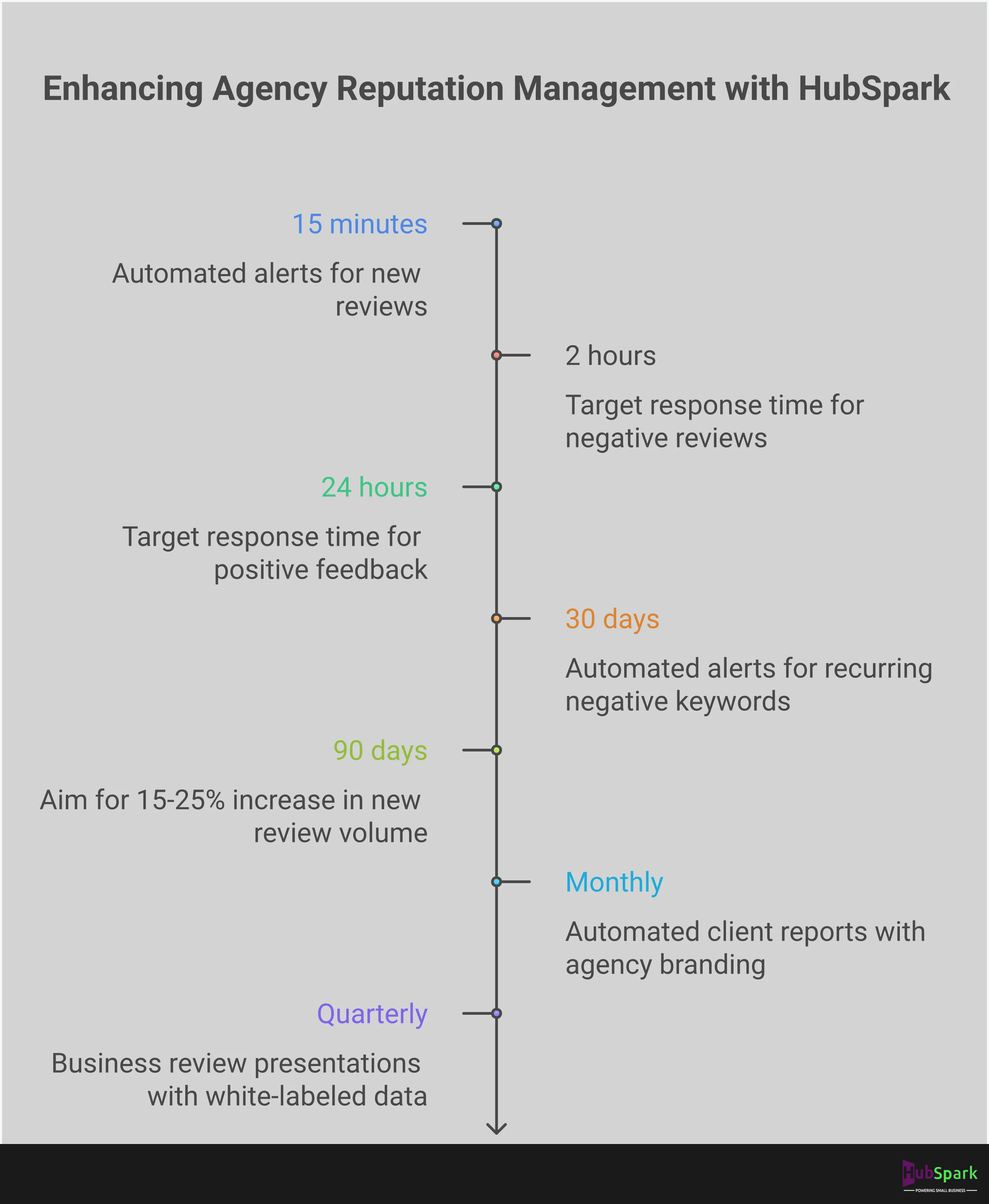
Demonstrating your agency’s value is not optional. Your clients expect to see a clear return on their investment, and manual reporting is a time-consuming process that is prone to errors and inconsistencies. Your software must provide automated reporting that creates professional, client-ready reports automatically. These reports should go beyond simple data dumps of star ratings. They need to deliver actionable insights, tracking key performance indicators like review volume, average rating trends, sentiment scores, and response times. This functionality allows you to consistently prove your impact, justify your fees, and strengthen client relationships without draining your team’s resources on administrative tasks.
AI-Powered Sentiment Analysis
Simply tracking star ratings is no longer enough. To provide true strategic value, your agency must understand the context and emotion behind customer feedback. Modern reputation management platforms use AI-powered sentiment analysis to analyze review text, identify recurring themes, and categorize feedback as positive, negative, or neutral. This technology allows you to instantly pinpoint specific operational issues or strengths for your clients, such as compliments on a particular employee or complaints about service speed. By leveraging these tools, you can move beyond reactive review responses and provide proactive, data-driven advice that helps your clients improve their business operations.
White-Label Capabilities to Reinforce Your Brand
Your agency is the expert, and your software should reflect that. White-labeling is an essential feature that allows you to present the reputation management platform as your own proprietary solution. This includes customizing reports, dashboards, and client-facing communications with your agency’s branding, not the software provider’s. This capability is critical for reinforcing your brand identity and building client trust. When clients log in to a portal that carries your logo, it solidifies your position as their dedicated partner. It ensures you get the credit for the powerful tools and results you provide, strengthening client loyalty and reducing churn.
A Comparative Analysis of Top Reputation Management Platforms
HubSpark: The Integrated Solution for Reputation Management
HubSpark is not just a reputation management tool; it is a complete operating system for your agency and its clients. Instead of juggling separate apps for reviews, messaging, and payments, HubSpark centralizes every function into a single, efficient dashboard. This integration is its core strength. You can automatically send review requests via SMS or email the moment a client’s invoice is paid. The platform’s reviews and reputation management solutions are directly connected to a robust CRM, allowing you to tie feedback directly to customer profiles and service history. This eliminates operational bottlenecks and provides a clear, holistic view of each client’s performance, making it the definitive choice for agencies aiming to deliver comprehensive, streamlined service.
Vendasta
Vendasta is built specifically for agencies that need to scale their service offerings. Its platform excels at providing white-label solutions, allowing you to present comprehensive reports and dashboards under your own brand. This reinforces your agency’s value and strengthens client relationships. Vendasta’s suite of tools includes AI-powered insights to help you manage online listings and reviews efficiently across numerous client accounts. For agencies focused on growth, Vendasta provides the necessary framework to manage reputation without getting bogged down by manual processes. It’s a powerful system for those who resell digital marketing services and need a scalable, client-facing platform.
Birdeye
Birdeye is a strong contender for agencies managing large, multi-location clients. The platform is engineered to handle high volumes of customer interactions and reviews, making it a reliable choice for enterprise-level accounts. Key features include AI-powered review replies, which help your team respond to feedback quickly and maintain a consistent brand voice across all locations. Birdeye also integrates surveys and social media monitoring, providing a more complete picture of customer sentiment. It is one of the best reputation management software options for businesses that require robust tools to manage a complex and widespread online presence effectively.
BrightLocal
For agencies where local SEO is a primary service, BrightLocal offers a tightly integrated solution. Its reputation management tools are designed to directly support and enhance a client’s local search visibility. The platform includes essential features like review monitoring, automated review requests, and customizable widgets to showcase positive reviews on a client’s website. Because these tools are often bundled with BrightLocal’s broader local SEO suite, you can create a cohesive strategy that links reputation directly to local ranking performance. It is frequently listed among the top choices for agencies that need a comprehensive suite of tools for local marketing.
ReviewTrackers
ReviewTrackers excels at aggregating customer feedback from over 100 different sources, giving you one of the most comprehensive views of a client’s online reputation. Its strength lies in its powerful analytics, which transform raw feedback into actionable business intelligence. The platform helps you identify recurring themes, track sentiment over time, and even perform competitor analysis to see how your clients stack up. If your agency’s goal is to go beyond simple review monitoring and provide clients with deep insights into the customer experience, ReviewTrackers provides the customer feedback analytics to make informed, strategic decisions. It’s ideal for data-driven agencies.
Deconstructing the Cost of Reputation Management Software
Investing in reputation management software is not an expense; it is a strategic decision that directly impacts your agency’s efficiency and your clients’ success. The cost of these platforms varies widely, and understanding the financial structure is critical to making a profitable choice. A low-cost tool that requires significant manual effort is a drain on resources, while an overpriced platform with unused features is a waste of capital. The goal is to find a solution that aligns with your service model and delivers a clear return on investment. This requires looking beyond the monthly fee to assess the total cost of ownership, which includes the time your team spends operating the software. An effective platform automates tedious tasks, centralizes client data, and provides actionable insights, freeing up your team to focus on high-value strategy. To do this, you must first analyze the common pricing models in the market and then identify the key factors that determine the true value of your investment. This breakdown will equip you to evaluate platforms not just on price, but on their capacity to accelerate growth for your agency and your clients.
Analyzing Common Pricing Models
Reputation management software pricing is typically structured in tiers, often based on the number of locations you manage. Expect to encounter a few standard models. Lower-tier platforms generally range from $8 to $50 per location per month and offer basic review tracking. While affordable, these often lack the automation required for an agency to operate at scale. Mid-to-high-tier solutions, priced from $75 to over $250 per location, provide the robust automation, white-labeling, and comprehensive reporting that agencies need. HubSpark’s reviews and reputation management solutions are designed to provide this level of professional-grade functionality. Be aware that many enterprise-level providers do not publish their pricing, forcing you into a sales call, which is an inefficient process for decisive agency owners.
Key Factors That Impact Your Investment
The sticker price is only one part of the equation. The true value of a platform is determined by its ability to integrate into your existing operations and scale with your agency’s growth. Before committing, evaluate these critical factors. First, confirm the software is scalable and can handle an expanding client portfolio without a prohibitive increase in cost. Second, assess its integration capabilities. The platform must work seamlessly with the other tools you rely on, especially your customer relationship management (CRM) software, to create a unified workflow. Finally, prioritize automation. The right software saves your team hundreds of hours by automating review requests, monitoring, and reporting, which directly translates to higher profit margins and better client results.
The Metrics That Matter: How to Measure Reputation Management ROI
You cannot manage what you do not measure. To justify your agency’s value and retain clients long-term, you must move beyond vanity metrics and demonstrate a tangible return on investment. Effective reputation management is not just about making a brand look good; it is about driving measurable business outcomes. The right software provides the data required to connect your efforts directly to a client’s bottom line, transforming your agency from a service provider into an indispensable growth partner.
Proving ROI requires a disciplined approach to tracking the right key performance indicators (KPIs). These metrics serve as the definitive evidence of your strategy’s success, showing clients exactly how your management of their online presence translates into improved customer loyalty, increased visibility, and sustainable growth. With a platform like HubSpark, you can centralize this data into automated reports that clearly articulate the value of your reviews and reputation management solutions, making client conversations about performance both simple and powerful.
Track Review Volume and Quality
The foundational metrics of any reputation strategy are the quantity and quality of client reviews. A consistent increase in the total number of reviews signals to both customers and search engines that the business is active and credible. Simultaneously, you must track the average star rating across all critical platforms. Your goal is to demonstrate a clear, upward trend in both areas. Pinpointing these indicators allows your agency to identify which strategies are generating positive feedback and where improvements are needed. This data is essential for refining your approach and proving that your work directly impacts how a client’s business is perceived online, which is a cornerstone of effective local SEO.
Monitor Response Rates and Engagement
A static reputation is a vulnerable one. Your agency’s value is demonstrated through active management, and response rate is the primary metric for this. Tracking how quickly and consistently your team responds to new reviews, both positive and negative, is non-negotiable. A high response rate shows potential customers that the business is attentive and values feedback, which builds immediate trust. For your clients, it is concrete proof of the service you provide. Centralizing this process through a unified messaging platform eliminates missed opportunities and ensures every customer feels heard. This metric transforms reputation management from a passive task into an active engagement strategy that strengthens customer relationships.
Measure Overall Sentiment Scores
Star ratings only tell part of the story. True insight comes from understanding the sentiment behind the reviews. Modern reputation management software uses AI to analyze the language within reviews, categorizing them as positive, negative, or neutral. This provides a much deeper understanding of customer perception. By tracking overall sentiment, you can identify recurring themes in feedback, such as compliments on specific employees or complaints about a particular service. This data allows you to provide clients with actionable business intelligence that goes far beyond reputation, helping them make operational improvements that address the root cause of customer feedback and foster genuine brand loyalty.
Link Reputation Efforts to Client Retention
The ultimate measure of ROI is the impact on your client’s customer base. A strong online reputation directly correlates with customer trust and loyalty. To prove this, you must connect your reputation management efforts to client retention and churn rates. By tracking these figures alongside reputation metrics, you can demonstrate how an improved star rating or a higher sentiment score leads to fewer lost customers over time. This requires a system that can manage customer data effectively. Using a CRM for business growth allows you to track customer relationships and illustrate how a positive reputation translates into repeat business and increased customer lifetime value, solidifying your agency’s role as a critical driver of revenue.
Debunking Common Myths That Hinder Agency Growth
Misconceptions about reputation management prevent agencies from delivering maximum value to their clients. Believing these myths leads to inefficient strategies, missed opportunities, and ultimately, stunted growth for both your agency and the businesses you serve. It’s time to replace these outdated ideas with a clear, operational framework for success. By understanding the reality of modern reputation management, you can position your agency as an indispensable partner.
Myth #1: “This is only for large brands.”
This is fundamentally incorrect. Reputation management is arguably more critical for the local service businesses your agency represents. While large corporations have massive marketing budgets, your clients compete on trust and credibility at a local level. Potential customers are actively searching online, comparing local plumbers, roofers, or law firms, and reading reviews to make their decisions. A strong online reputation is a powerful competitive advantage that directly impacts lead generation. Effective reviews and reputation management solutions are not a luxury; they are a core component of a successful local marketing strategy that drives measurable results.
Myth #2: “Reputation management is a one-time setup.”
Treating reputation management as a one-time task is a critical error. The digital conversation about your clients never stops, and a “set it and forget it” approach guarantees you will miss crucial feedback and opportunities. Your clients’ online reputation requires constant monitoring and active management to be effective. New reviews, social media mentions, and business listing updates happen daily. An effective strategy involves a continuous process of listening, responding, and analyzing feedback. This ongoing effort protects your clients’ brand image and provides valuable insights into their customer experience, turning reputation management into a dynamic operational tool.
Myth #3: “All software platforms are created equal.”
Assuming any software can deliver the results your clients need will create operational bottlenecks for your agency. The market is saturated with tools, but they are not interchangeable. Many platforms offer only a fraction of the features required, forcing you to juggle multiple subscriptions and dashboards. This fragmented approach is inefficient and unscalable. A superior platform centralizes all client activity, from review monitoring to response and reporting, into a single interface. An integrated system like HubSpark provides a comprehensive customer relationship management (CRM) software that connects reputation directly to the customer journey, giving your agency a decisive advantage.
Myth #4: “You can eliminate all negative reviews.”
The goal of reputation management is not to erase every piece of negative feedback. Attempting to do so is not only impractical but also counterproductive. A profile with exclusively five-star reviews can appear inauthentic to savvy consumers. The actual objective is to manage the conversation effectively. Responding to negative reviews promptly and professionally demonstrates that your client values customer feedback and is committed to resolving issues. This public display of customer service can turn a negative situation into a powerful demonstration of trust and accountability, mitigating the impact of the initial complaint and building credibility with future customers.
A Framework for Choosing the Right Platform for Your Agency
Selecting the right software is a strategic decision that directly impacts your agency’s efficiency and profitability. A haphazard choice leads to wasted resources and client dissatisfaction. Use this three-step framework to make a decisive, informed investment that aligns with your operational needs and growth objectives. This process eliminates ambiguity and ensures the platform you choose becomes a long-term asset, not a short-term liability. A methodical approach is not optional; it is essential for building a scalable, high-performing agency that delivers measurable results for every client in your portfolio.
Step 1: Evaluate Your Client Portfolio Needs
First, analyze the clients you serve. An agency focused on service-based businesses requires a platform built to amplify local SEO for small businesses. These clients need hyper-local review monitoring, accurate listings management, and straightforward reporting. In contrast, agencies managing large, multi-location enterprises will require features for complex regional hierarchies and brand-level analytics. Do not invest in a platform designed for a different business model. Define your core client profile and select a tool that directly addresses their specific challenges. This initial assessment prevents you from overpaying for features you will never use or under-equipping your team for the clients you actually have.
Step 2: Define Integration and Compatibility Requirements
Your reputation management software cannot operate in a vacuum. It must integrate seamlessly with the other systems that run your agency and your clients’ businesses. A platform that fails to connect with your core CRM creates data silos and manual work, defeating the purpose of the investment. The most efficient solution is a unified platform where reputation management is built-in, not bolted on. This eliminates compatibility issues entirely. A system with a native CRM for business growth ensures that customer feedback is directly linked to customer records, providing a complete operational view without the friction of third-party connectors.
Step 3: Plan for Scalability and Future Growth
The right software meets your needs today and supports your agency’s expansion tomorrow. Scalability is not just about adding more client accounts; it is about the platform’s ability to grow with your service offerings. As you bring on more clients or expand into new verticals, your software must handle the increased load without a decline in performance. Evaluate the platform’s capacity to manage additional users, locations, and data volume. Choose a partner that provides a clear growth path, allowing you to scale your operations efficiently. An investment in a scalable platform is an investment in your agency’s future profitability and market leadership.
Why Reputation Management Software Is a Profitable Investment
Reputation management software is not an expense; it is a core business asset that generates a direct return. By centralizing control over your online presence, you move from a reactive position to a proactive one. This shift allows you to systematically build trust, streamline operations, and drive measurable growth. Investing in the right platform means investing in client loyalty, operational excellence, and a stronger bottom line. It transforms your online reputation from a potential liability into a powerful engine for acquiring and retaining customers.
The Benefit: Increase Client Retention and Satisfaction
Your online reputation is the foundation of client trust. With most customers reading reviews before making a purchase, a positive digital presence is non-negotiable. Reputation management software automates the critical process of monitoring and responding to feedback across all platforms. This immediate engagement shows clients their voice is heard and valued, which directly improves satisfaction. A well-managed reputation builds loyalty, reduces churn, and turns satisfied customers into vocal advocates for your brand. HubSpark’s Reviews and Reputation Management Solutions centralize this entire process, ensuring no customer feedback goes unnoticed.
The Benefit: Achieve Greater Operational Efficiency
Manually tracking reviews across dozens of sites is an inefficient use of your team’s time. A dedicated software platform eliminates this administrative burden by consolidating all reviews, mentions, and messages into a single dashboard. Instead of wasting hours compiling data, you get instant access to performance metrics that guide your strategy. Monitoring key indicators like website traffic and click-through rates reveals how your reputation directly affects user behavior. This efficiency allows you to reallocate resources from tedious monitoring to high-impact activities that grow the business, like improving your customer relationship management strategy.
The Benefit: Unlock New Revenue Growth Opportunities
A strong online reputation is one of your most effective sales tools. Positive reviews act as powerful social proof, attracting new leads and converting prospects into paying clients. Reputation management software provides the insights needed to identify and address recurring issues mentioned in customer feedback, whether it’s a product flaw or a service gap. By taking meaningful action based on this data, you not only resolve problems but also demonstrate a commitment to excellence. This continuous improvement cycle enhances brand loyalty and transforms your reputation into a reliable asset for long-term, sustainable growth.
Related Articles
- Reviews and Reputation Management Software | HubSpark
- Find the Best Local SEO Software for Your Business
Frequently Asked Questions
How is an integrated platform like HubSpark different from a standalone reputation tool? Standalone reputation tools only solve one piece of the puzzle, forcing your agency to manage client operations across multiple, disconnected applications. An integrated platform like HubSpark functions as a complete operating system. It connects reputation management directly to core business functions like the CRM and payment processing, allowing you to automate review requests after a transaction and link customer feedback directly to their history. This eliminates operational friction and provides a unified view of the entire client relationship.
How quickly can my agency expect to see a return on investment after implementing this software? You will see an immediate return in operational efficiency. The time your team saves by using a centralized dashboard instead of manually checking review sites translates directly into higher profit margins. In terms of client-facing results, you can demonstrate an impact within the first month by tracking metrics like response rates. Showing a clear, upward trend in review volume and average star ratings typically becomes evident within the first quarter, solidifying your value and securing client retention.
My clients are small, local businesses. Is this level of software really necessary for them? Yes, it is absolutely critical. Local businesses compete on trust and credibility, and their online reviews are their most powerful form of social proof. Potential customers are comparing local service providers online every day, and a poorly managed reputation directly results in lost leads. This software is not a corporate luxury; it is a fundamental tool for any local business that wants to dominate its service area and build a trustworthy brand.
What is the most critical mistake agencies make when managing online reputations for clients? The most significant error is treating reputation management as a passive, reactive task. Manually checking for reviews when you have time guarantees that critical feedback will be missed, damaging your client’s brand and your agency’s credibility. Effective management requires a proactive, systematic approach. Using dedicated software enforces this discipline, ensuring every review is addressed promptly and turning reputation management into a consistent, scalable, and profitable service.

I am a serial entrepreneur with a 20+ year background in marketing & advertising, with a specific focus on SEO/online/digital marketing. I have a passion for helping owners of small & medium sized businesses grow rapidly through organic search engine optimization & digital marketing. I am blessed to lead a team of some of the most hard working, brilliant, and passionate team to help all of our clients reach their revenue goals!
 App Today!